Category

Financing Strategy

46 insights · page 1 of 6

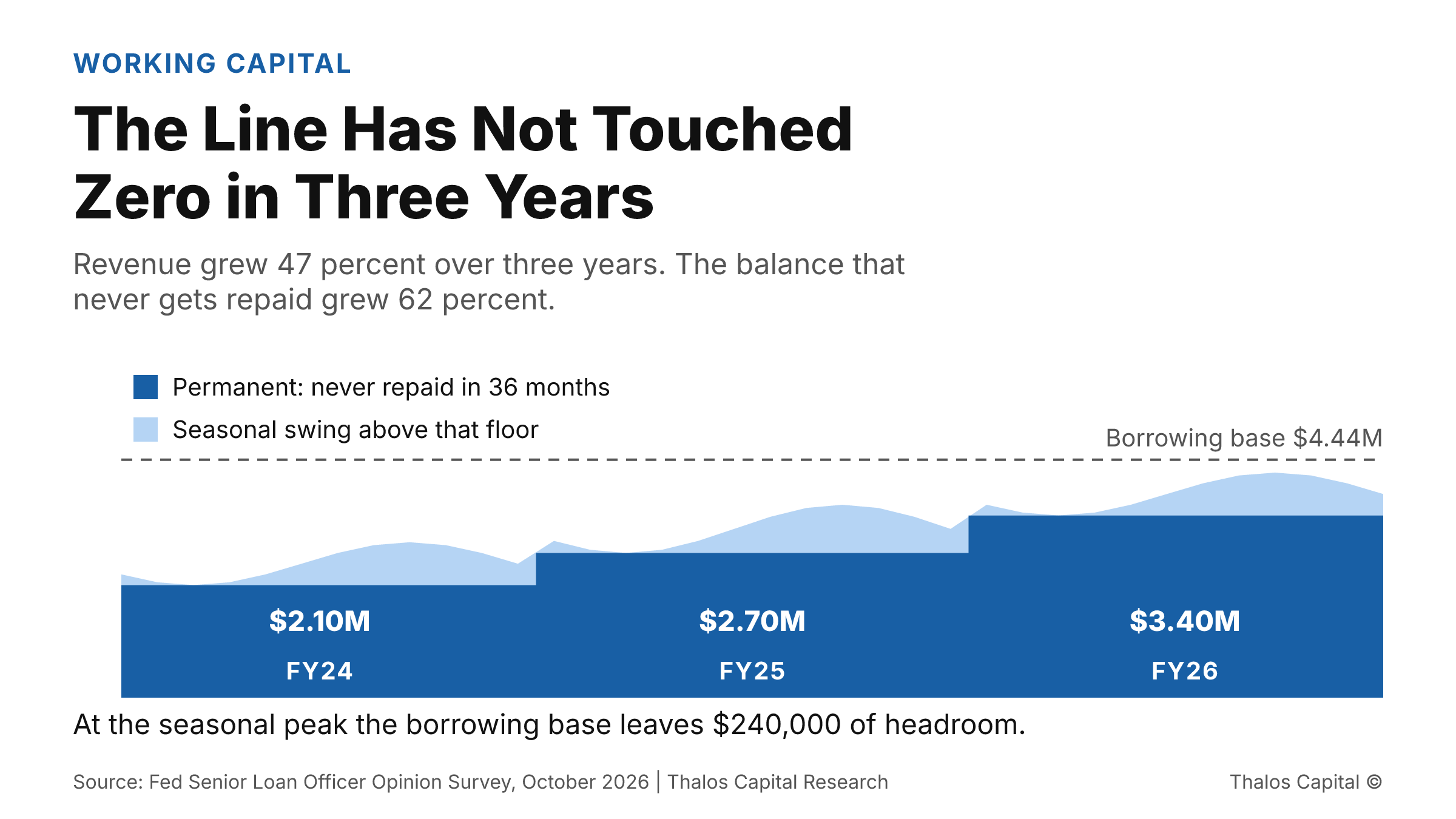
A stepped area chart of a $6.0 million revolving line across three fiscal years. The balance swings seasonally and never reaches zero. The lowest balance of each year rises from $2.10 million in FY24 to $2.70 million in FY25 and $3.40 million in FY26, while the seasonal swing above that floor stays close to $0.8 million. A dashed line marks the $4.44 million borrowing base just above the $4.20 million peak.

The Line Has Not Touched Zero in Three Years

A $6.0 million revolver whose balance has never fallen below $2.10 million, and whose floor has grown faster than the business. The permanent part is not working capital, and the obvious fix makes the cash position worse.
Read More
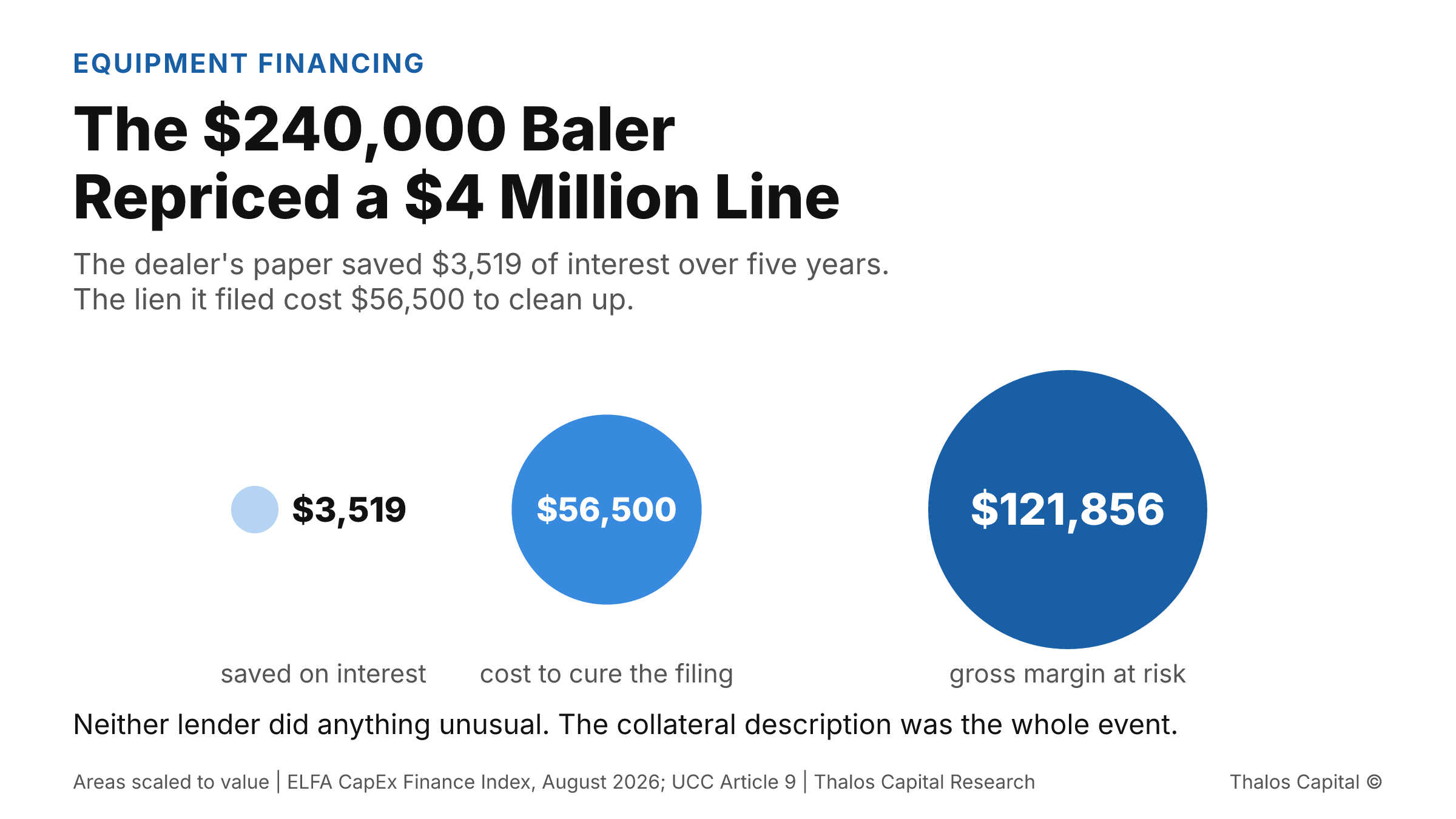
Three area-scaled circles comparing the cost of one equipment purchase. The interest saved by accepting a blanket lien is $3,519 over five years. Curing the resulting covenant breach cost $56,500. The gross margin exposed to three weeks of conditioned advances on the revolver is $121,856.

The $240,000 Baler Repriced a $4 Million Line

Dealer-arranged equipment paper funded in nine days and filed a lien on all assets. That filing tripped a negative covenant on a revolver sixteen times its size, and curing it cost $56,500 against an interest saving of $3,519.
Read More
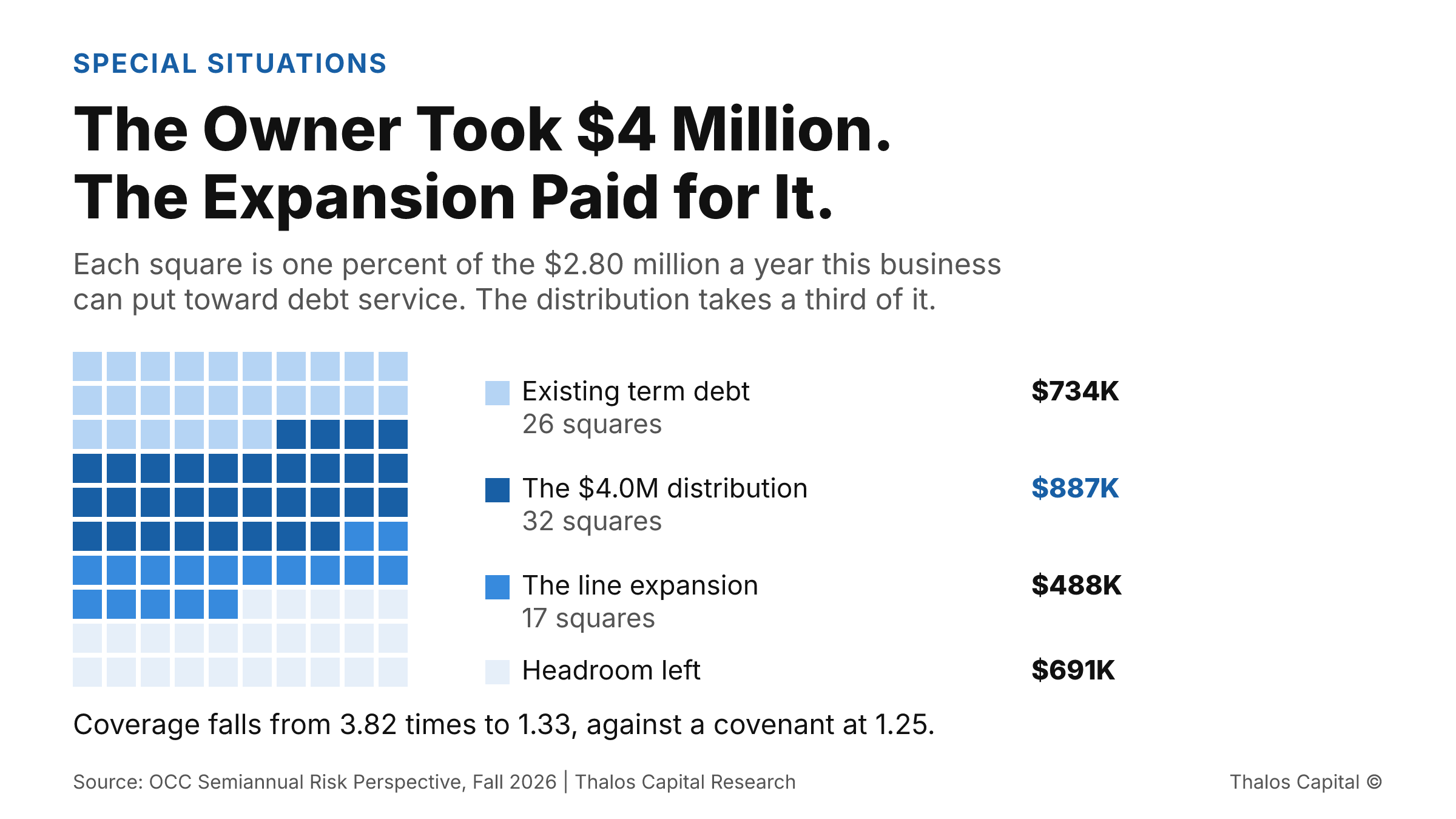
A hundred-square waffle of a food manufacturer's annual debt service capacity of $2.8 million. Twenty-six squares go to existing term debt at $734,000, thirty-two to the new debt funding a $4.0 million owner distribution at $887,000, seventeen to the planned line expansion at $488,000, and twenty-five remain as headroom at $691,000.

The Owner Took $4 Million. The Expansion Paid for It.

A food manufacturer's owner takes $4.0 million of liquidity without selling. Nothing breaks on the day it funds. The line expansion the company had planned for next year is what actually pays for it.
Read More
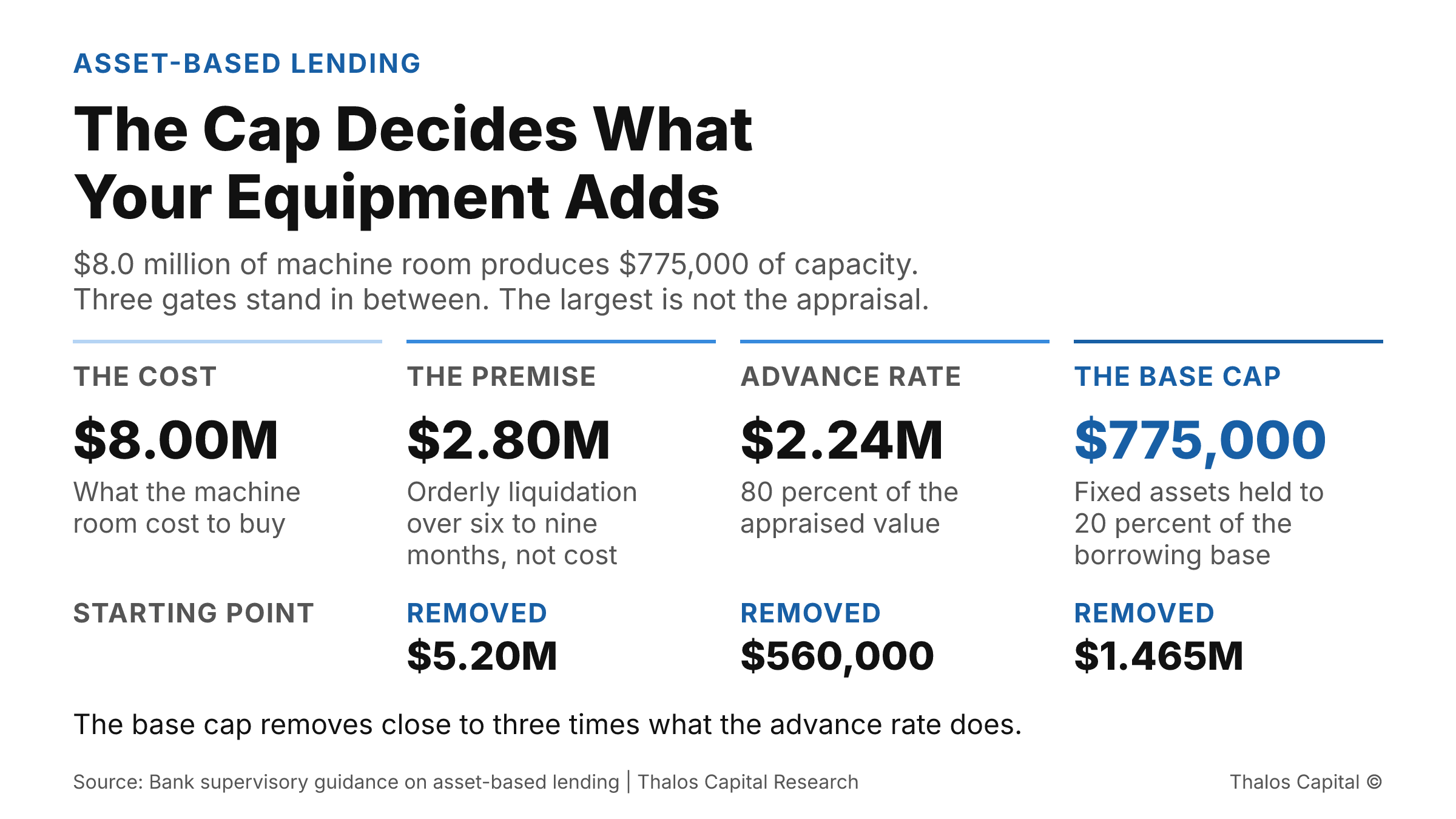
An anatomy diagram of an equipment advance in four gates. The machine room cost $8.0 million. The valuation premise takes it to $2.8 million of net orderly liquidation value, removing $5.2 million. An 80 percent advance rate takes it to $2.24 million, removing $560,000. A cap limiting fixed assets to 20 percent of the borrowing base takes it to $775,000, removing $1.465 million.

The Cap Decides What Your Equipment Adds, Not the Appraisal

A commercial laundry's machine room cost $8.0 million. Inside an asset-based facility it contributes $775,000 of borrowing capacity, and the cap on fixed assets removes nearly three times what the advance rate does.
Read More
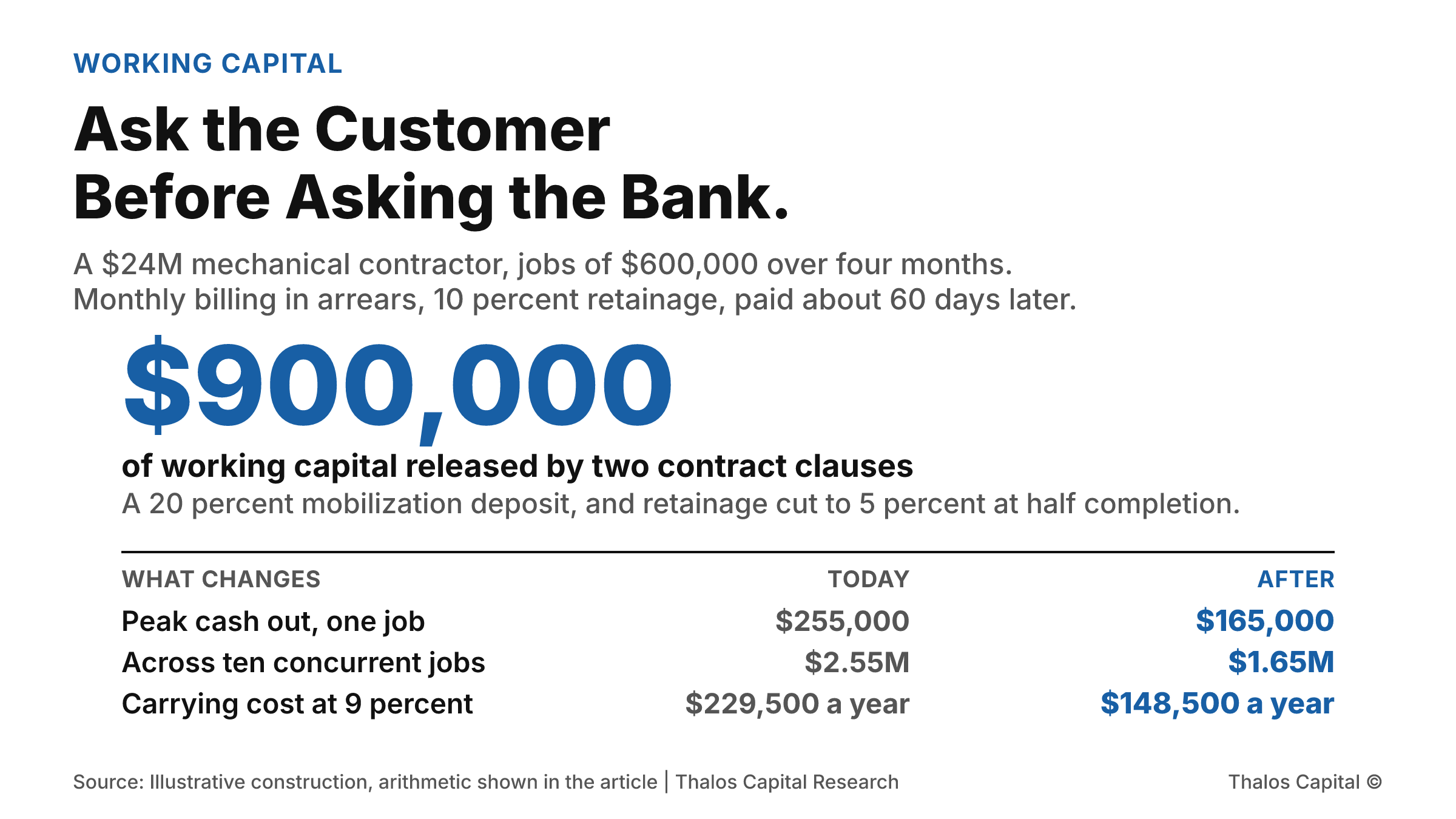
A callout showing $900,000 of working capital released by changing billing terms at a mechanical contractor, with supporting figures: $255,000 of cash per job falling to $165,000, $2.55 million across ten concurrent jobs falling to $1.65 million, and annual carrying cost falling from $229,500 to $148,500.

Ask the Customer Before Asking the Bank

A mechanical contractor carries $255,000 of cash per job and $2.55 million across ten. A deposit and a retainage change release $900,000 of it, which is working capital that costs nothing and needs no facility.
Read More
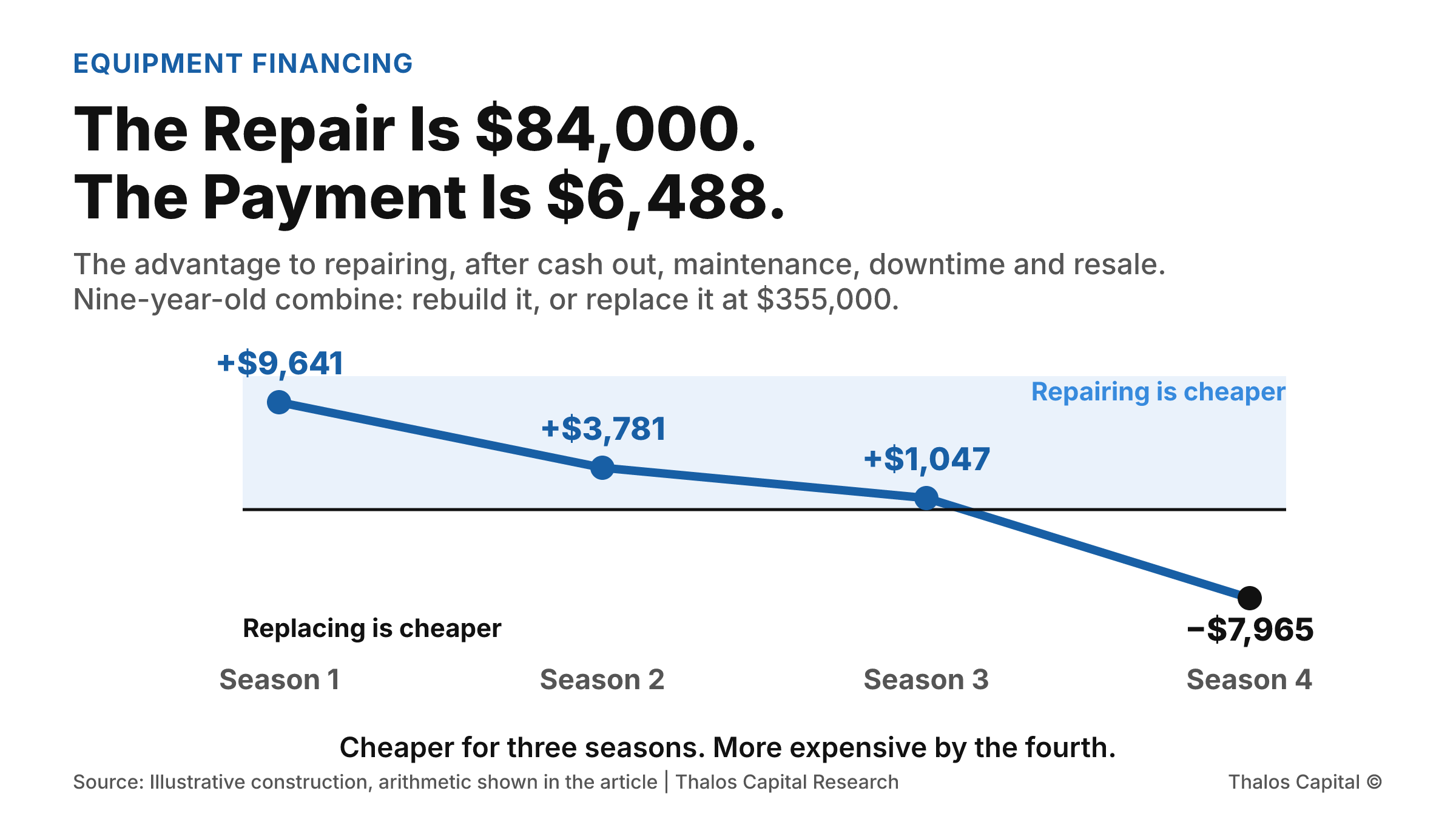
Two lines of cumulative net cost across four harvest seasons. Repairing the existing combine costs $49,000 after one season, $114,000 after two, $179,000 after three and $242,000 after four. Replacing it costs $58,641, $117,781, $180,047 and $234,035, crossing below the repair line in the fourth season.

The Repair Is $84,000. The Payment Is $6,488.

A combine needs an $84,000 rebuild. Replacing it costs $6,488 a month. Counting downtime, maintenance and what each machine is worth afterwards, the repair is cheaper for three seasons and more expensive by the fourth.
Read More
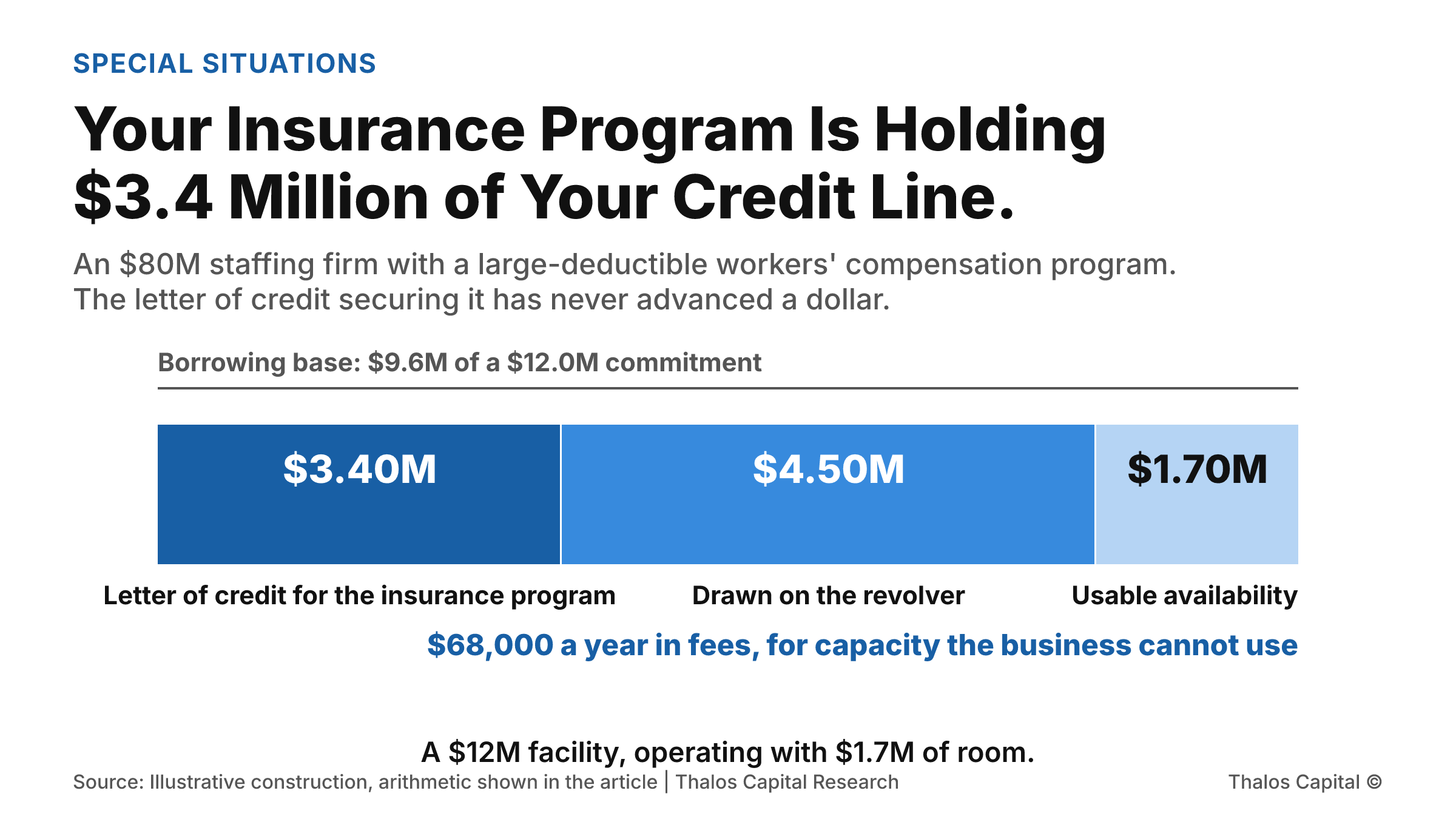
A $9.6 million borrowing base split three ways at a staffing firm. A $3.4 million letter of credit collateralizes the workers' compensation program, $4.5 million is drawn on the revolver, and $1.7 million is usable availability, against a $12 million commitment.

Your Insurance Program Is Holding $3.4 Million of Your Credit Line

A staffing firm's workers' compensation collateral has grown to $3.4 million, posted as a letter of credit under its revolver. It funds nothing, it grows with payroll, and it leaves $1.7 million of usable availability.
Read More
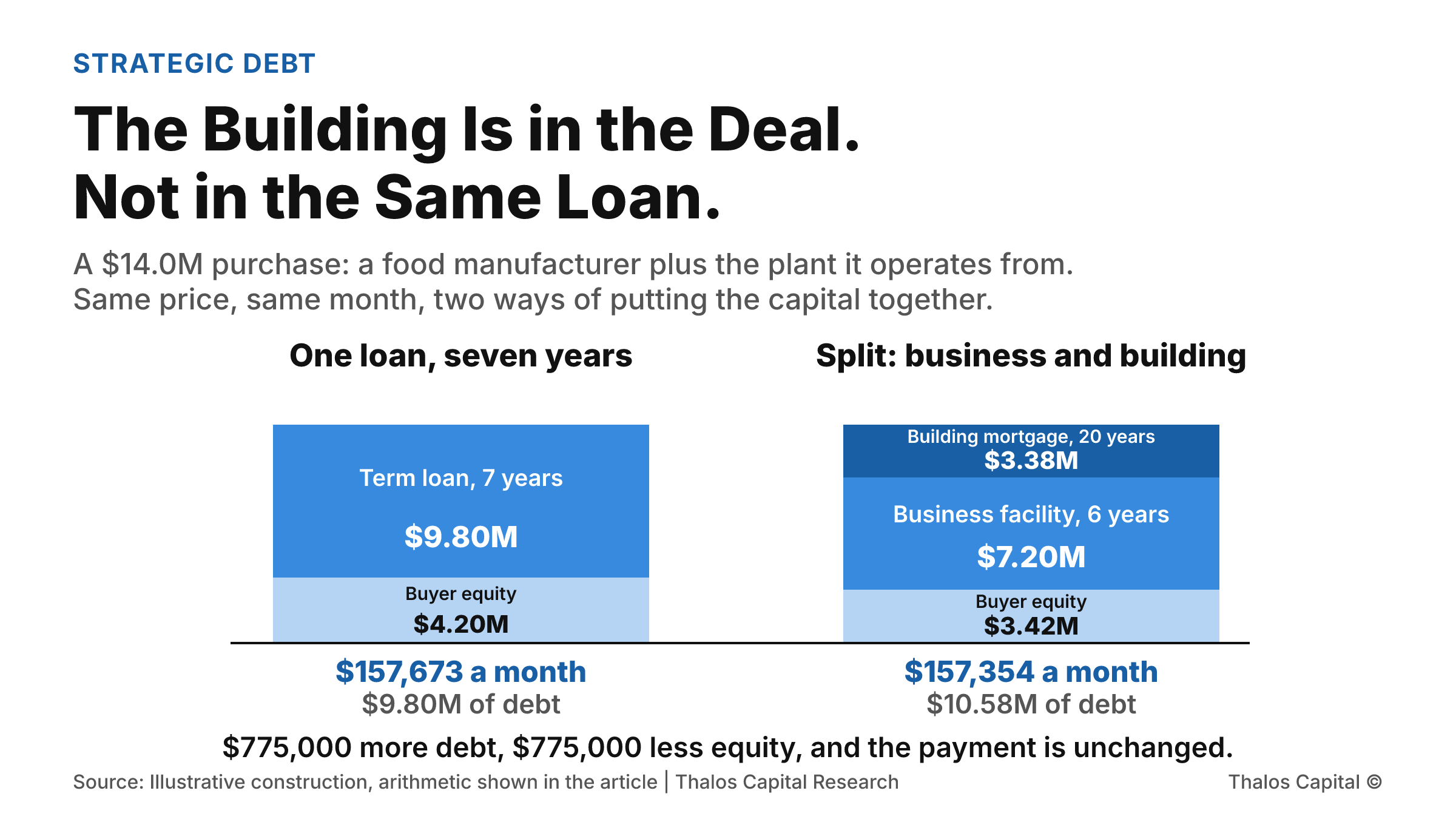
Two financing structures for the same $14 million acquisition. As one seven-year loan it carries $9.8 million of debt at $157,673 a month and needs $4.20 million of equity. Split into a six-year business facility of $7.2 million and a twenty-year mortgage of $3.375 million on the building, it carries $10.575 million at $157,354 a month and needs $3.425 million of equity.

The Building Is in the Deal. It Should Not Be in the Same Loan.

A $14 million acquisition includes the plant the seller owns. Financed as one loan it supports $9.8 million of debt. Split into a business facility and a mortgage on the building, it supports $10.58 million at the same annual cost.
Read More
Working through a financing decision?
Insights are a starting point. A conversation maps your actual options.
Tell us what you are financing and we will map the structures and sources that fit.
Submit your financing request →
Explore our financing solutions
Equipment FinancingWorking CapitalAsset-Based LendingStrategic Debt