Category

Borrower Advisory

73 insights · page 1 of 10

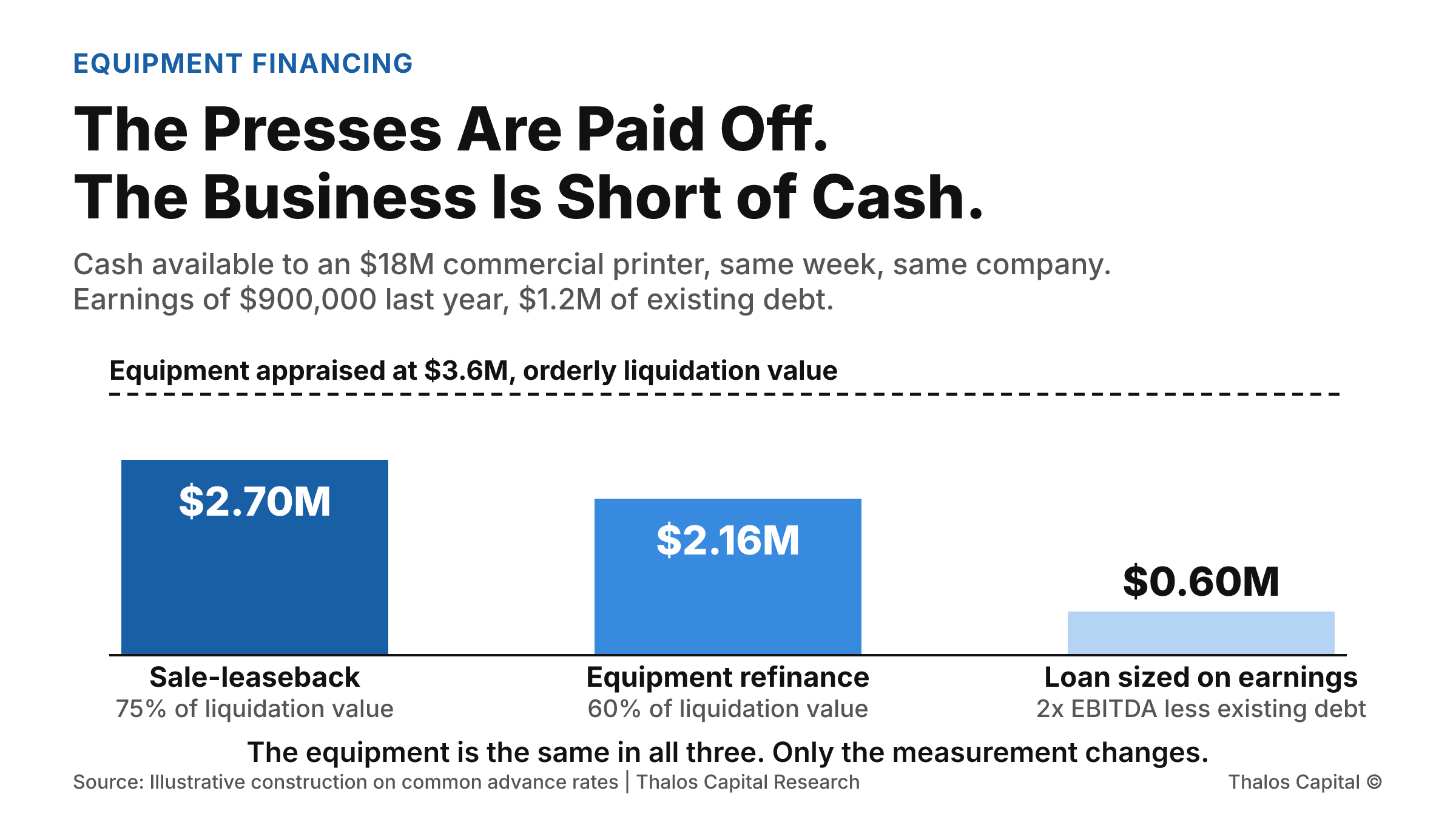
Three columns of cash available to a commercial printer. A sale-leaseback of owned presses raises $2.70 million, an equipment-secured refinance raises $2.16 million, and a loan sized on last year's earnings raises $600,000, against equipment appraised at $3.6 million.

The Presses Are Paid Off. The Business Is Short of Cash.

A commercial printer owns $3.6 million of appraised equipment and can borrow $600,000 on last year's earnings. A sale-leaseback on the same presses raises $2.7 million, at $69,800 a month and $650,000 of total cost.
Read More
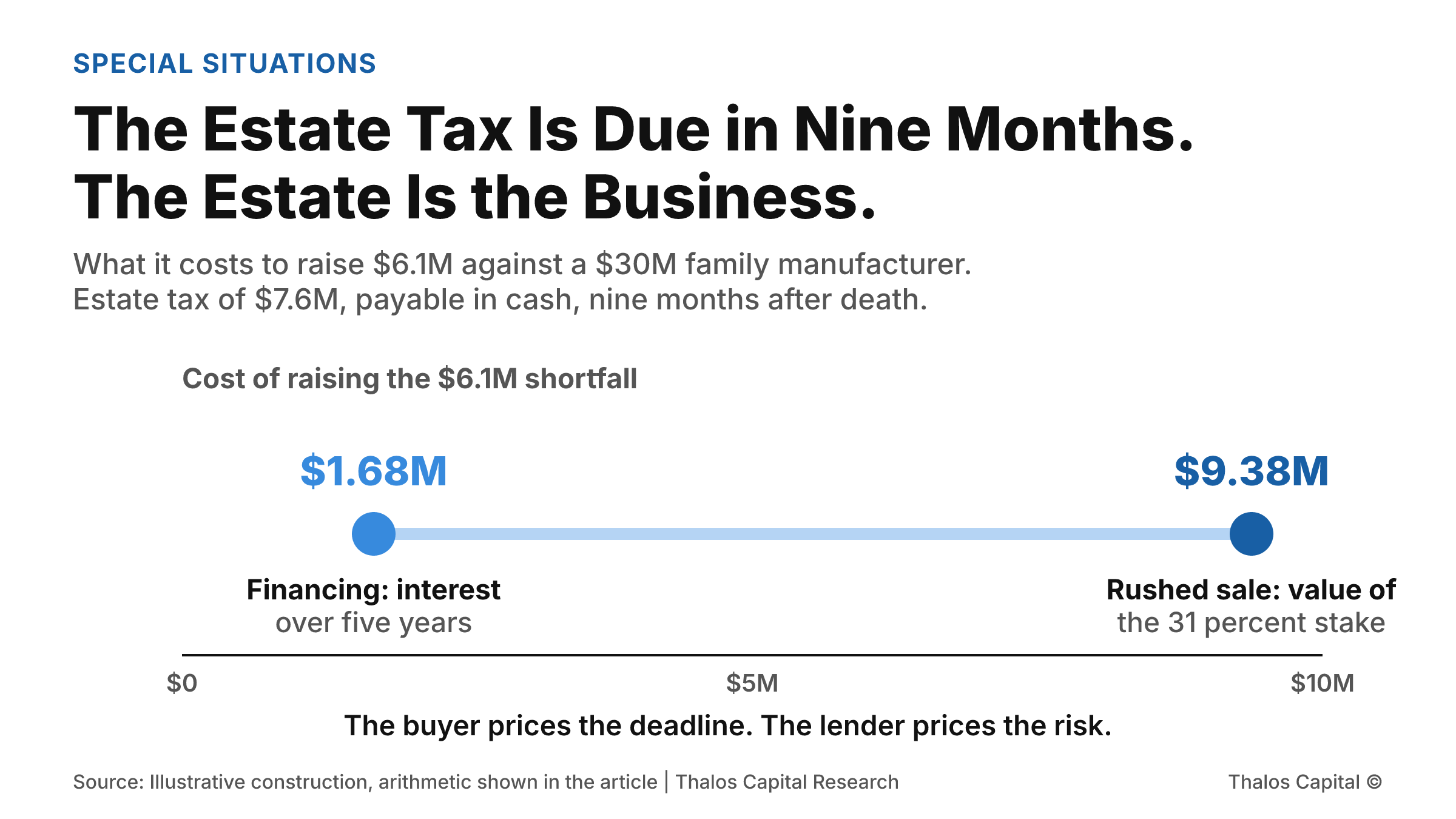
A two-point comparison of what it costs to raise $6.1 million against a $30 million family manufacturer. Selling a 31 percent stake under a deadline gives up $9.38 million of business value. Financing the same amount over five years costs $1.68 million of interest.

The Estate Tax Is Due in Nine Months. The Estate Is the Business.

A family owes $7.6 million of estate tax nine months after the founder's death, with $1.5 million of cash and a $30 million manufacturer. Selling a stake under the deadline gives up $9.4 million of value. Financing costs $1.68 million.
Read More
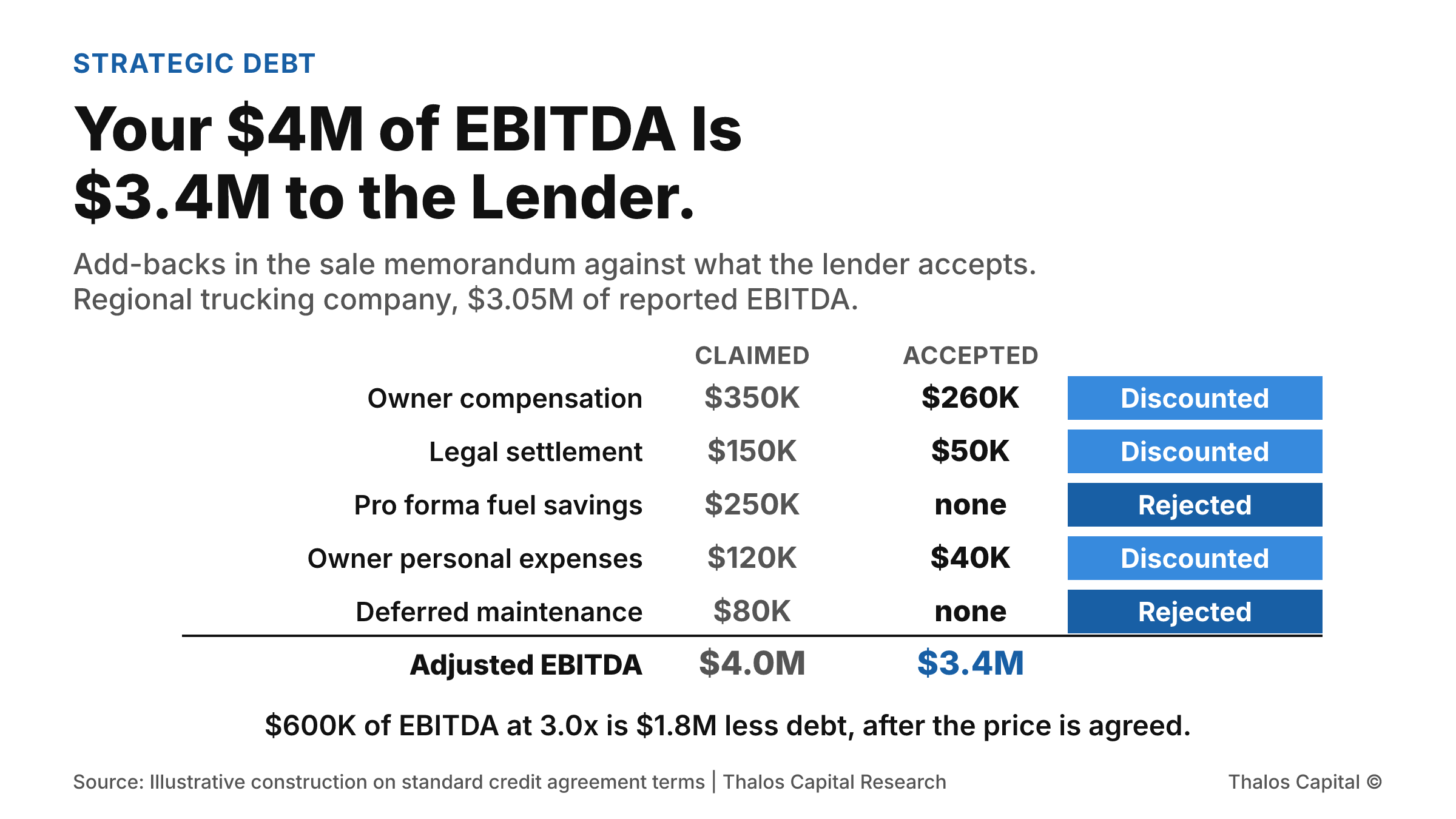
Five add-back categories in a grid, each with the amount claimed in the sale memorandum and the amount a lender accepts. Owner compensation, $350,000 claimed and $260,000 accepted. A legal settlement, $150,000 and $50,000. Pro forma fuel savings, $250,000 and nothing. Owner personal expenses, $120,000 and $40,000. Deferred maintenance, $80,000 and nothing. $950,000 claimed, $350,000 accepted.

Your $4 Million of EBITDA Is $3.4 Million to the Lender

A trucking company is marketed at $4.0 million of adjusted EBITDA. The lender accepts $3.4 million, which cuts the debt available by $1.8 million and raises the equity the buyer has to write by the same amount, after the price is agreed.
Read More
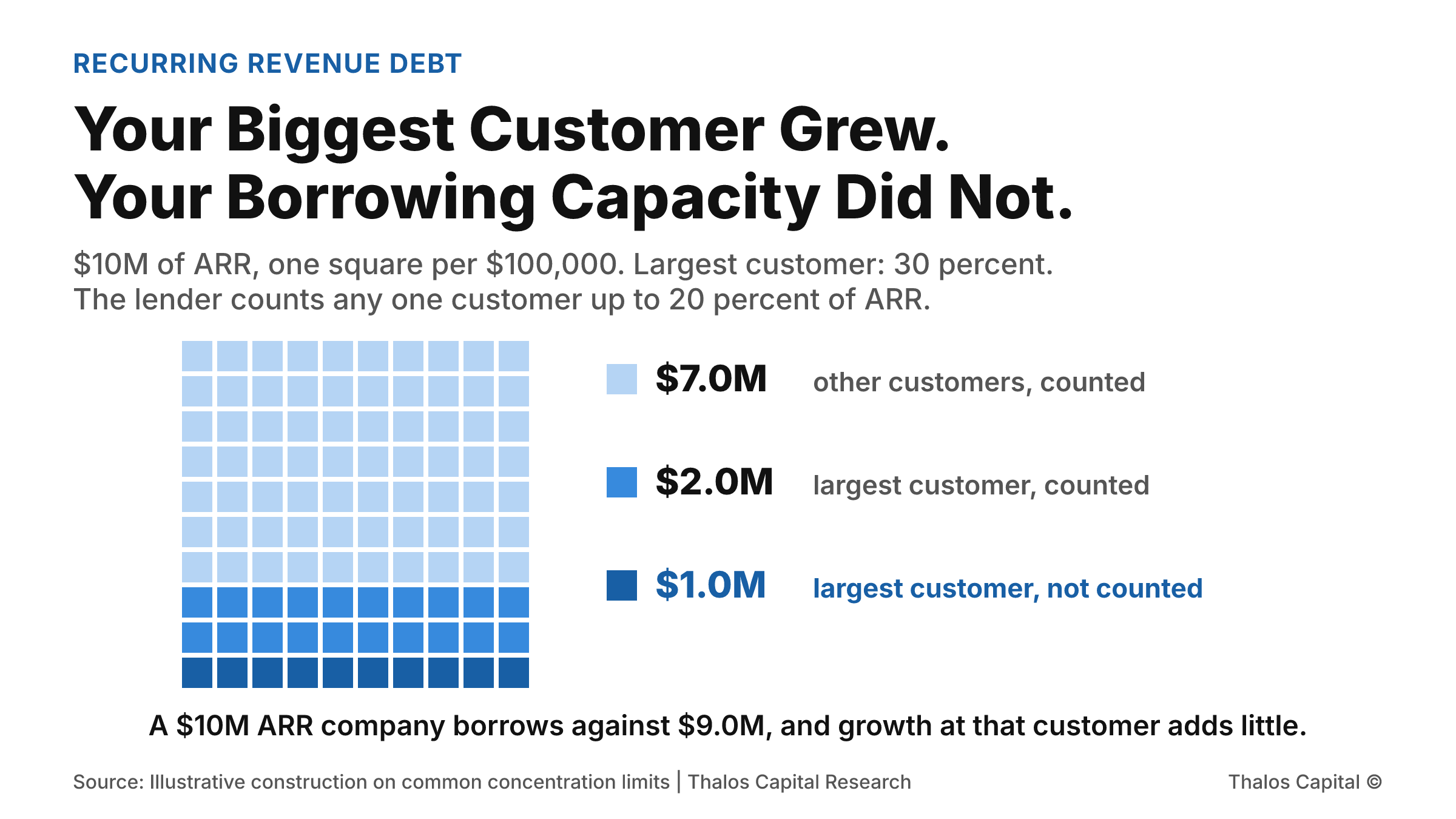
A grid of 100 squares, each worth $100,000 of a software company's $10 million ARR. Seventy squares are other customers and count toward borrowing. Thirty belong to the largest customer: twenty count and ten, the excess above a 20 percent concentration cap, do not.

Your Biggest Customer Grew. Your Borrowing Capacity Did Not.

A $10 million ARR software company adds $2 million of new ARR. From its largest customer, that lifts borrowing capacity by $240,000. From two new customers, the same ARR lifts it by $1.44 million, six times as much.
Read More
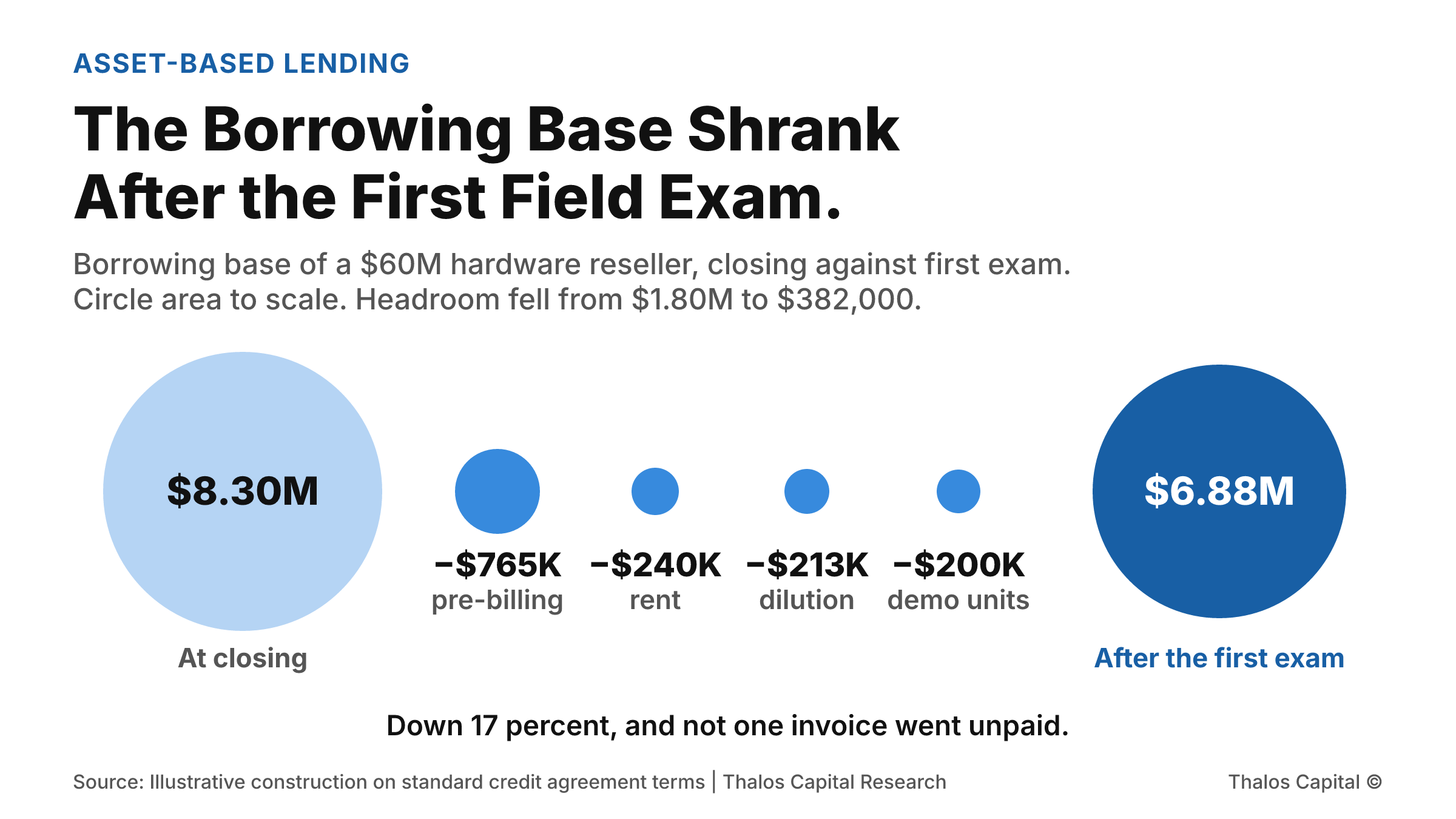
Proportional circles showing a borrowing base of $8.30 million at closing and $6.88 million after the first field exam, with four smaller circles for the adjustments between them: $765,000 of pre-billed invoices, $240,000 of rent reserve, $213,000 from excess dilution and $200,000 of demo units.

The Borrowing Base Shrank After the First Field Exam

A $60 million hardware reseller closed an asset-based line on an $8.30 million borrowing base. The first field exam tested the same collateral and found $6.88 million, and planned headroom of $1.80 million fell to $382,000.
Read More
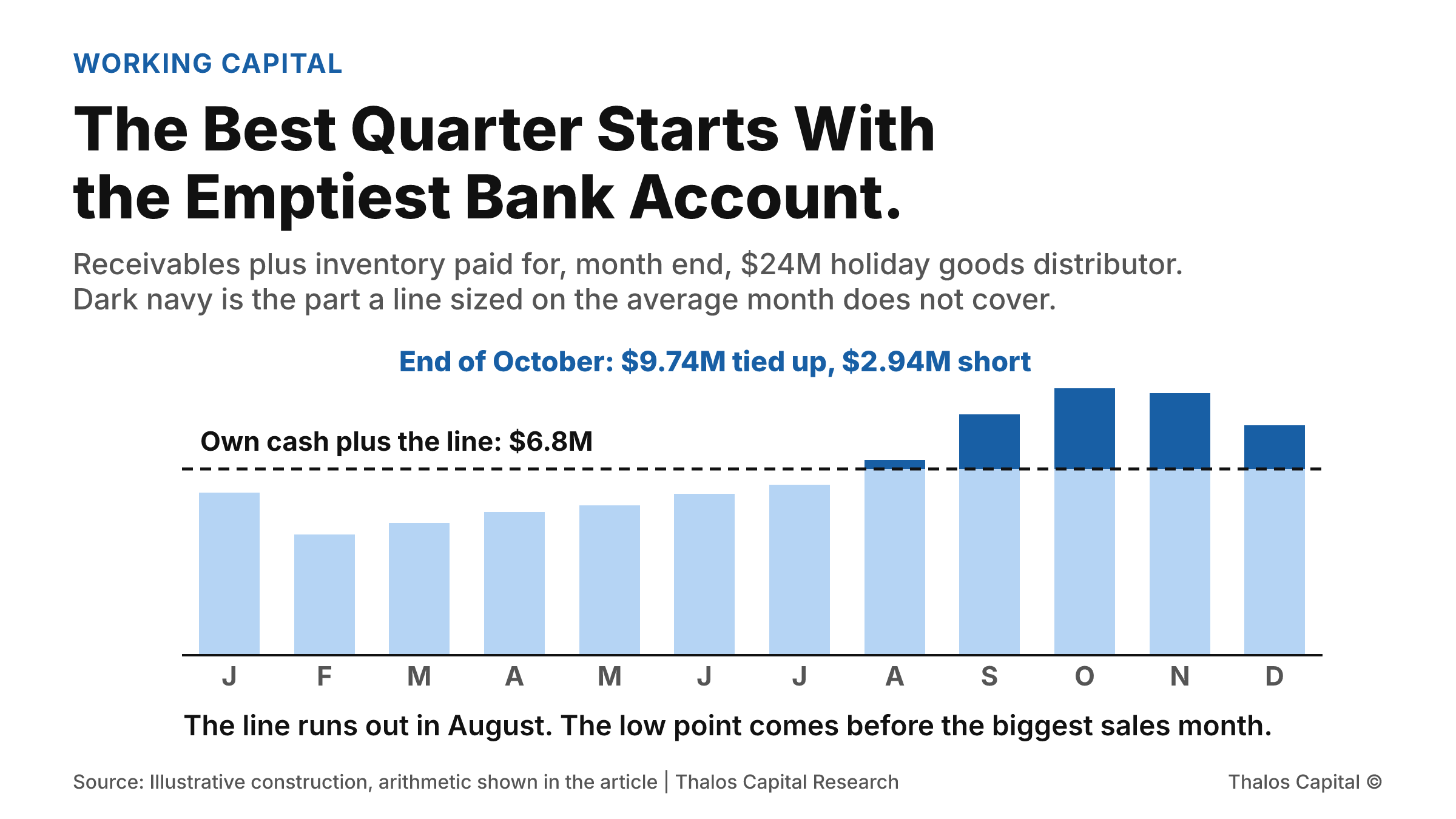
Twelve monthly columns of working capital tied up at a $24 million holiday goods distributor. Months January to July sit below the $6.8 million covered by the owner's cash and a line sized on the average month. August to December rise above it, peaking at $9.74 million at the end of October, $2.94 million short.

The Best Quarter Starts With the Emptiest Bank Account

A $24 million holiday goods distributor ties up $9.74 million in receivables and inventory at the end of October, against $6.8 million on an average month. A credit line sized on the average runs out in August and is $2.94 million short at the peak.
Read More
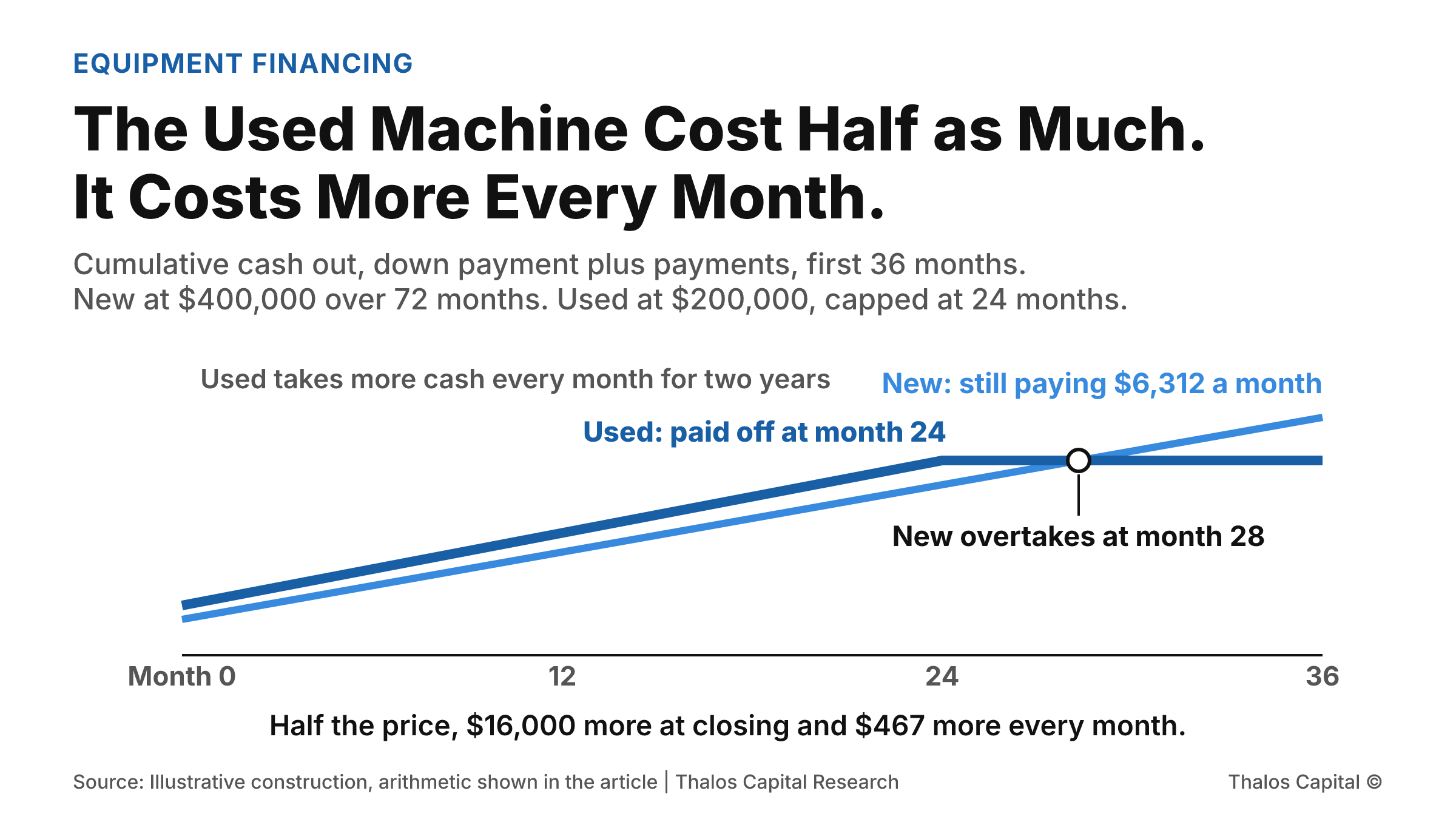
Two lines of cumulative cash out over 36 months. A used excavator at $200,000 takes more cash every month for two years and is paid off at month 24 at $218,686. A new excavator at $400,000 starts lower, overtakes the used machine around month 28, and is still being paid at $6,312 a month.

The Used Machine Cost Half as Much. It Costs More Every Month.

A ten-year-old excavator at half the price of a new one needs $16,000 more at closing and $467 more a month. Older equipment finances on shorter terms against lower appraisals, and the listed price shows neither.
Read More
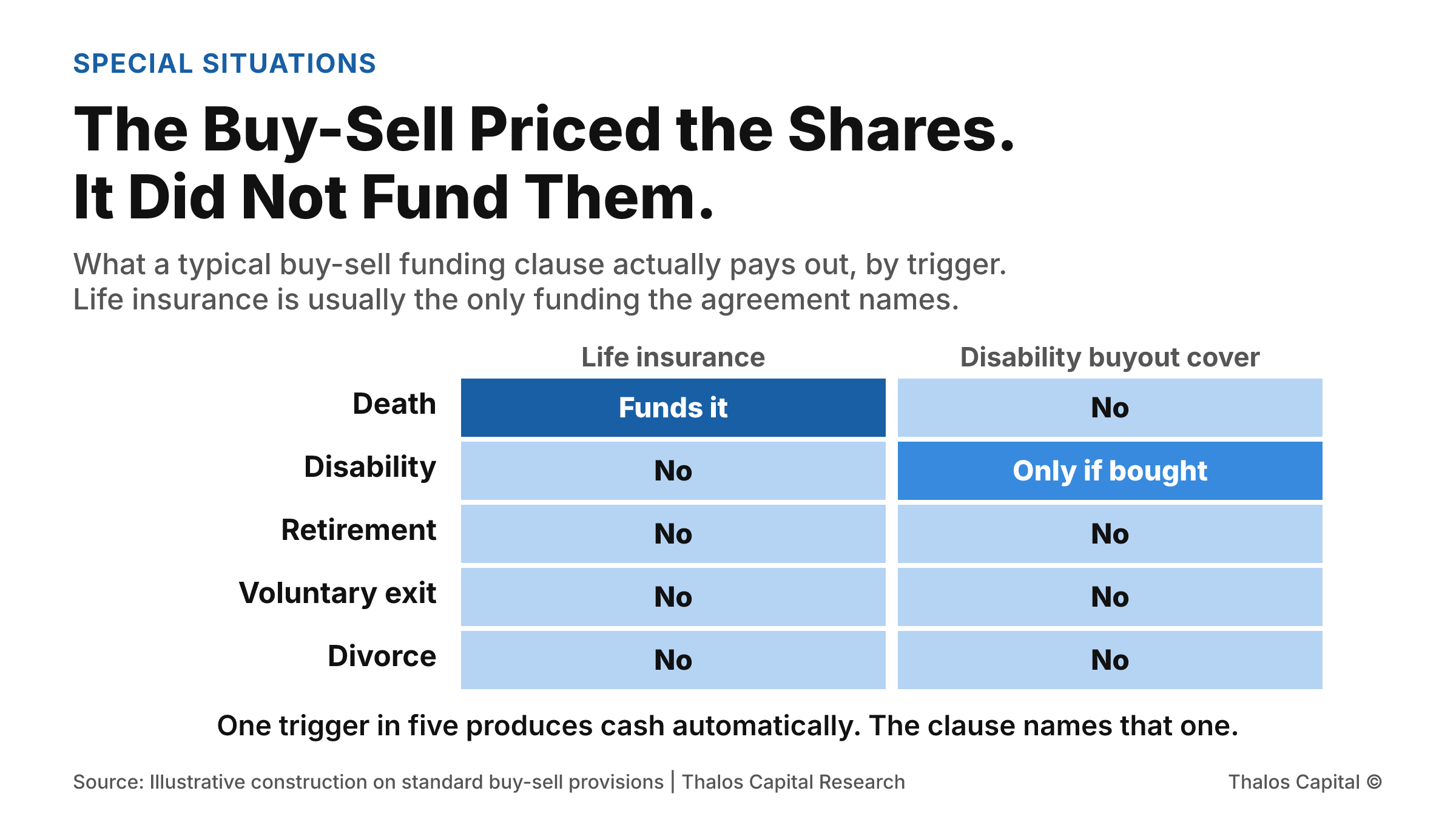
A grid of five buy-sell triggers against two insurance funding sources, showing that life insurance produces cash only on death, disability buyout cover only on disability and only if it was bought, and that retirement, voluntary exit and divorce produce no automatic funding at all.

The Buy-Sell Priced the Shares. It Did Not Fund Them.

A buy-sell agreement settles who can trigger a sale and exactly what the shares are worth. It usually settles funding in one sentence naming life insurance, which pays on only one of the five events that can fire it.
Read More
Working through a financing decision?
Insights are a starting point. A conversation maps your actual options.
Tell us what you are financing and we will map the structures and sources that fit.
Submit your financing request →
Explore our financing solutions
Equipment FinancingWorking CapitalAsset-Based LendingStrategic Debt