Category

Financing Strategy

46 insights · page 2 of 6

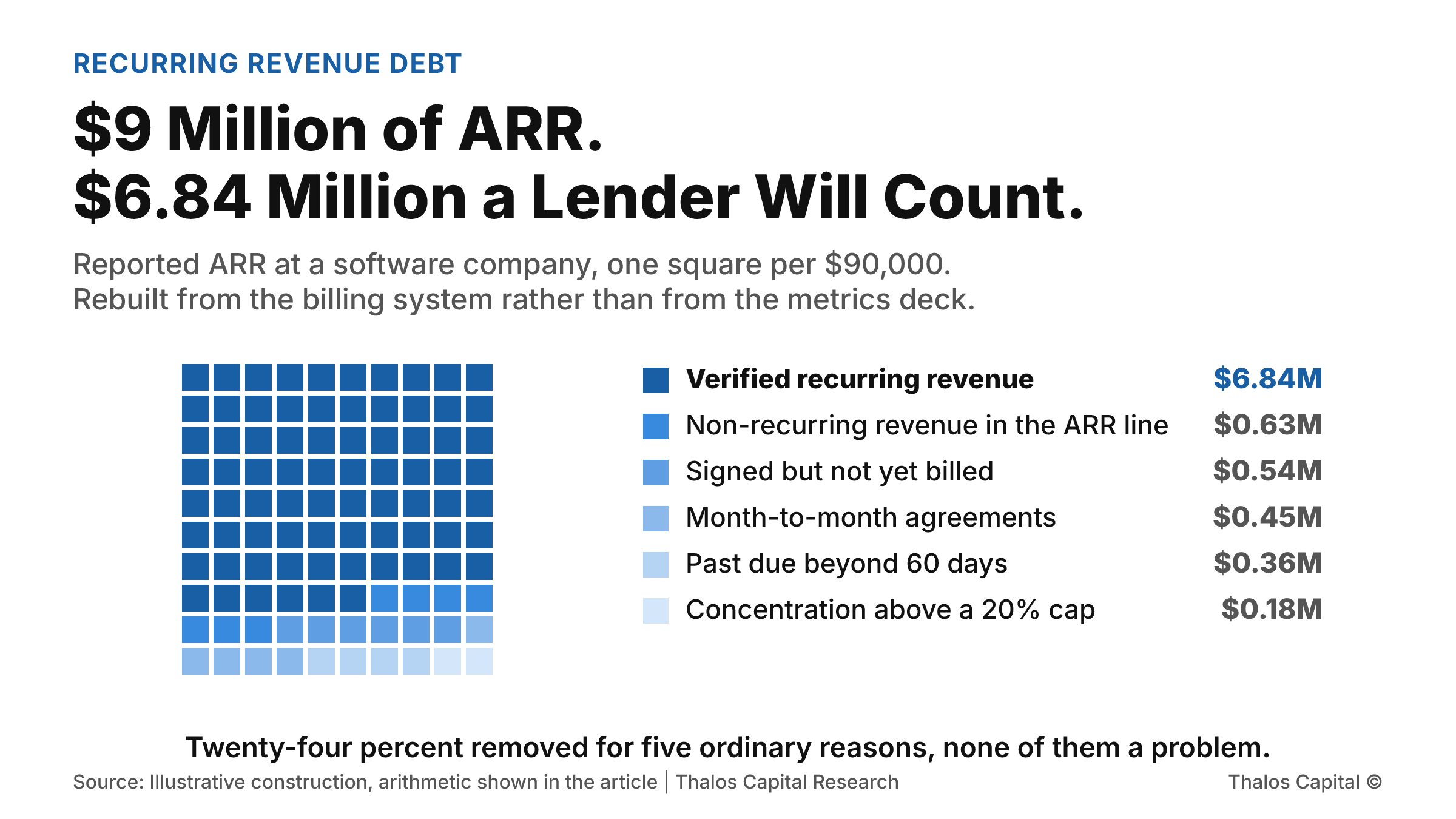
A grid of 100 squares, each $90,000 of a software company's $9.0 million of reported ARR. Seventy-six squares are verified. Twenty-four are removed: seven for non-recurring revenue, six for signed but unbilled contracts, five for month-to-month agreements, four for accounts past due beyond 60 days and two for concentration above a 20 percent cap.

$9 Million of ARR. $6.84 Million a Lender Will Count.

A software company reports $9.0 million of ARR. A recurring revenue lender rebuilds it from the billing system and verifies $6.84 million, and every multiple in the term sheet applies to the second number.
Read More
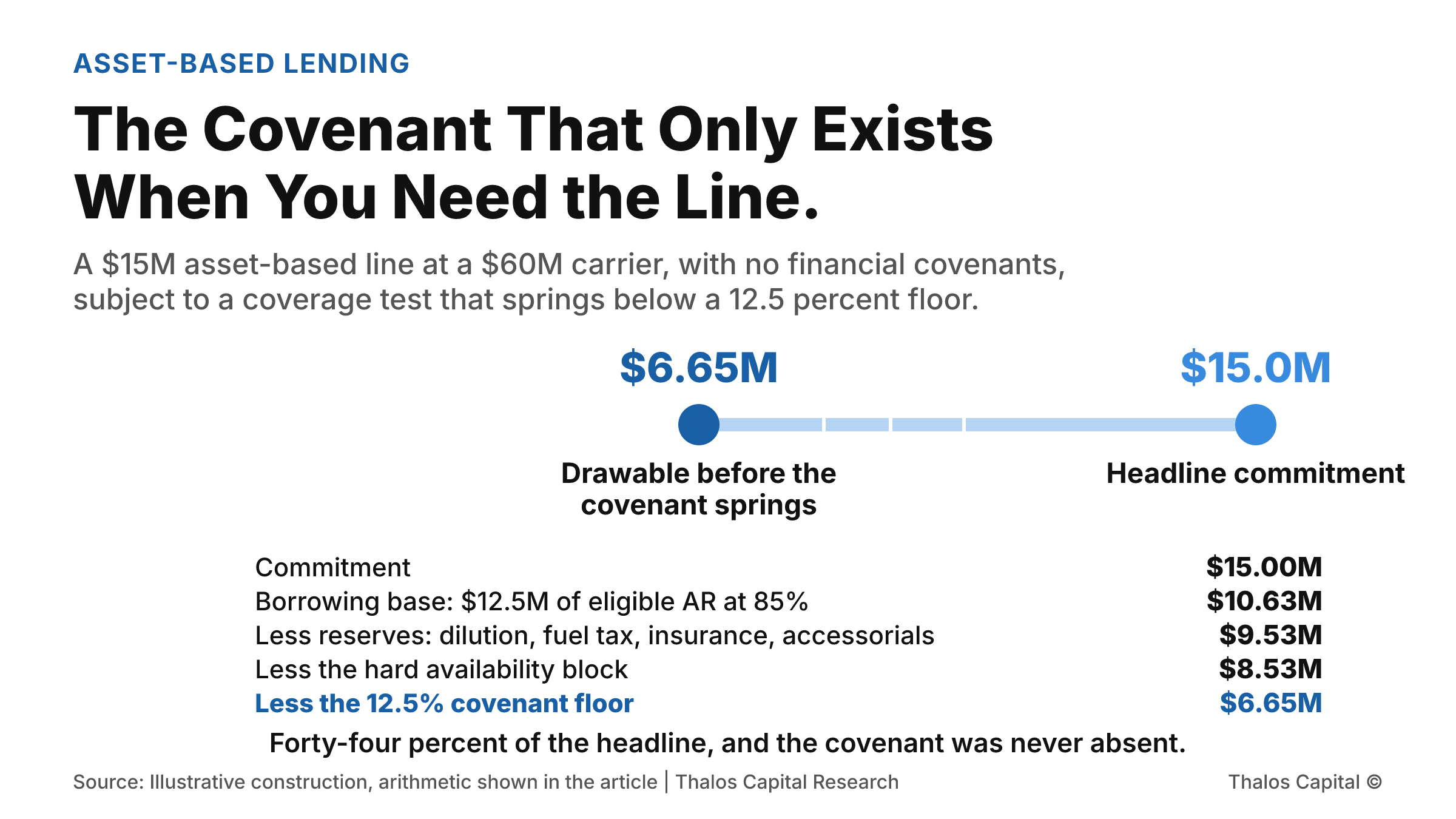
A two-point comparison on a $15 million asset-based line. The headline commitment is $15.0 million. After the borrowing base, reserves, an availability block and the covenant floor, $6.65 million can be drawn without springing the coverage test, which is 44 percent of the headline figure.

The Covenant That Only Exists When You Need the Line

A $15 million asset-based line gives a carrier $6.65 million it can draw without consequence. Below that, a coverage test springs into effect, in the quarter the business is least able to pass it.
Read More
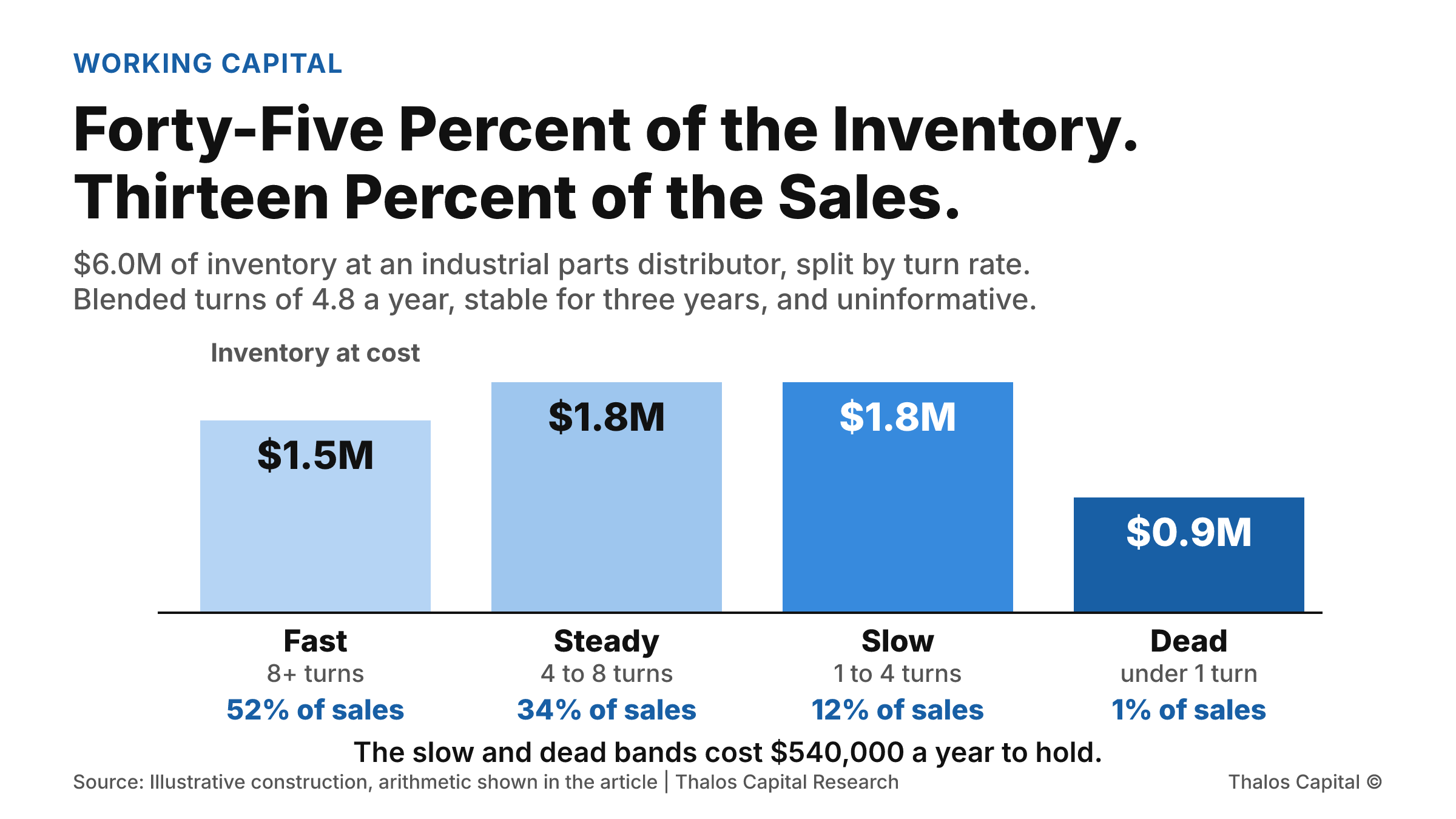
Four columns of inventory at cost by turn band at a parts distributor. Fast-moving stock is $1.5 million and produces 52 percent of cost of goods sold. Steady stock is $1.8 million and 34 percent. Slow stock is $1.8 million and 13 percent. Dead stock is $900,000 and produces under 1 percent.

Forty-Five Percent of the Inventory. Thirteen Percent of the Sales.

A parts distributor holds $6 million of inventory. The slow and dead bands are $2.7 million of it and produce 13 percent of cost of goods sold, while costing $540,000 a year to carry.
Read More
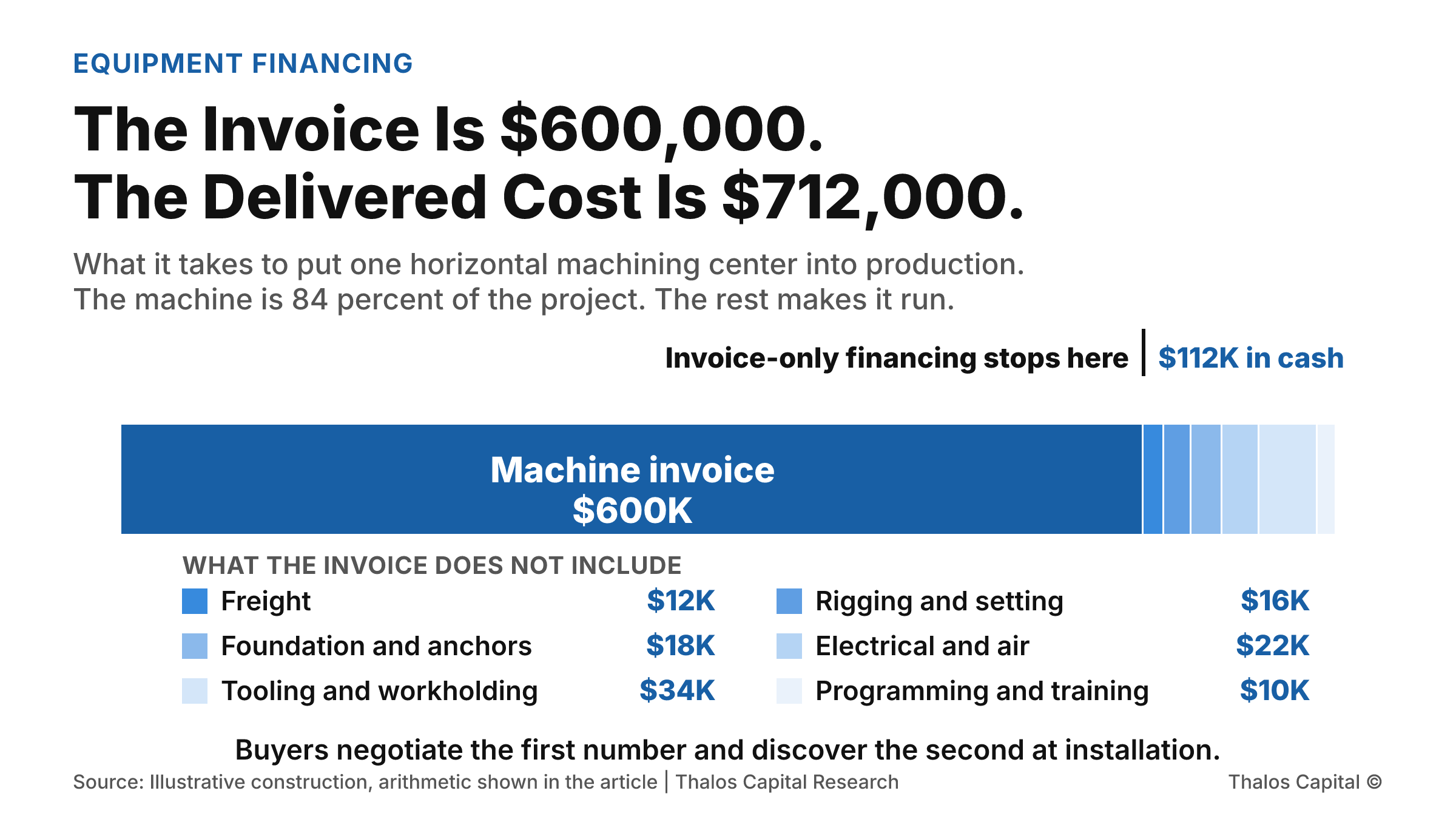
A single bar of $712,000 of delivered cost split into the $600,000 machine invoice, $12,000 of freight, $16,000 of rigging, $18,000 of foundation work, $22,000 of electrical and air, $34,000 of tooling and $10,000 of programming and training, with a marker showing that invoice-only financing covers the first segment and leaves $112,000 in cash.

The Invoice Is $600,000. The Delivered Cost Is $712,000.

Freight, rigging, foundation work, electrical, tooling and training add $112,000 to a machine quoted at $600,000. What a lender will advance against those items decides whether the buyer writes a cheque at closing.
Read More
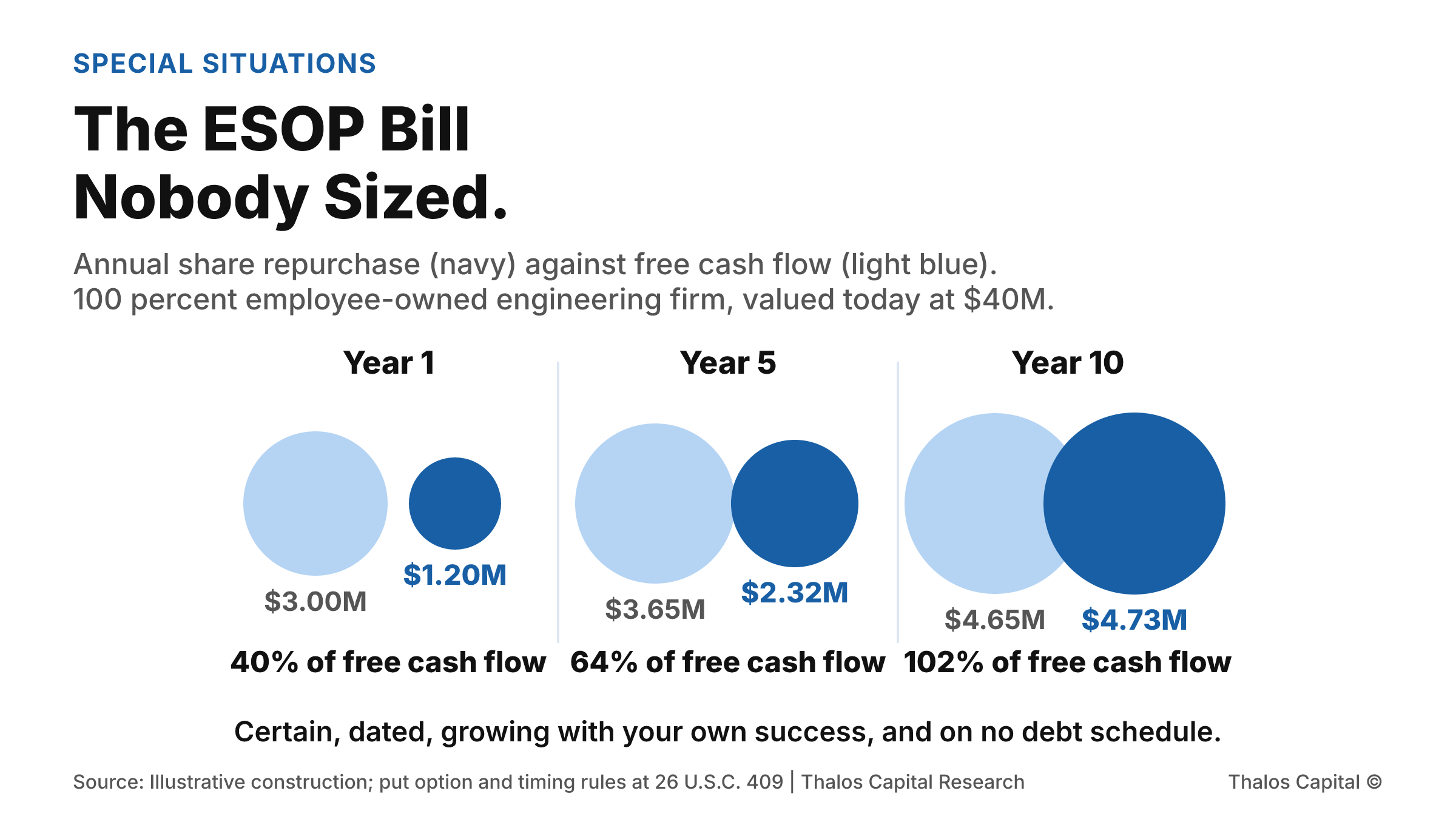
Three panels comparing the annual share repurchase obligation against free cash flow at an employee-owned firm. In year one it is $1.2 million against $3.0 million, or 40 percent. In year five it is $2.32 million against $3.65 million, or 64 percent. In year ten it is $4.73 million against $4.65 million, or 102 percent.

The ESOP Bill Nobody Sized

An employee-owned engineering firm buys back $1.2 million of shares this year and $4.7 million in year ten, against free cash flow that grows from $3.0 million to $4.65 million. The obligation is certain, dated, and rarely financed.
Read More
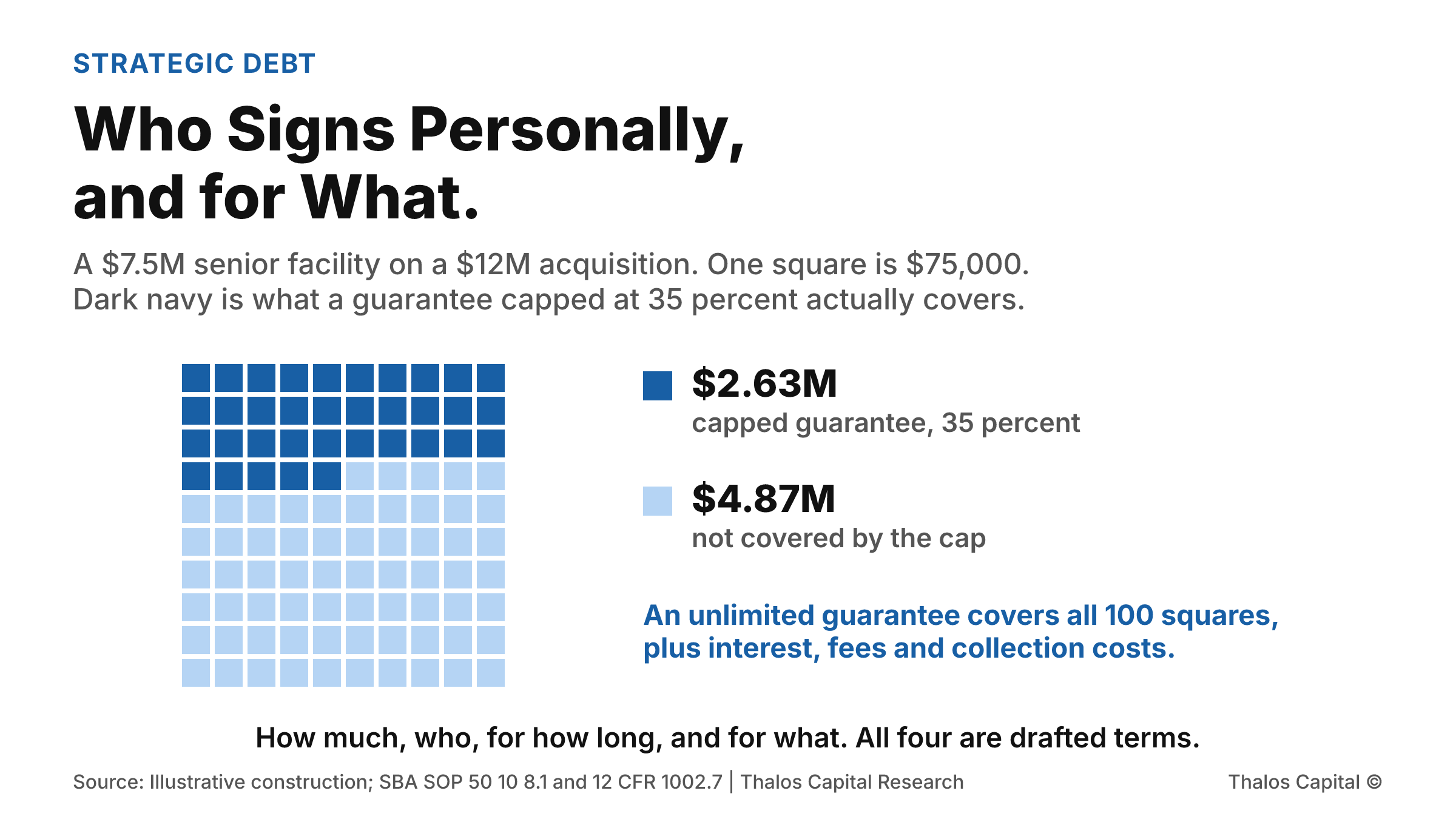
A grid of 100 squares representing a $7.5 million senior facility at $75,000 each. Thirty-five squares are shaded dark to show the $2.63 million covered by a guarantee capped at 35 percent of the facility, against an unlimited guarantee that covers all 100.

Who Signs Personally, and for What

A contractor financing a $12 million acquisition can sign an unlimited guarantee, a guarantee capped at 35 percent of the facility, or none at all. The structures differ by millions of dollars of personal exposure and by about 250 basis points.
Read More
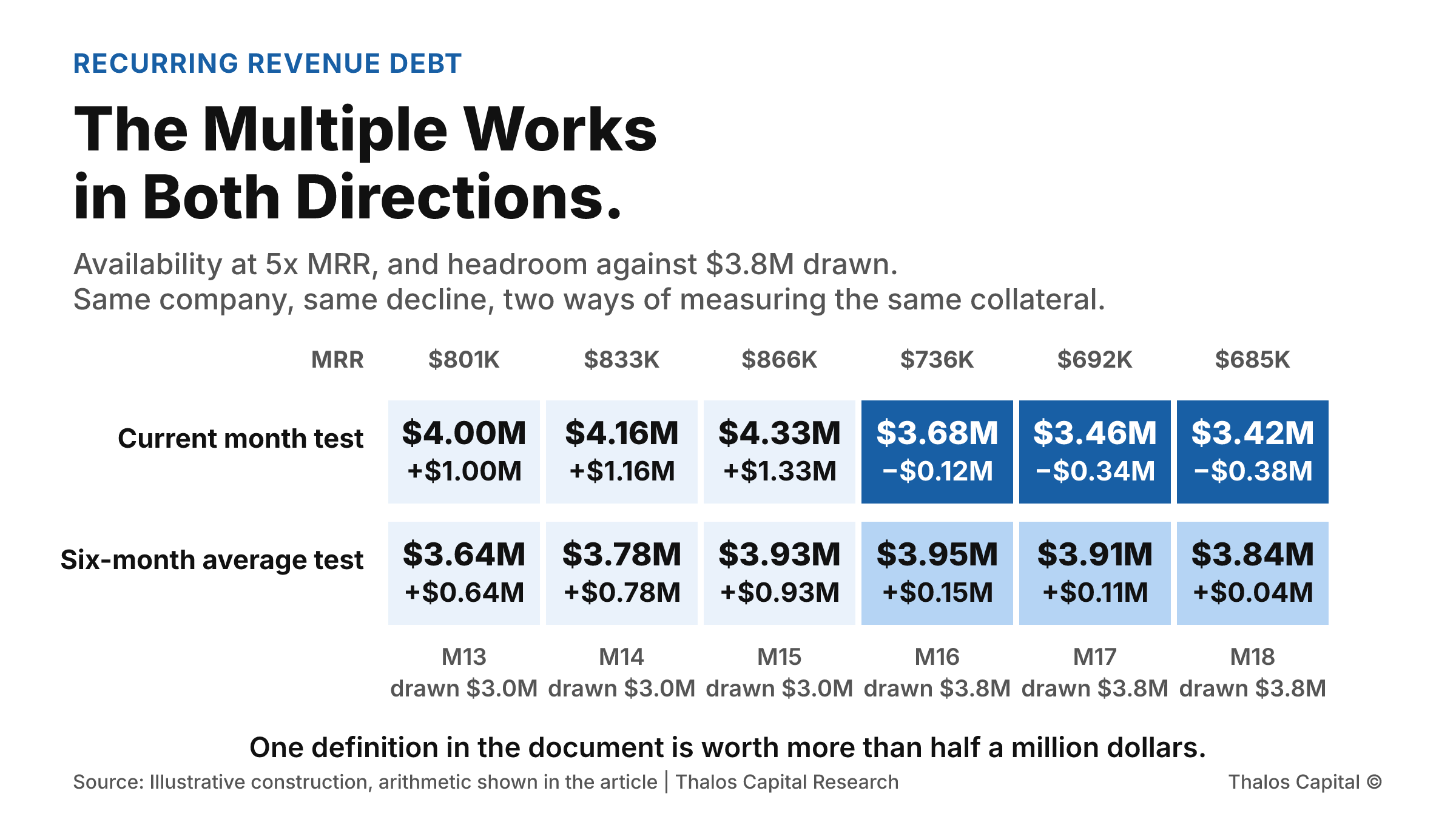
A grid of six months by two testing conventions. Tested on current month MRR, availability falls below the $3.8 million drawn in the last three months, producing deficiencies of $120,000, $340,000 and $376,000. Tested on a trailing six-month average, headroom stays positive at $150,000, $110,000 and $40,000.

The Multiple Works in Both Directions

A software company draws $3.8 million against a facility sized at five times MRR. One bad quarter cuts MRR 21 percent, and availability recalculates to $3.42 million, putting the limit $376,000 below the balance already drawn.
Read More
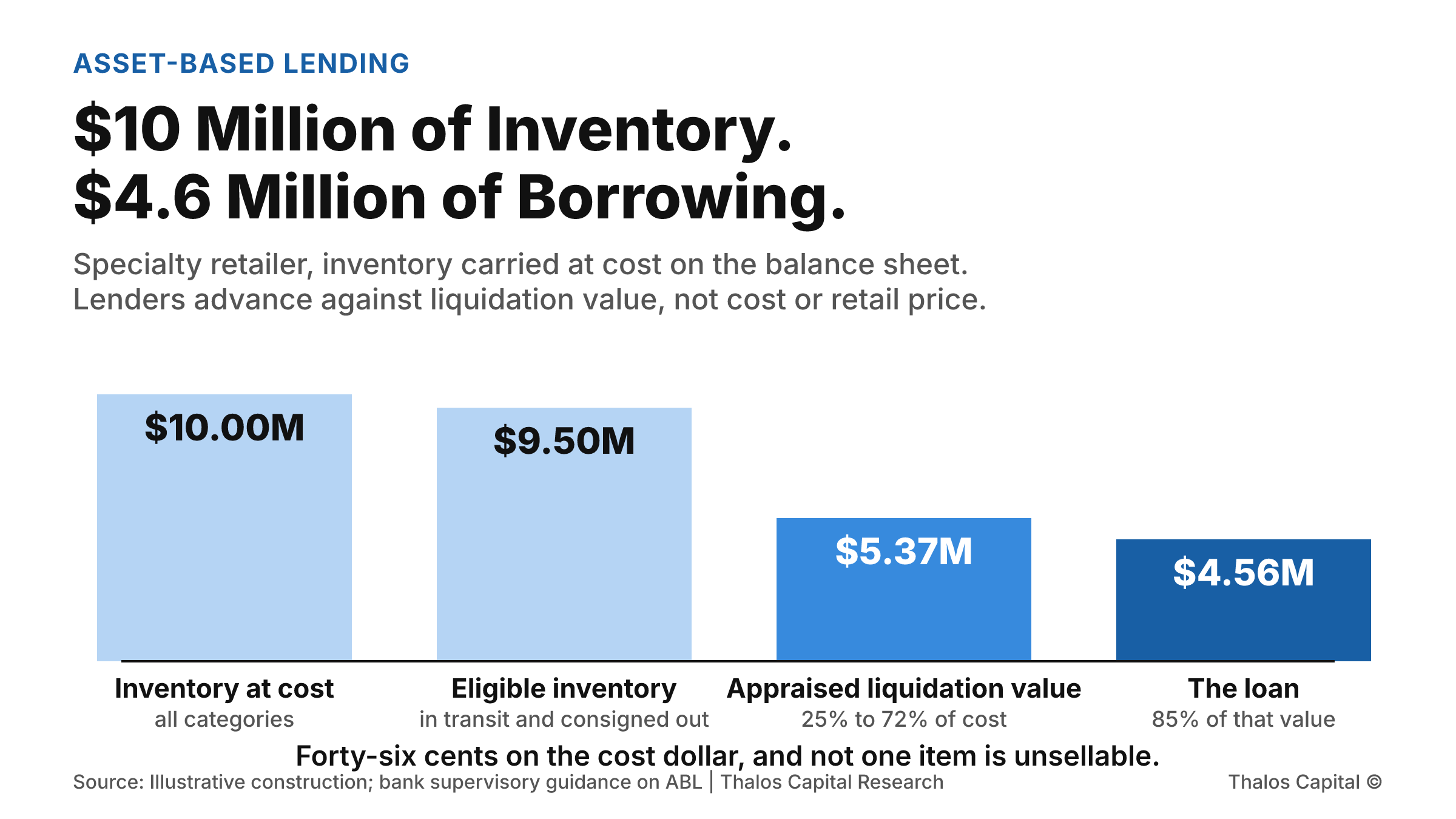
Four descending columns. Inventory at cost is $10.0 million, eligible inventory is $9.5 million, the appraised net orderly liquidation value is $5.37 million, and the loan at 85 percent of that value is $4.56 million, or 46 cents on the cost dollar.

$10 Million of Inventory. $4.6 Million of Borrowing.

A specialty retailer carries $10 million of inventory at cost. An appraiser values it at $5.37 million in an orderly liquidation, and the lender advances 85 percent of that, which is 46 cents on the cost dollar.
Read More
Working through a financing decision?
Insights are a starting point. A conversation maps your actual options.
Tell us what you are financing and we will map the structures and sources that fit.
Submit your financing request →
Explore our financing solutions
Equipment FinancingWorking CapitalAsset-Based LendingStrategic Debt