Thalos Capital Research

Insights

Commercial finance analysis and practical guidance, equipment, working capital, asset-based lending, and strategic debt, for business owners, executives, and finance leaders across the United States and Canada.

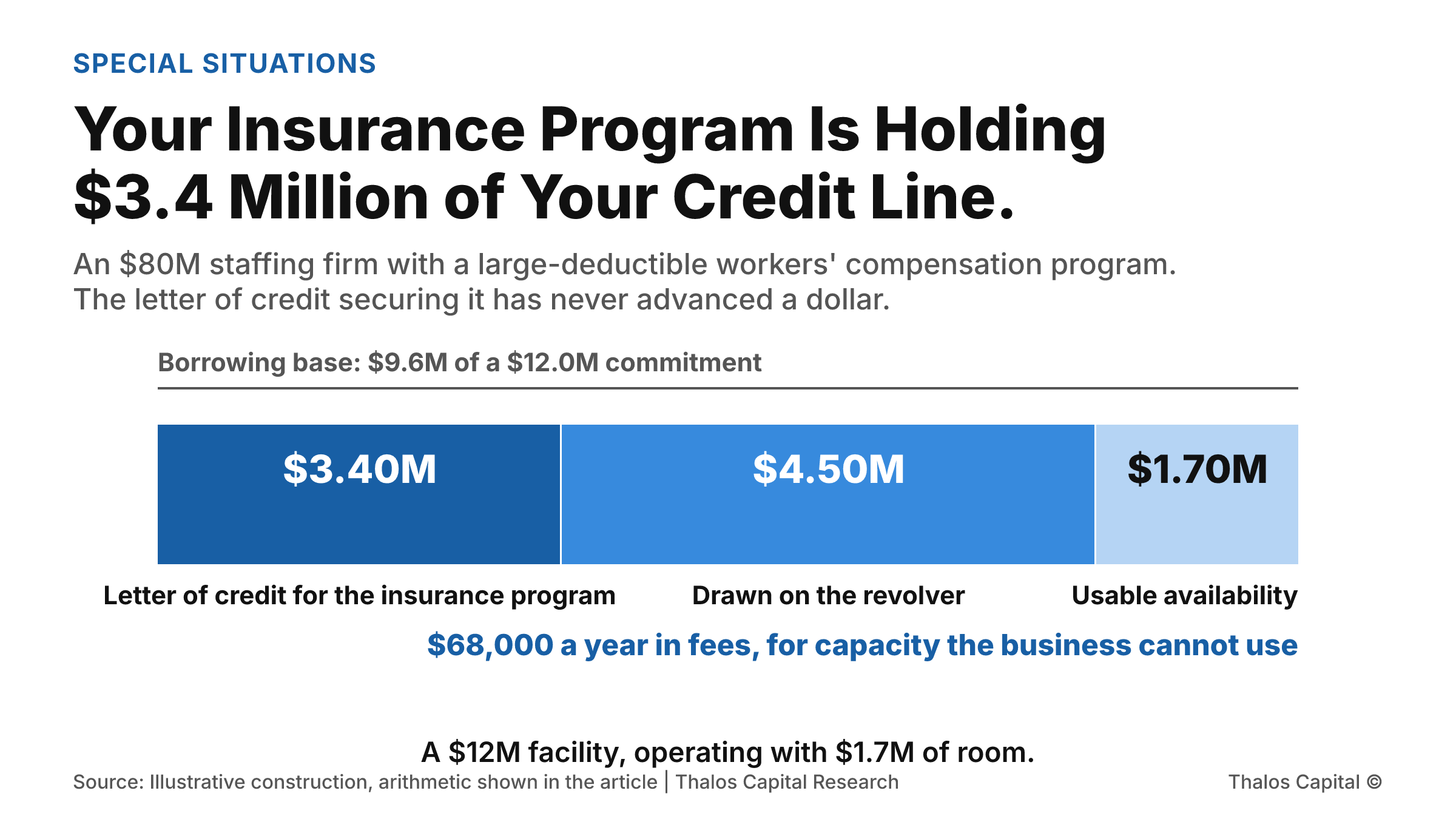
A $9.6 million borrowing base split three ways at a staffing firm. A $3.4 million letter of credit collateralizes the workers' compensation program, $4.5 million is drawn on the revolver, and $1.7 million is usable availability, against a $12 million commitment.

Your Insurance Program Is Holding $3.4 Million of Your Credit Line

A staffing firm's workers' compensation collateral has grown to $3.4 million, posted as a letter of credit under its revolver. It funds nothing, it grows with payroll, and it leaves $1.7 million of usable availability.
Read More
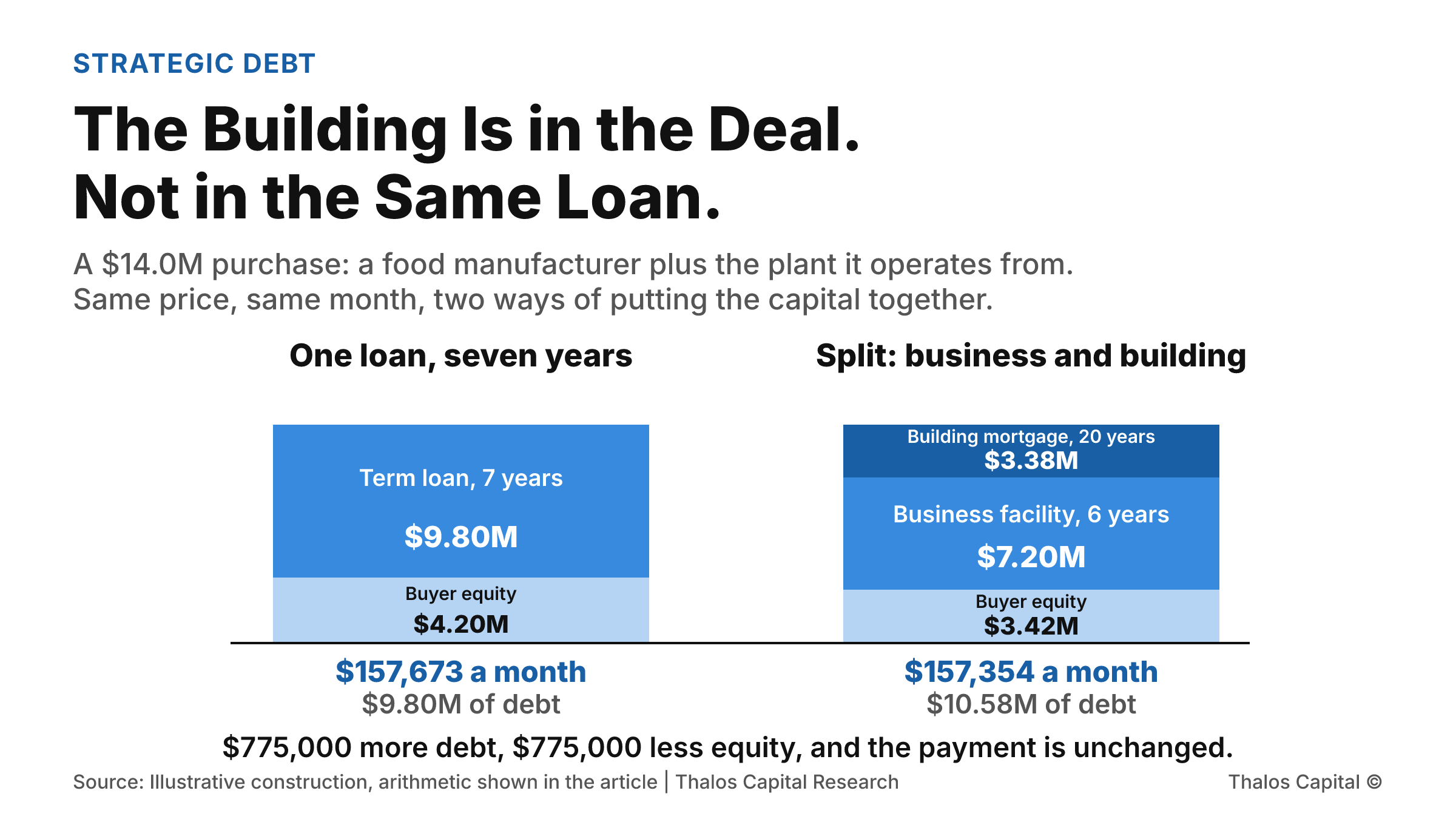
Two financing structures for the same $14 million acquisition. As one seven-year loan it carries $9.8 million of debt at $157,673 a month and needs $4.20 million of equity. Split into a six-year business facility of $7.2 million and a twenty-year mortgage of $3.375 million on the building, it carries $10.575 million at $157,354 a month and needs $3.425 million of equity.

The Building Is in the Deal. It Should Not Be in the Same Loan.

A $14 million acquisition includes the plant the seller owns. Financed as one loan it supports $9.8 million of debt. Split into a business facility and a mortgage on the building, it supports $10.58 million at the same annual cost.
Read More
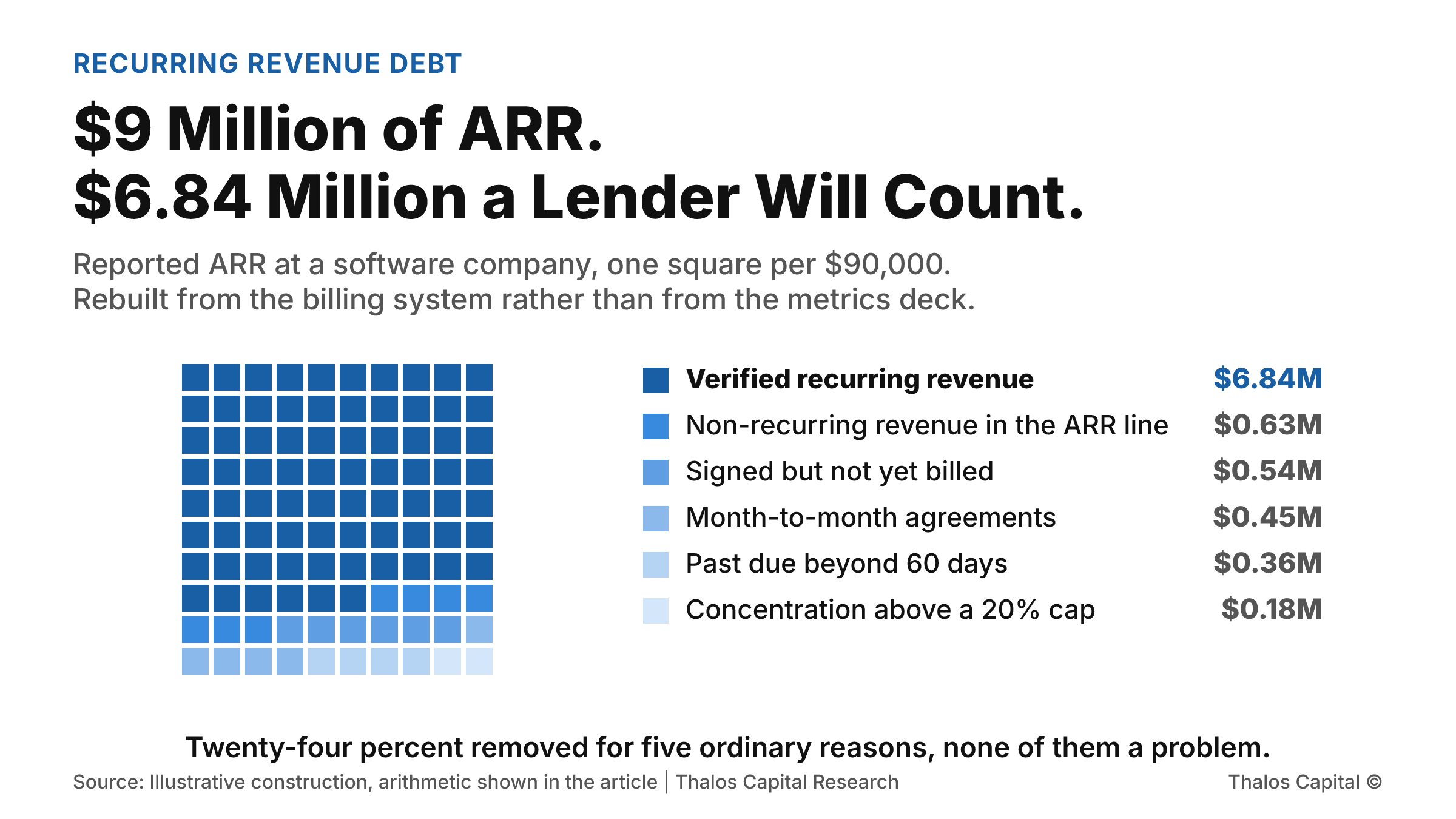
A grid of 100 squares, each $90,000 of a software company's $9.0 million of reported ARR. Seventy-six squares are verified. Twenty-four are removed: seven for non-recurring revenue, six for signed but unbilled contracts, five for month-to-month agreements, four for accounts past due beyond 60 days and two for concentration above a 20 percent cap.

$9 Million of ARR. $6.84 Million a Lender Will Count.

A software company reports $9.0 million of ARR. A recurring revenue lender rebuilds it from the billing system and verifies $6.84 million, and every multiple in the term sheet applies to the second number.
Read More
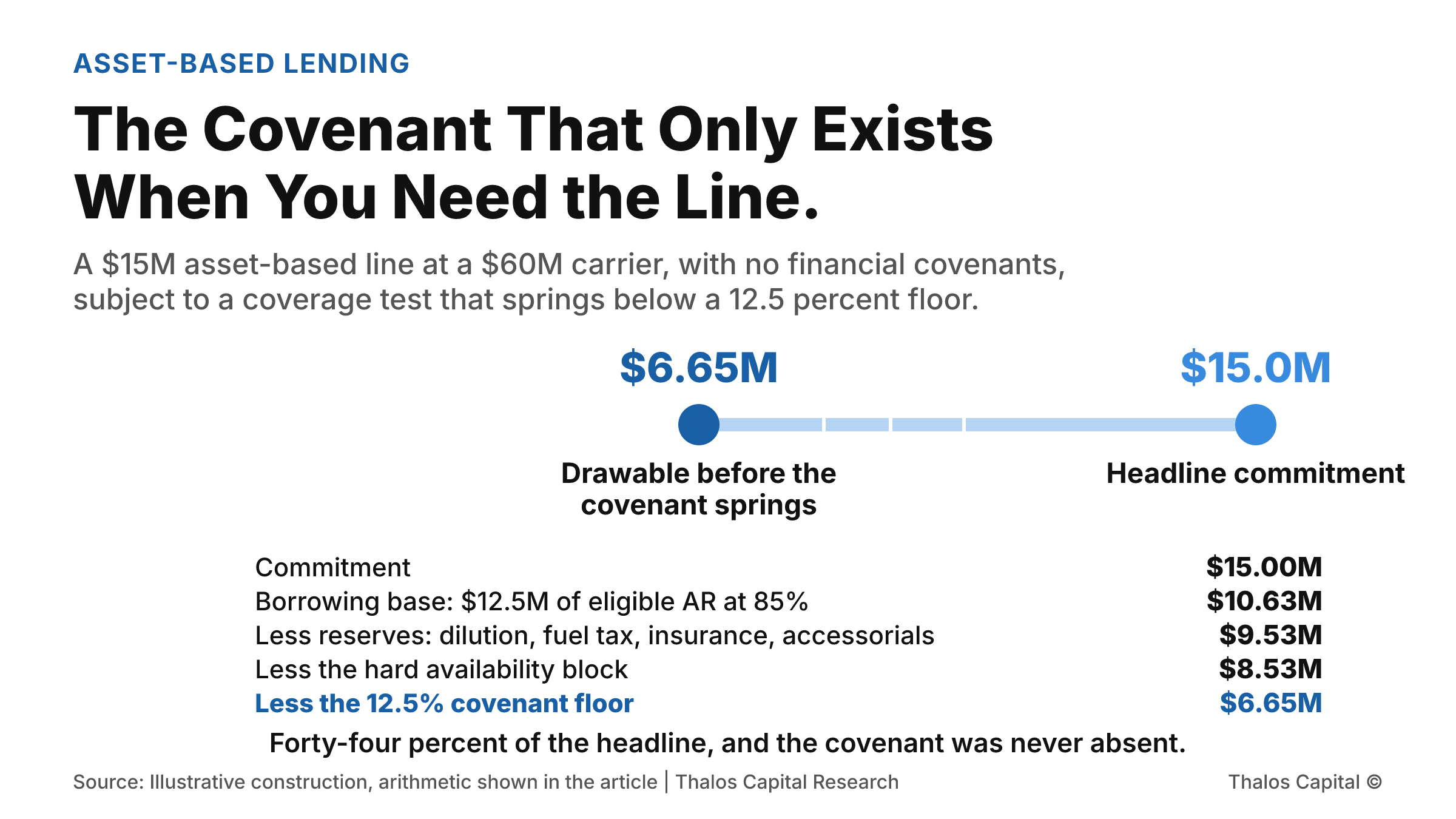
A two-point comparison on a $15 million asset-based line. The headline commitment is $15.0 million. After the borrowing base, reserves, an availability block and the covenant floor, $6.65 million can be drawn without springing the coverage test, which is 44 percent of the headline figure.

The Covenant That Only Exists When You Need the Line

A $15 million asset-based line gives a carrier $6.65 million it can draw without consequence. Below that, a coverage test springs into effect, in the quarter the business is least able to pass it.
Read More
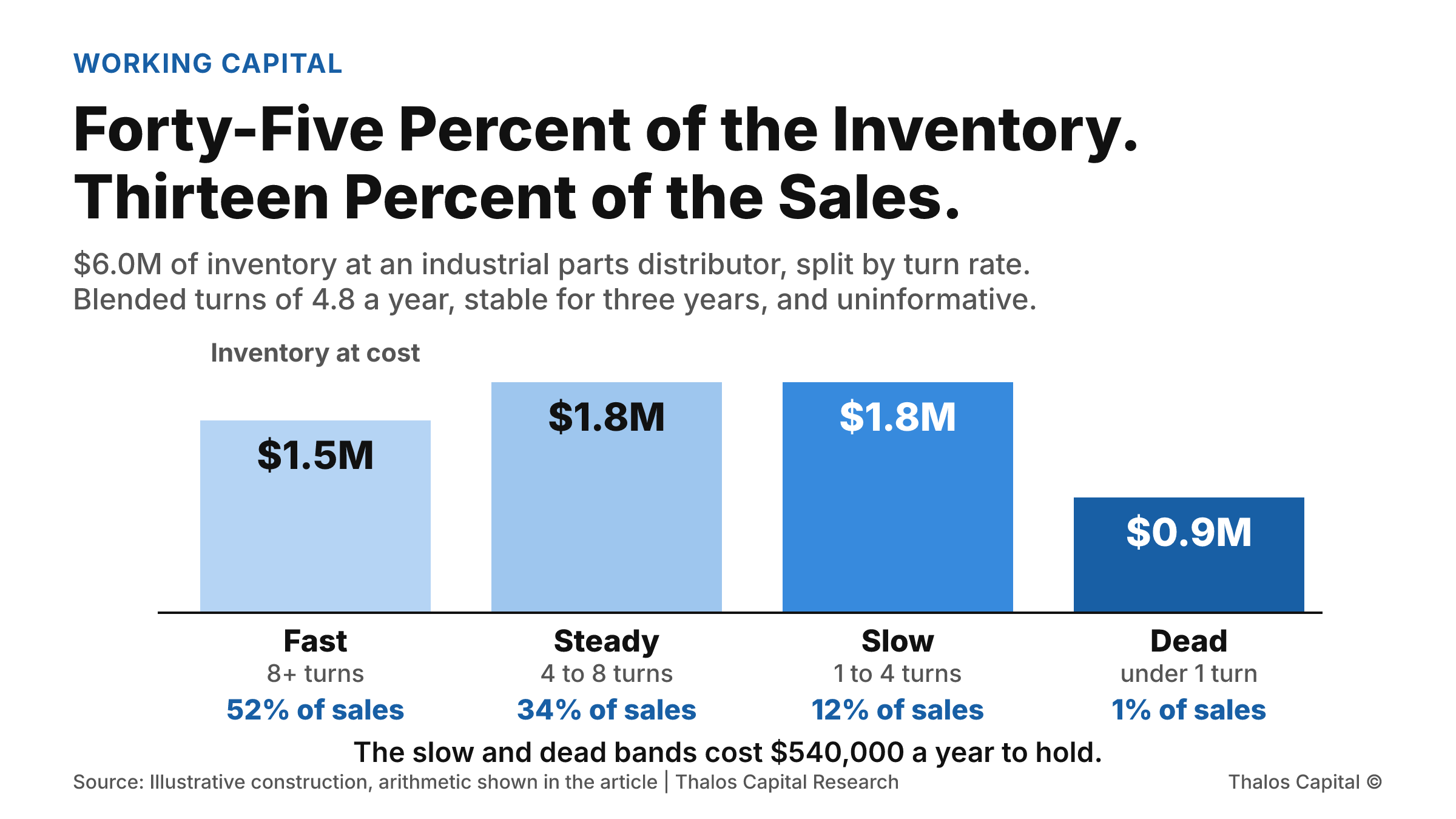
Four columns of inventory at cost by turn band at a parts distributor. Fast-moving stock is $1.5 million and produces 52 percent of cost of goods sold. Steady stock is $1.8 million and 34 percent. Slow stock is $1.8 million and 13 percent. Dead stock is $900,000 and produces under 1 percent.

Forty-Five Percent of the Inventory. Thirteen Percent of the Sales.

A parts distributor holds $6 million of inventory. The slow and dead bands are $2.7 million of it and produce 13 percent of cost of goods sold, while costing $540,000 a year to carry.
Read More
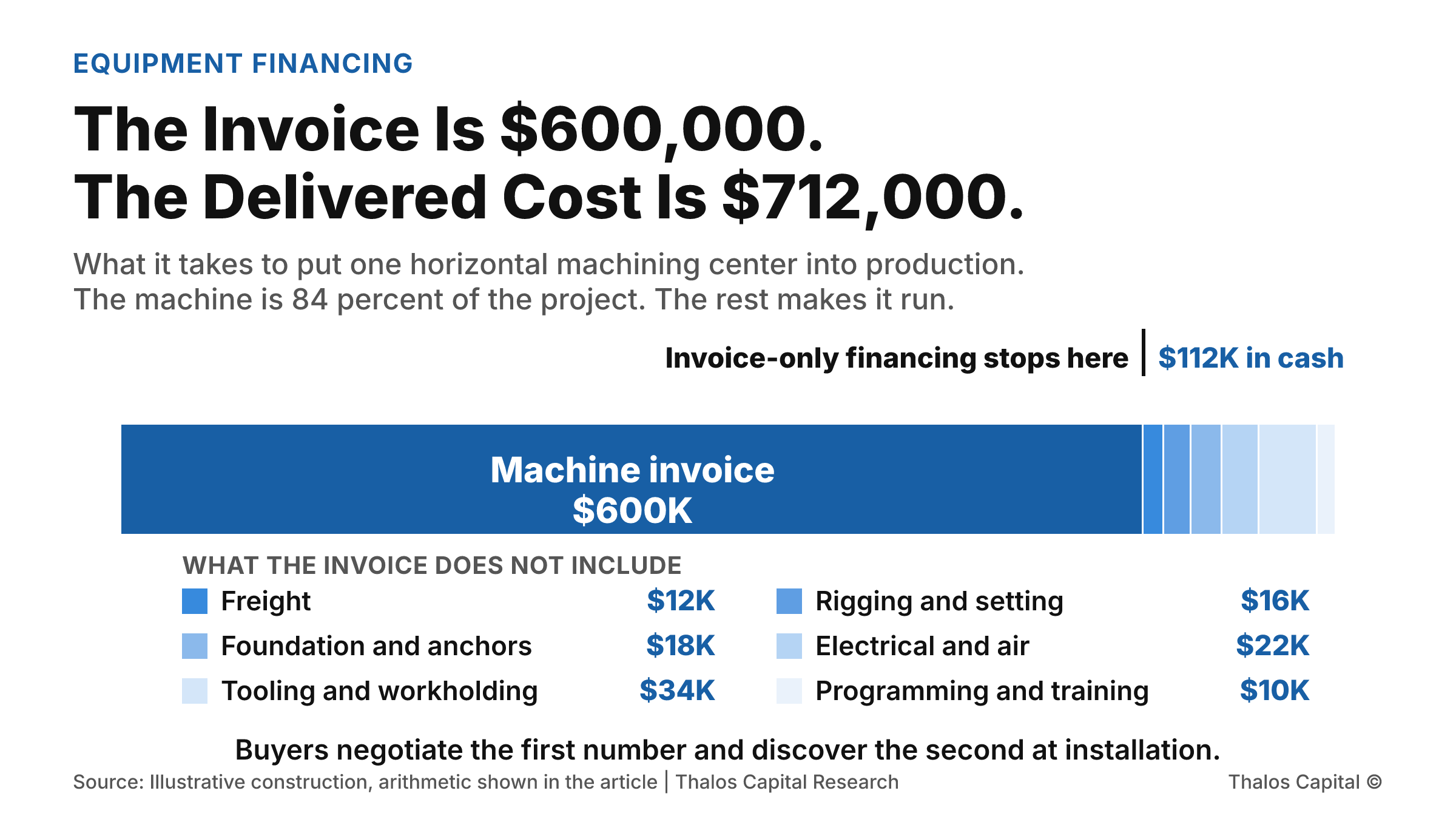
A single bar of $712,000 of delivered cost split into the $600,000 machine invoice, $12,000 of freight, $16,000 of rigging, $18,000 of foundation work, $22,000 of electrical and air, $34,000 of tooling and $10,000 of programming and training, with a marker showing that invoice-only financing covers the first segment and leaves $112,000 in cash.

The Invoice Is $600,000. The Delivered Cost Is $712,000.

Freight, rigging, foundation work, electrical, tooling and training add $112,000 to a machine quoted at $600,000. What a lender will advance against those items decides whether the buyer writes a cheque at closing.
Read More
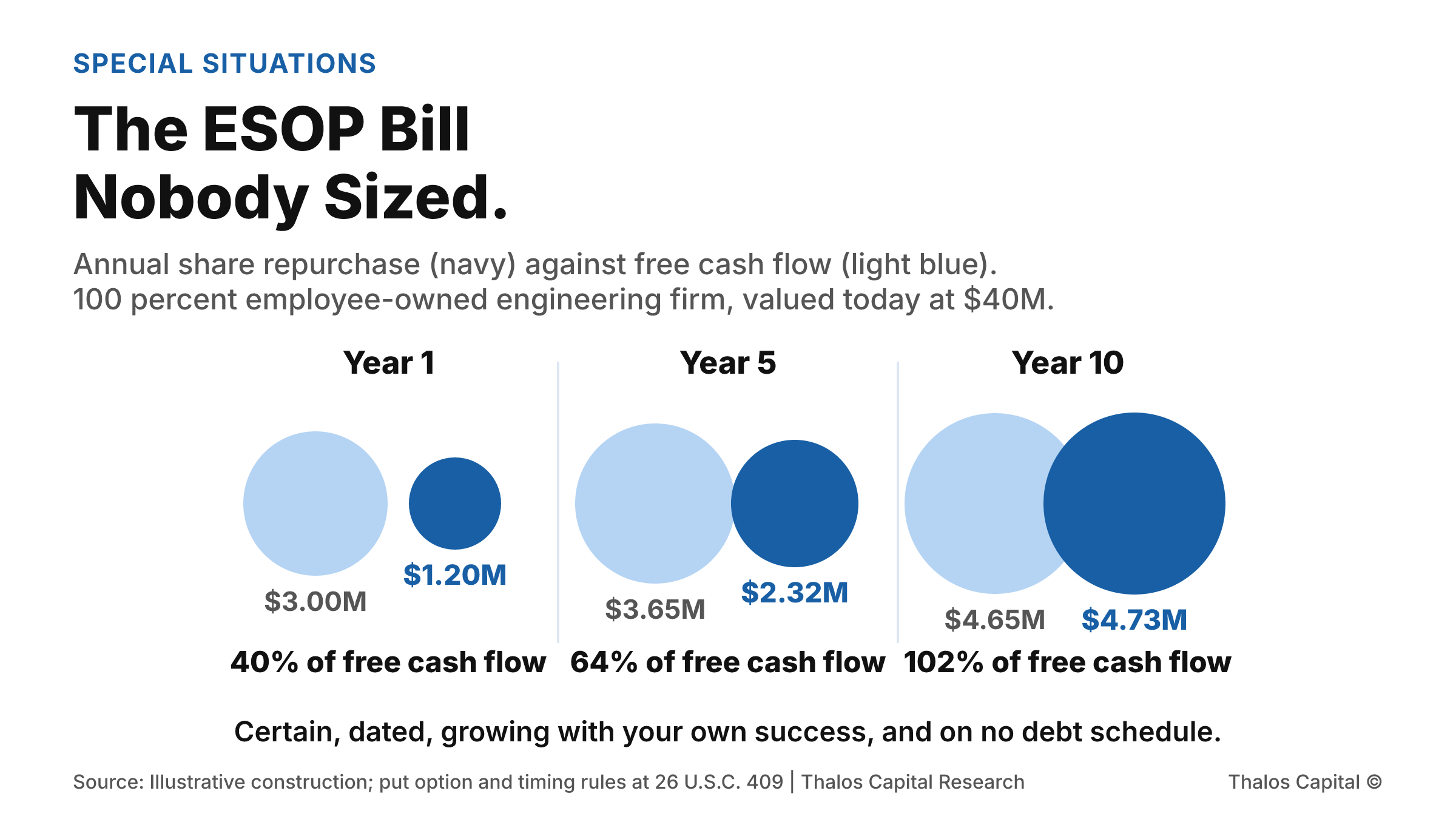
Three panels comparing the annual share repurchase obligation against free cash flow at an employee-owned firm. In year one it is $1.2 million against $3.0 million, or 40 percent. In year five it is $2.32 million against $3.65 million, or 64 percent. In year ten it is $4.73 million against $4.65 million, or 102 percent.

The ESOP Bill Nobody Sized

An employee-owned engineering firm buys back $1.2 million of shares this year and $4.7 million in year ten, against free cash flow that grows from $3.0 million to $4.65 million. The obligation is certain, dated, and rarely financed.
Read More
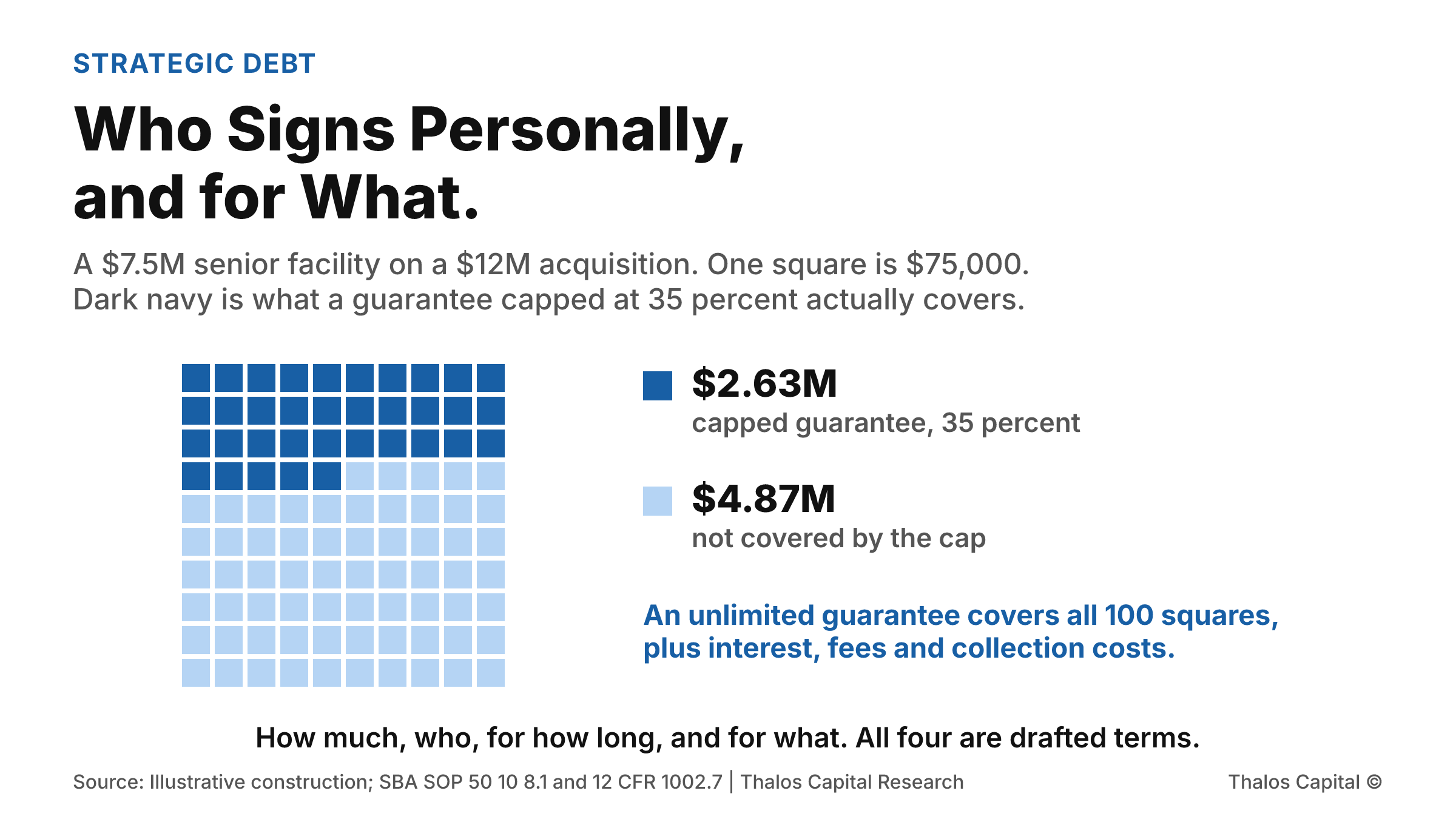
A grid of 100 squares representing a $7.5 million senior facility at $75,000 each. Thirty-five squares are shaded dark to show the $2.63 million covered by a guarantee capped at 35 percent of the facility, against an unlimited guarantee that covers all 100.

Who Signs Personally, and for What

A contractor financing a $12 million acquisition can sign an unlimited guarantee, a guarantee capped at 35 percent of the facility, or none at all. The structures differ by millions of dollars of personal exposure and by about 250 basis points.
Read More
Working through a financing decision?
Insights are a starting point. A conversation maps your actual options.
Tell us what you are financing and we will map the structures and sources that fit.
Submit your financing request →
Explore our financing solutions
Equipment FinancingWorking CapitalAsset-Based LendingStrategic Debt