Category

Financing Strategy

46 insights · page 3 of 6

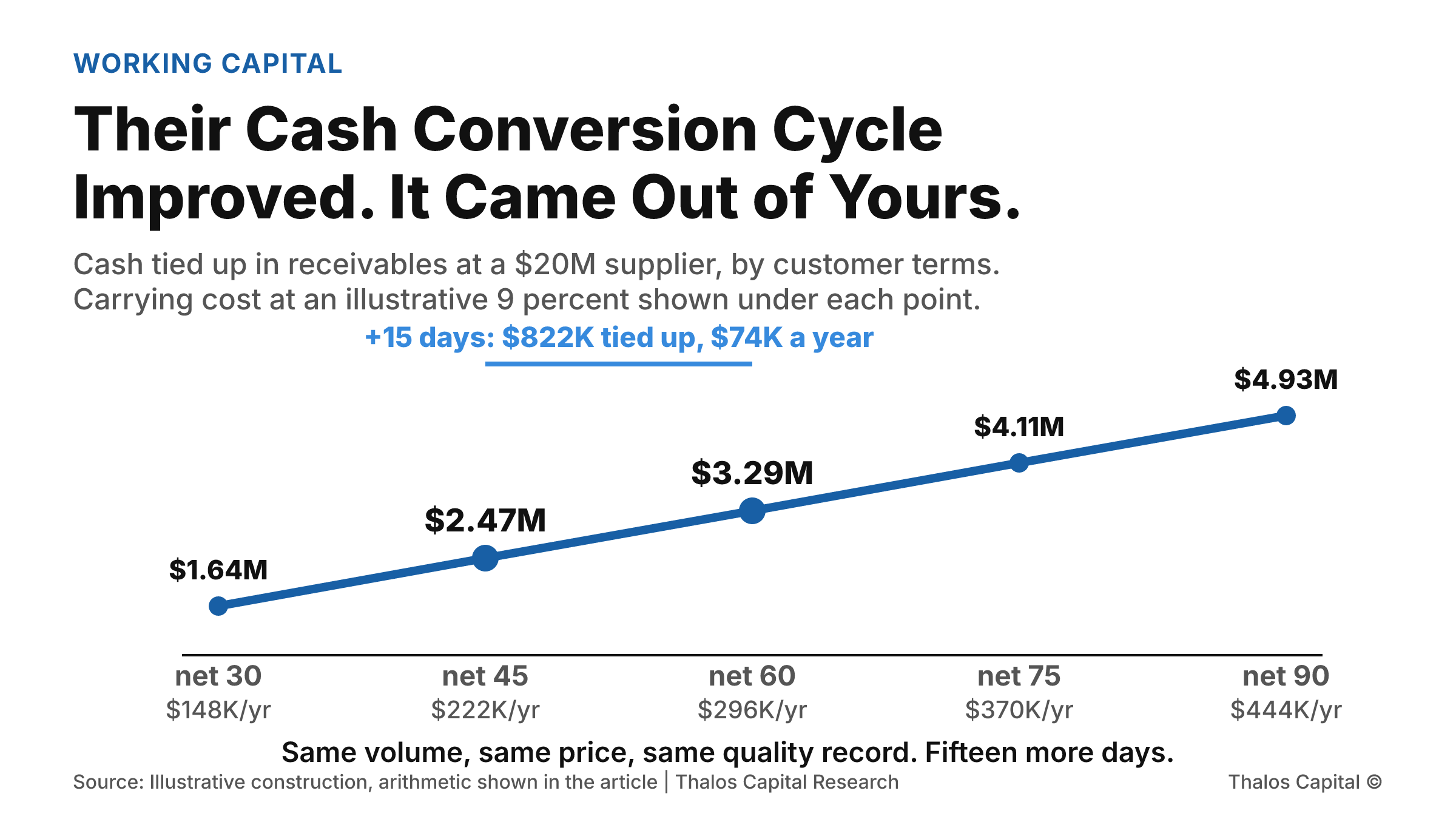
A line of cash tied up in receivables at a $20 million supplier as customer payment terms extend. At net 30 it is $1.64 million, at net 45 $2.47 million, at net 60 $3.29 million, at net 75 $4.11 million and at net 90 $4.93 million, with an annual carrying cost rising from $148,000 to $444,000 at an illustrative 9 percent.

Their Cash Conversion Cycle Improved. It Came Out of Yours.

The largest North American companies improved their cash conversion cycle by 0.2 days last year, entirely by paying suppliers 2.9 days later. For a $20 million supplier, a 15-day extension ties up $822,000 and costs about $74,000 a year.
Read More
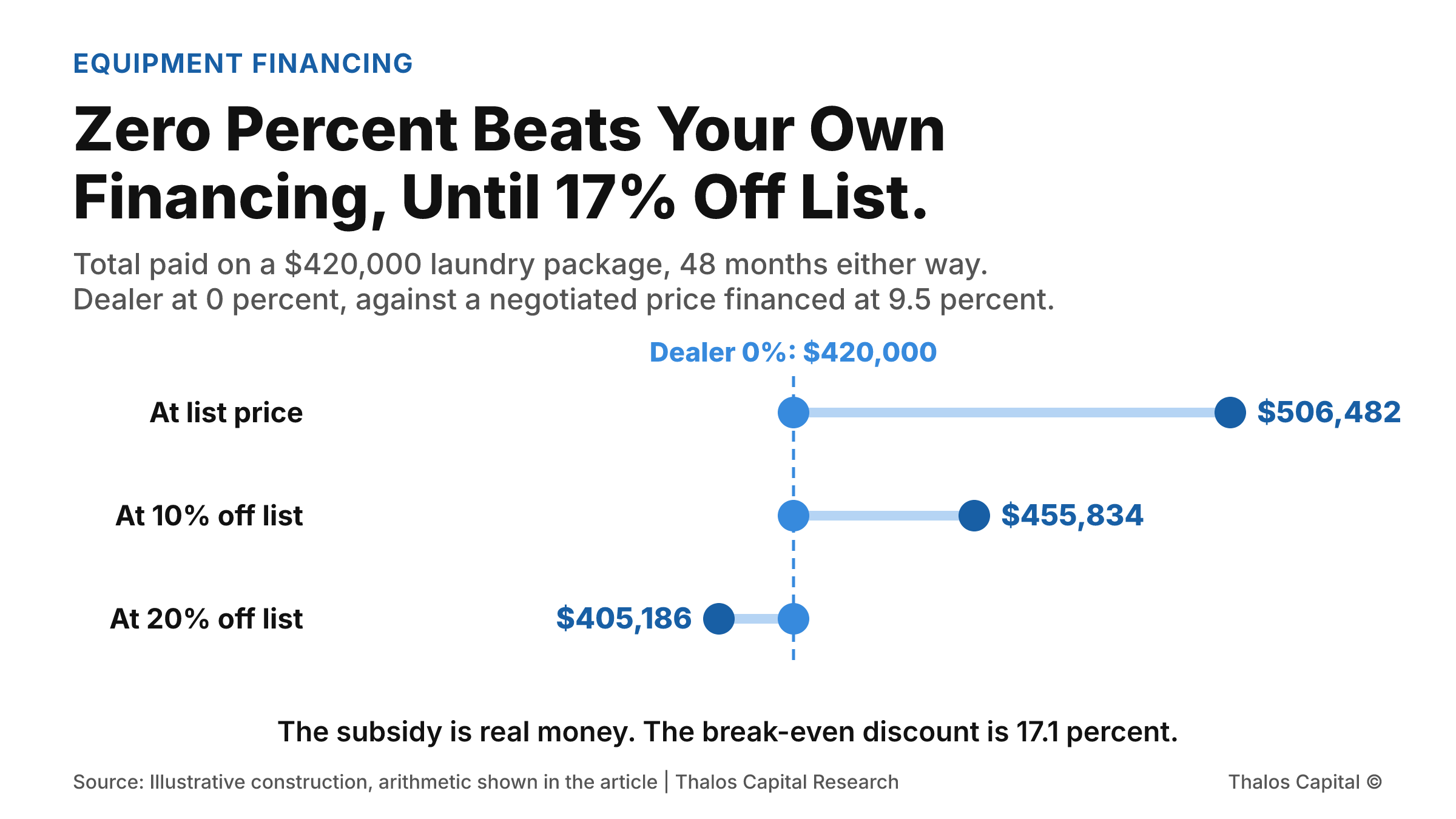
Three rows comparing a $420,000 dealer offer at zero percent over 48 months against the same machine bought at a discount and financed independently at 9.5 percent. At list the independent route costs $506,482, at a 10 percent discount $455,834, and at a 20 percent discount $405,186, crossing below the dealer offer at a discount of 17.1 percent.

Zero Percent Beats Your Own Financing, Unless the Discount Hits 17 Percent

A $420,000 laundry package at zero percent over 48 months costs $420,000. Financed independently at 9.5 percent, the cash price has to be 17.1 percent below list to match it. At a 10 percent discount it costs $35,834 more.
Read More
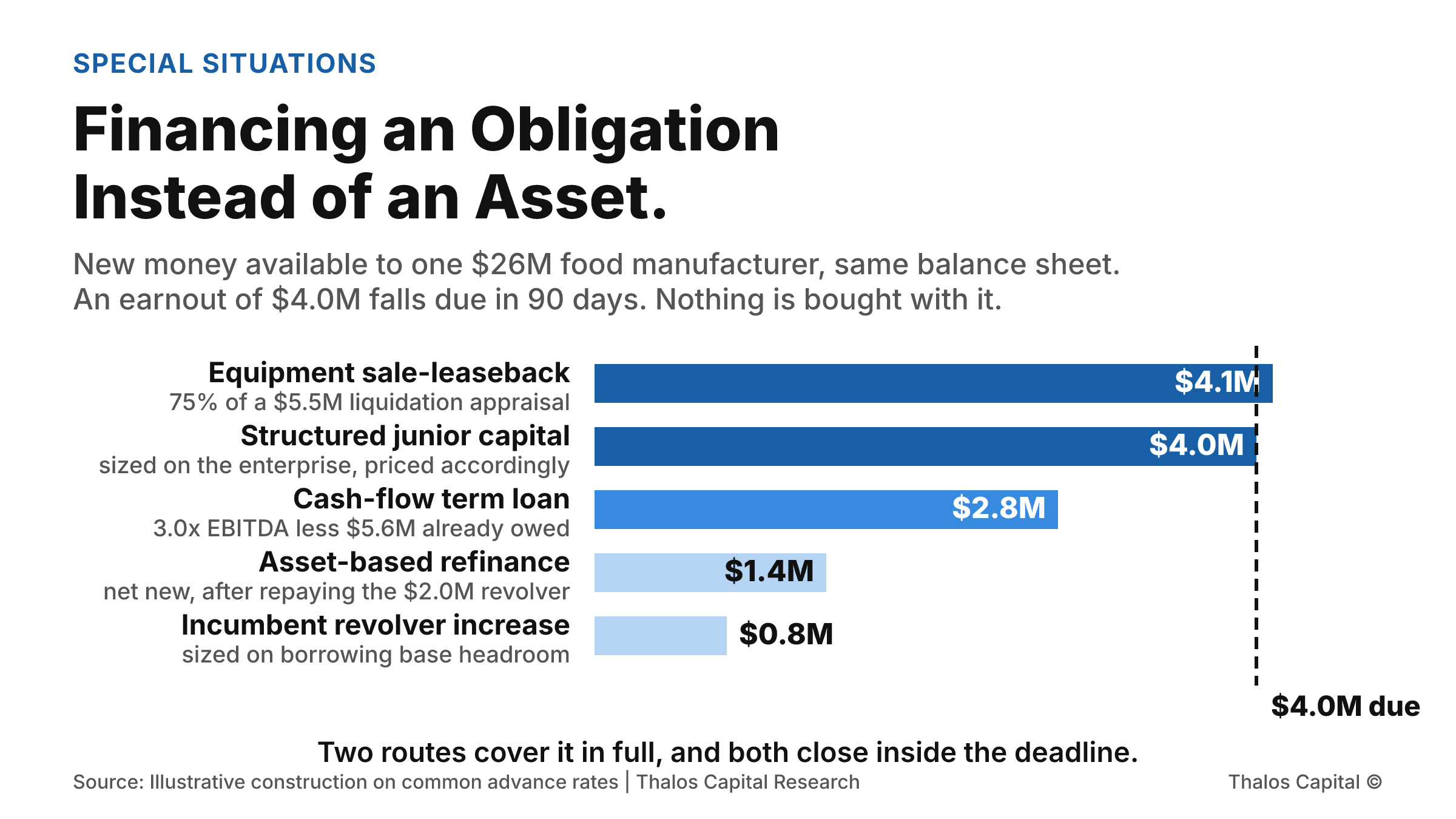
Five horizontal bars of new money available to the same food manufacturer: a revolver increase at $800,000, an asset-based refinance at $1.4 million net, a cash-flow term loan at $2.8 million, structured junior capital at $4.0 million and an equipment sale-leaseback at $4.1 million, against a $4.0 million obligation due in 90 days.

Financing an Obligation Instead of an Asset

A food manufacturer owes $4 million in 90 days with nothing new to show for it. Five funding routes against the same balance sheet produce $800,000 to $4.1 million, and only two of them close in time.
Read More
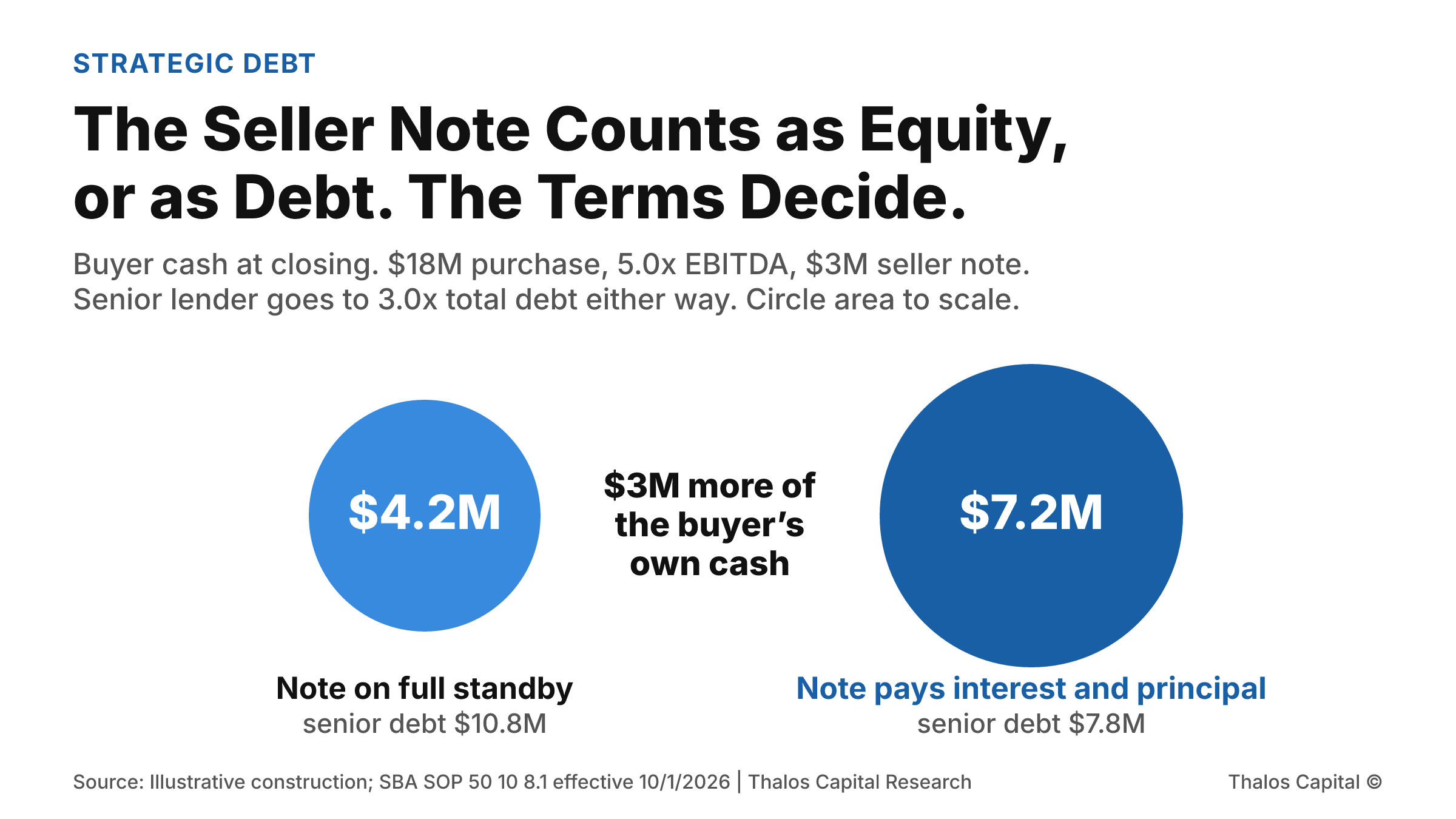
Two proportional circles of the buyer's cash at closing on the same $18 million acquisition with the same $3 million seller note. With the note on full standby it is $4.2 million. With the note paying current interest and principal it is $7.2 million, a difference of $3 million.

The Seller Note Counts as Equity, or as Debt. The Terms Decide.

On an $18 million acquisition, the same $3 million seller note moves the buyer's cash at closing from $4.2 million to $7.2 million, depending on whether it is on full standby. SBA rules for the same question changed on October 1.
Read More
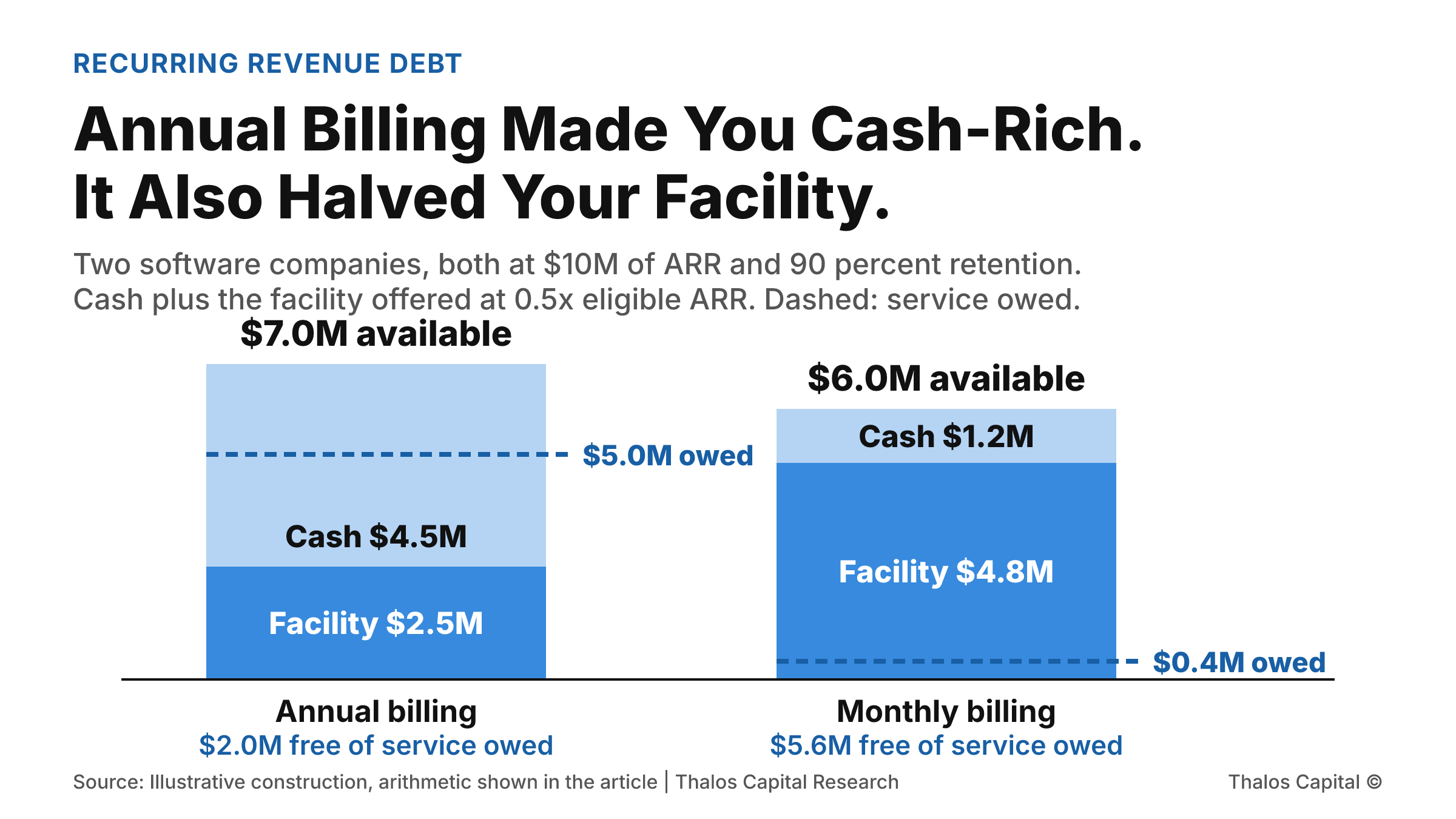
Two stacked bars of available liquidity. The annual biller holds $4.5 million of cash and is offered a $2.5 million facility, $7.0 million in total, of which $5.0 million is service already paid for and still owed. The monthly biller holds $1.2 million of cash and is offered $4.8 million, $6.0 million in total, of which $400,000 is owed.

Annual Billing Made You Cash-Rich. It Also Halved Your Facility.

Two software companies have identical ARR and retention. One bills annually in advance and holds $4.5 million of cash. The other bills monthly. The monthly biller is offered $4.8 million of debt against the annual biller's $2.5 million.
Read More
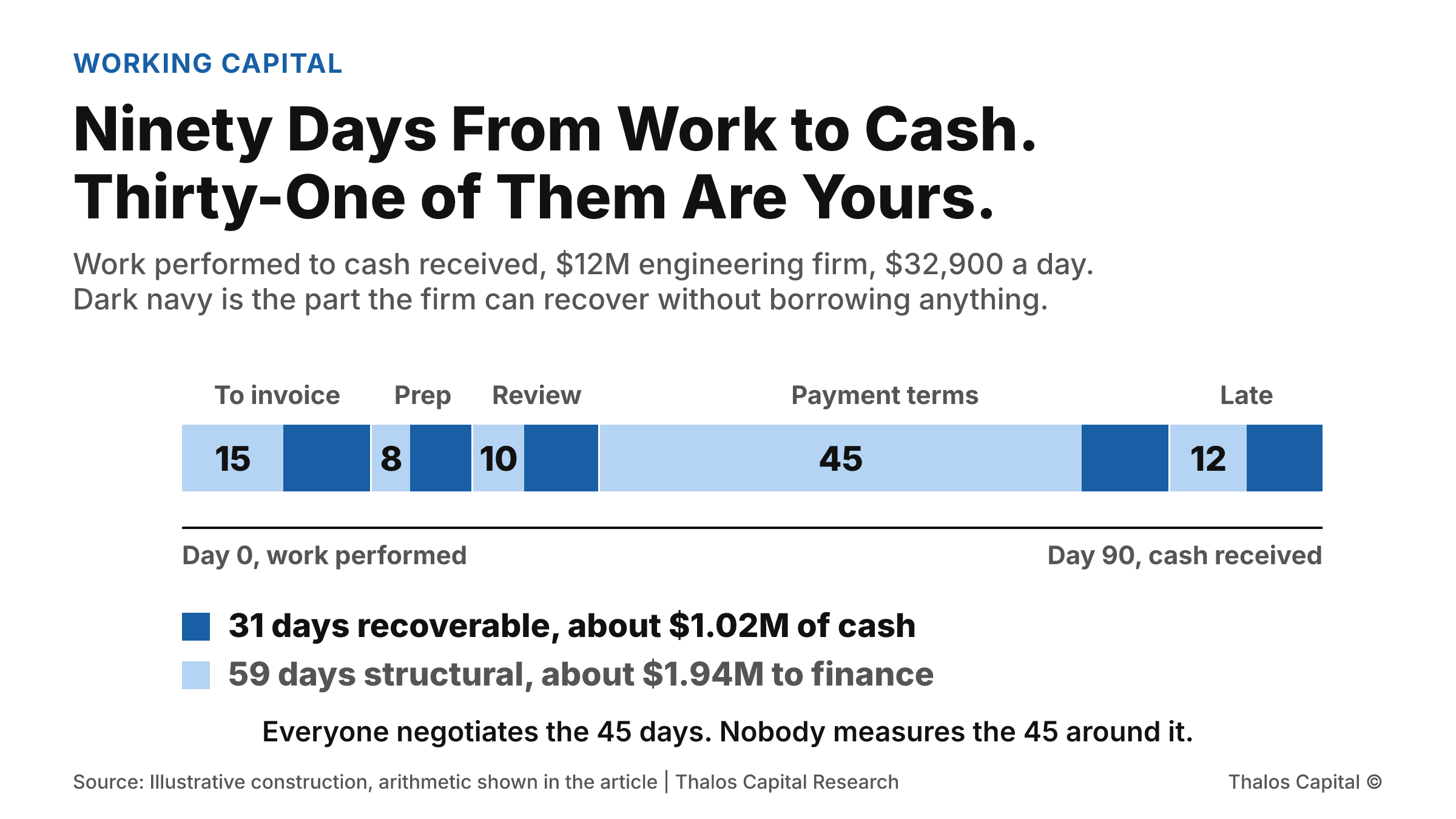
A 90-day timeline from work performed to cash received at an engineering firm, split into five stages: 15 days to month-end billing, 8 days of internal invoice preparation, 10 days of client review, 45 days of payment terms and 12 days of lateness. Thirty-one of the 90 days are marked as recoverable by the firm itself.

Ninety Days From Work to Cash. Thirty-One of Them Are Yours.

An engineering firm waits 90 days between doing the work and being paid for it. Thirty-one of those days come from its own billing process, worth about $1.02 million of cash. The other 59 days are a real financing need.
Read More
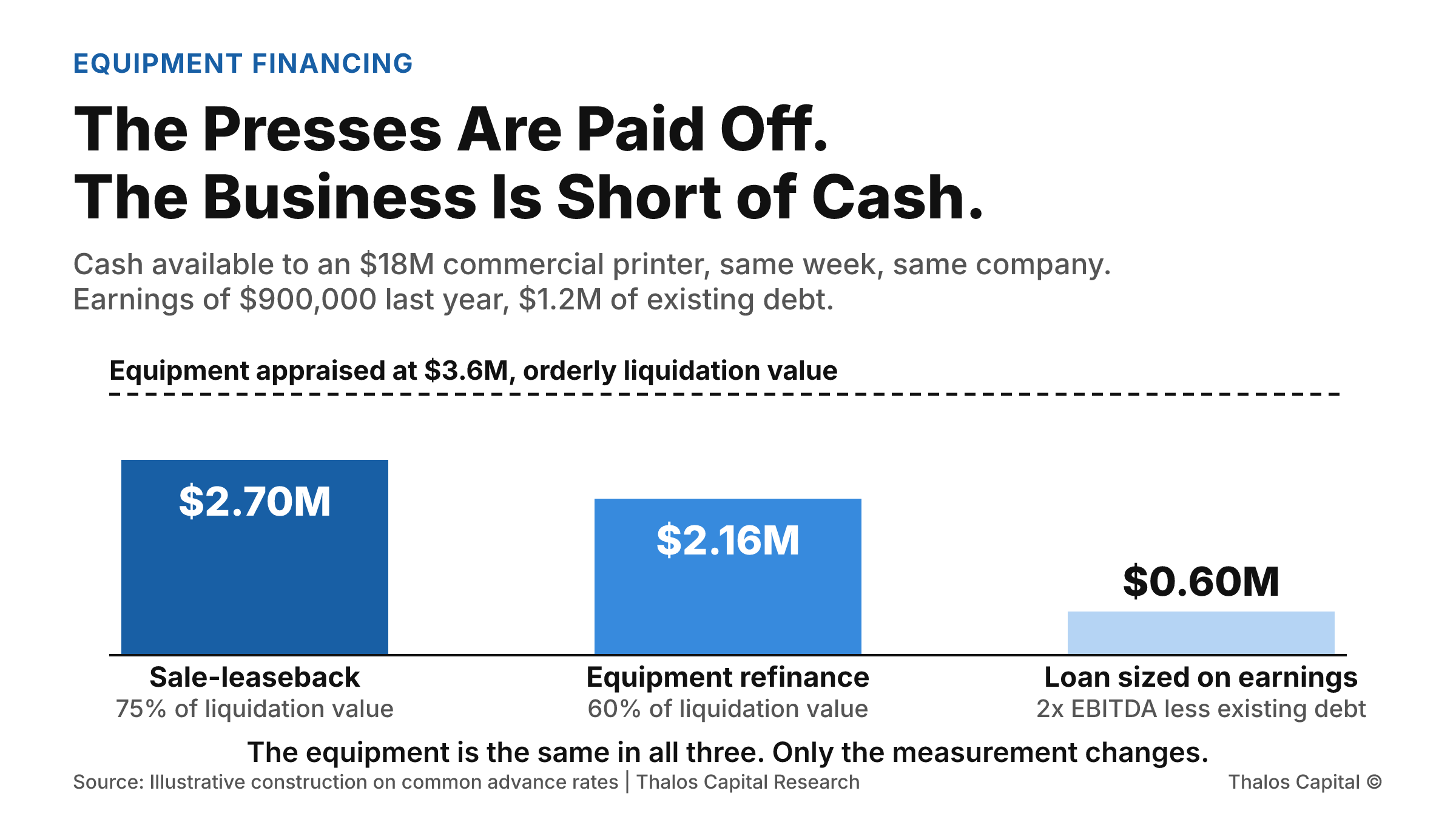
Three columns of cash available to a commercial printer. A sale-leaseback of owned presses raises $2.70 million, an equipment-secured refinance raises $2.16 million, and a loan sized on last year's earnings raises $600,000, against equipment appraised at $3.6 million.

The Presses Are Paid Off. The Business Is Short of Cash.

A commercial printer owns $3.6 million of appraised equipment and can borrow $600,000 on last year's earnings. A sale-leaseback on the same presses raises $2.7 million, at $69,800 a month and $650,000 of total cost.
Read More
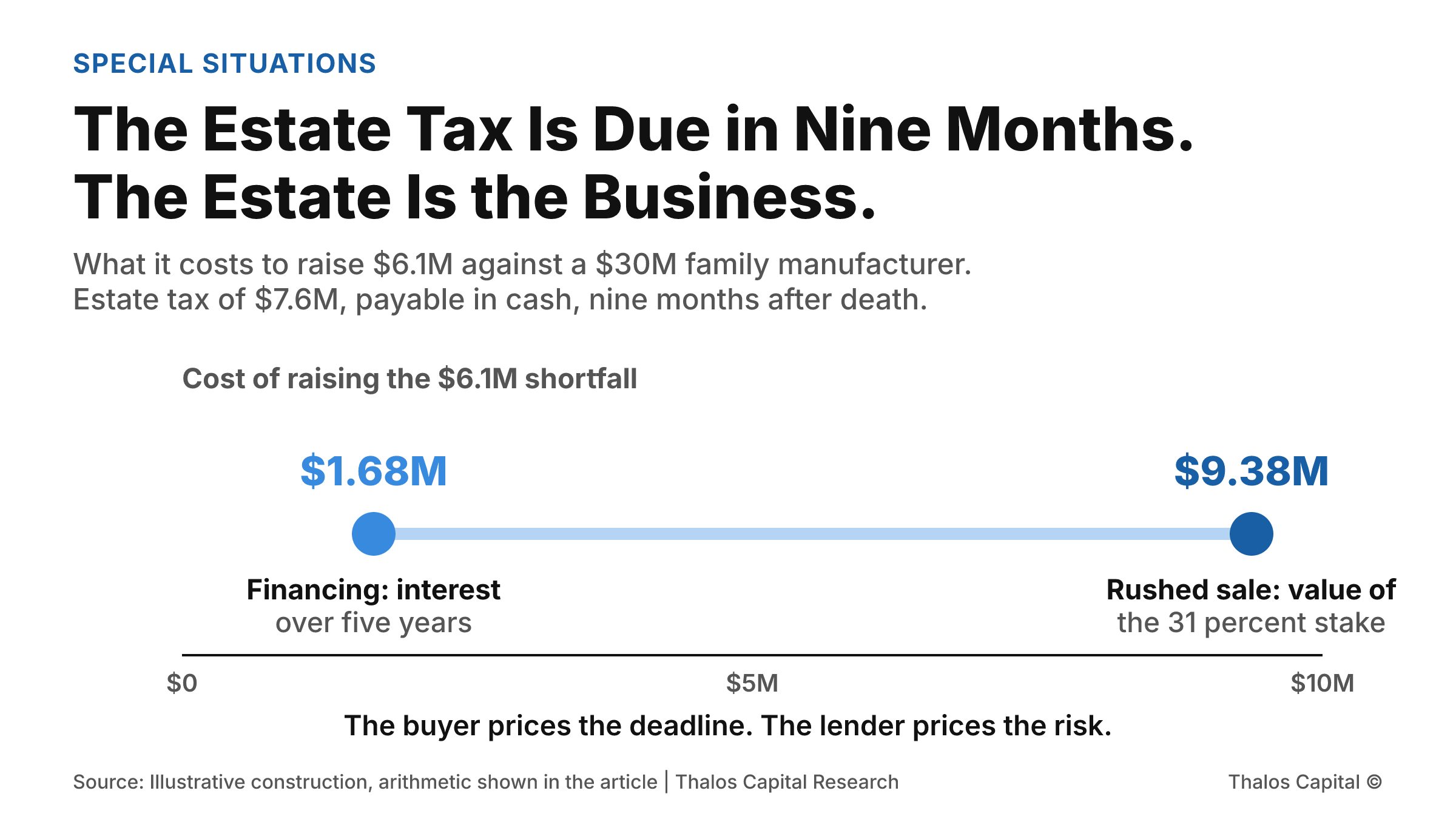
A two-point comparison of what it costs to raise $6.1 million against a $30 million family manufacturer. Selling a 31 percent stake under a deadline gives up $9.38 million of business value. Financing the same amount over five years costs $1.68 million of interest.

The Estate Tax Is Due in Nine Months. The Estate Is the Business.

A family owes $7.6 million of estate tax nine months after the founder's death, with $1.5 million of cash and a $30 million manufacturer. Selling a stake under the deadline gives up $9.4 million of value. Financing costs $1.68 million.
Read More
Working through a financing decision?
Insights are a starting point. A conversation maps your actual options.
Tell us what you are financing and we will map the structures and sources that fit.
Submit your financing request →
Explore our financing solutions
Equipment FinancingWorking CapitalAsset-Based LendingStrategic Debt