Tag

liquidity

11 insights

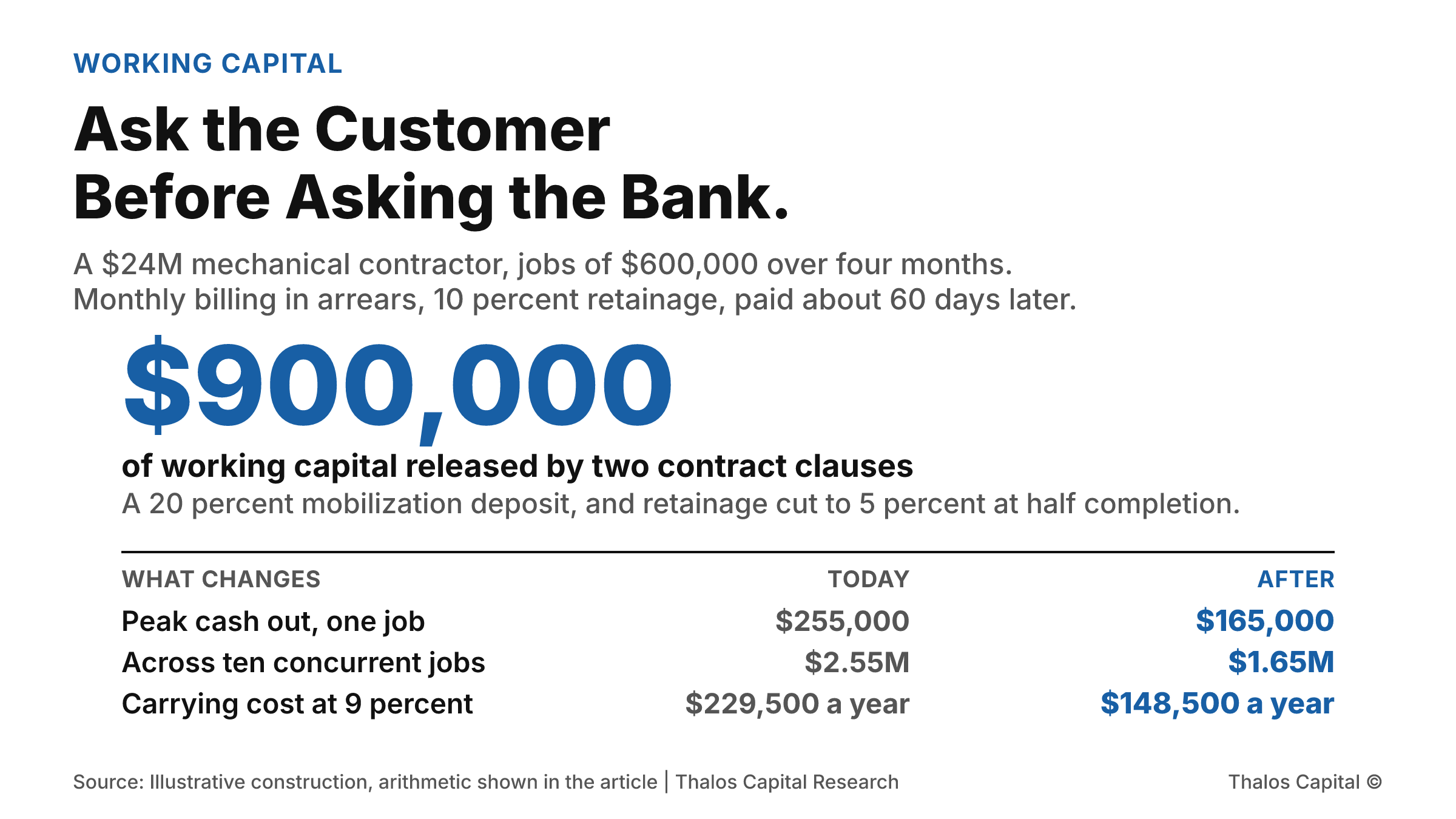
A callout showing $900,000 of working capital released by changing billing terms at a mechanical contractor, with supporting figures: $255,000 of cash per job falling to $165,000, $2.55 million across ten concurrent jobs falling to $1.65 million, and annual carrying cost falling from $229,500 to $148,500.

Ask the Customer Before Asking the Bank

A mechanical contractor carries $255,000 of cash per job and $2.55 million across ten. A deposit and a retainage change release $900,000 of it, which is working capital that costs nothing and needs no facility.
Read More
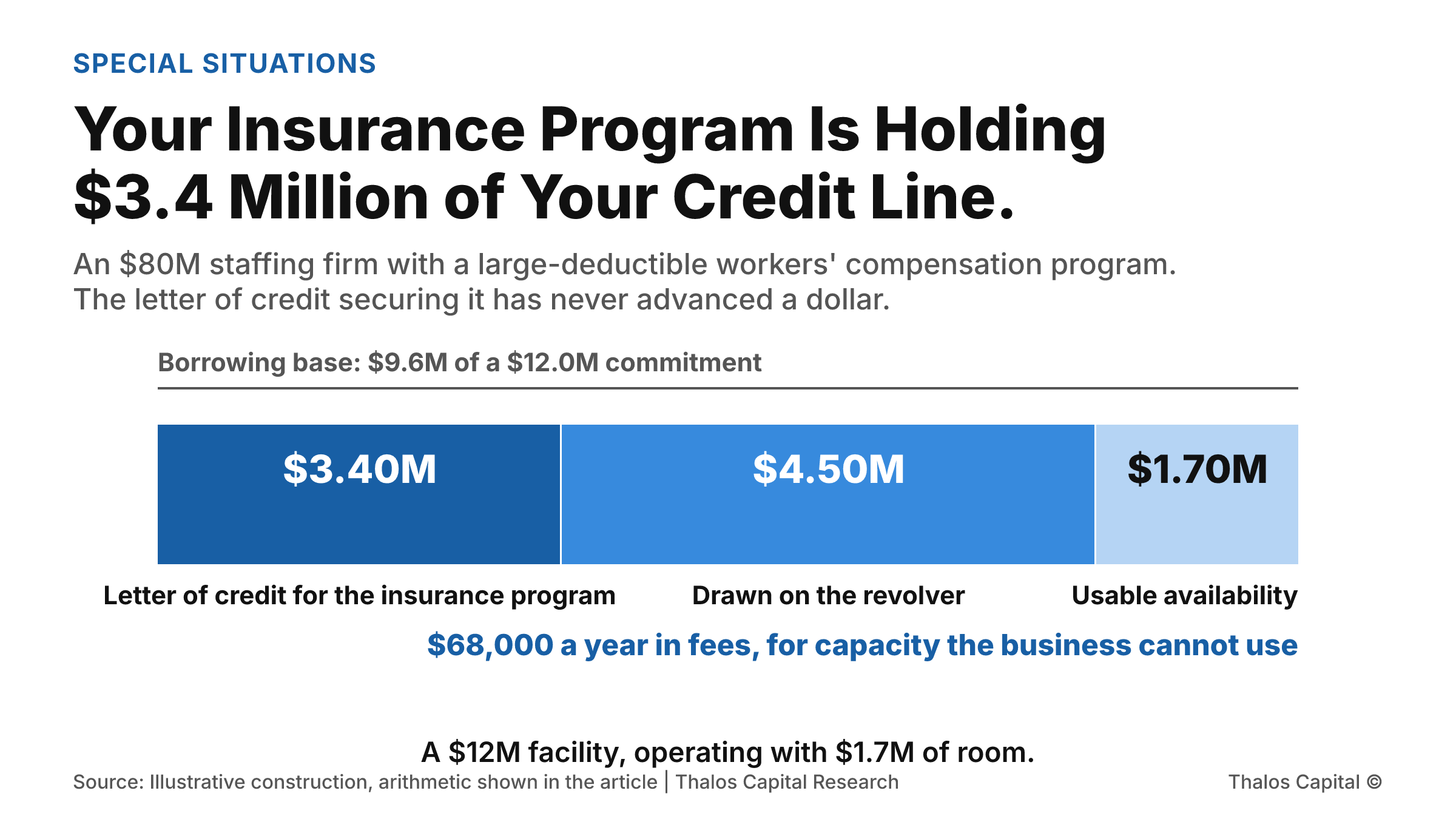
A $9.6 million borrowing base split three ways at a staffing firm. A $3.4 million letter of credit collateralizes the workers' compensation program, $4.5 million is drawn on the revolver, and $1.7 million is usable availability, against a $12 million commitment.

Your Insurance Program Is Holding $3.4 Million of Your Credit Line

A staffing firm's workers' compensation collateral has grown to $3.4 million, posted as a letter of credit under its revolver. It funds nothing, it grows with payroll, and it leaves $1.7 million of usable availability.
Read More
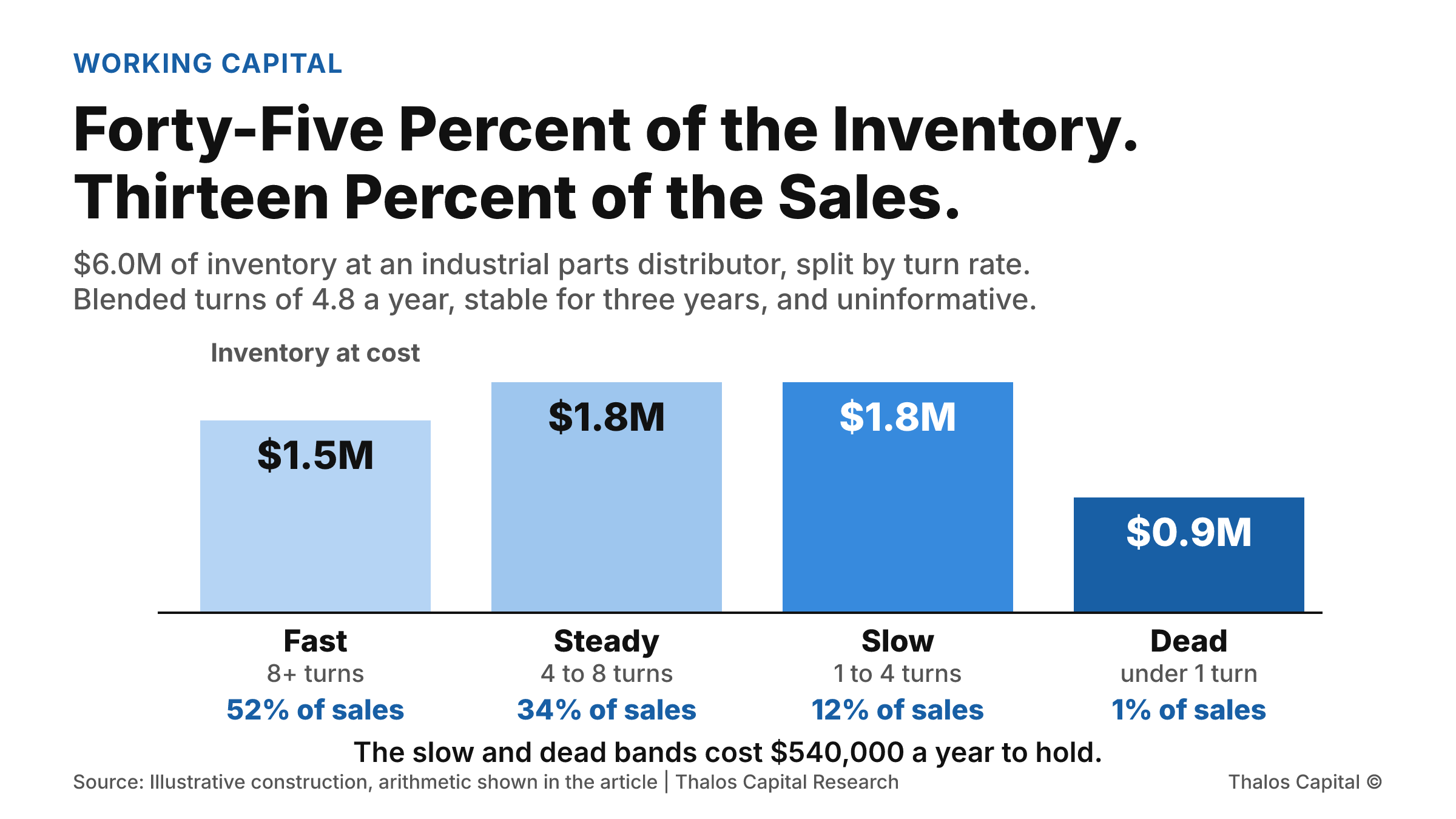
Four columns of inventory at cost by turn band at a parts distributor. Fast-moving stock is $1.5 million and produces 52 percent of cost of goods sold. Steady stock is $1.8 million and 34 percent. Slow stock is $1.8 million and 13 percent. Dead stock is $900,000 and produces under 1 percent.

Forty-Five Percent of the Inventory. Thirteen Percent of the Sales.

A parts distributor holds $6 million of inventory. The slow and dead bands are $2.7 million of it and produce 13 percent of cost of goods sold, while costing $540,000 a year to carry.
Read More
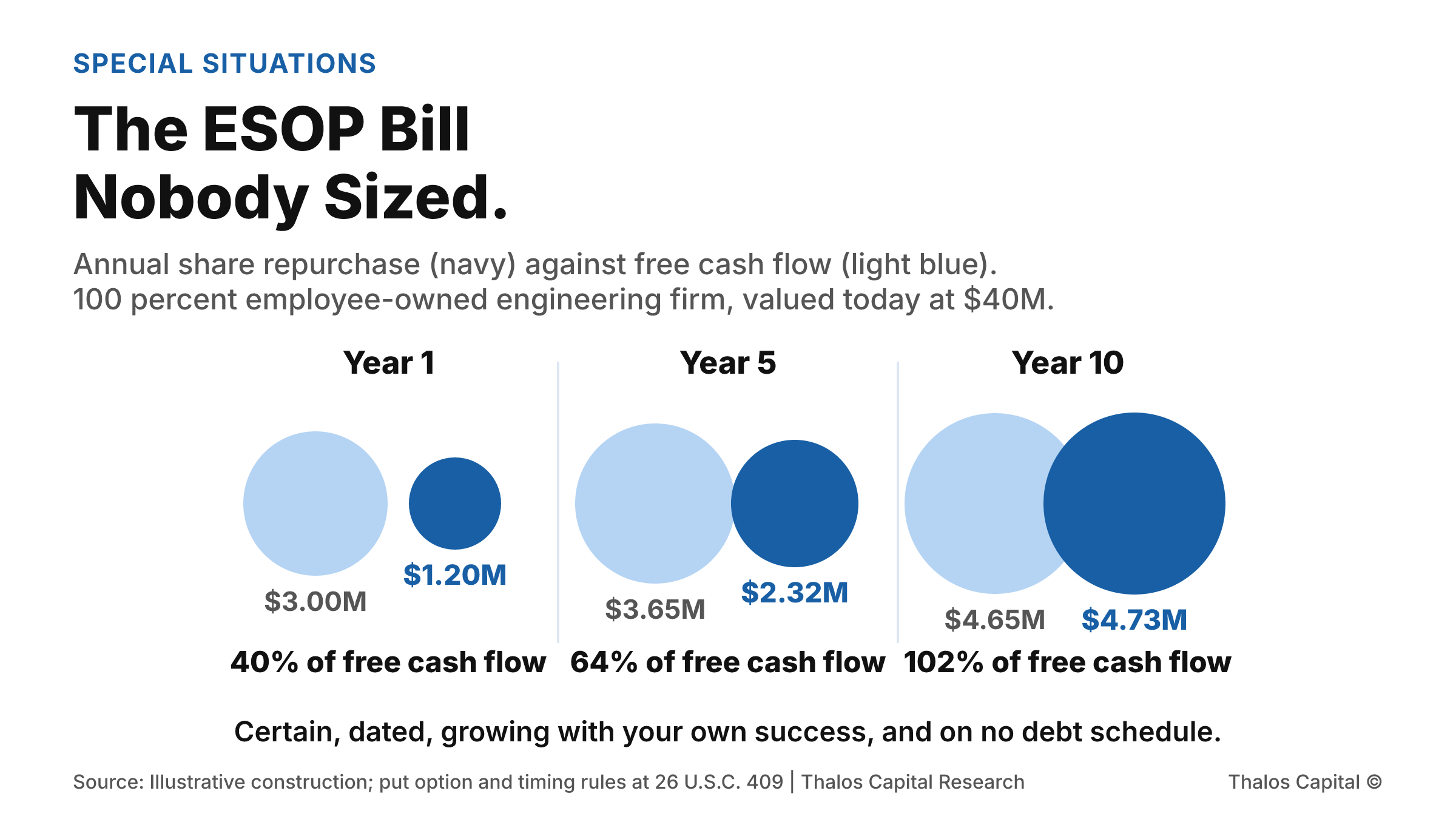
Three panels comparing the annual share repurchase obligation against free cash flow at an employee-owned firm. In year one it is $1.2 million against $3.0 million, or 40 percent. In year five it is $2.32 million against $3.65 million, or 64 percent. In year ten it is $4.73 million against $4.65 million, or 102 percent.

The ESOP Bill Nobody Sized

An employee-owned engineering firm buys back $1.2 million of shares this year and $4.7 million in year ten, against free cash flow that grows from $3.0 million to $4.65 million. The obligation is certain, dated, and rarely financed.
Read More
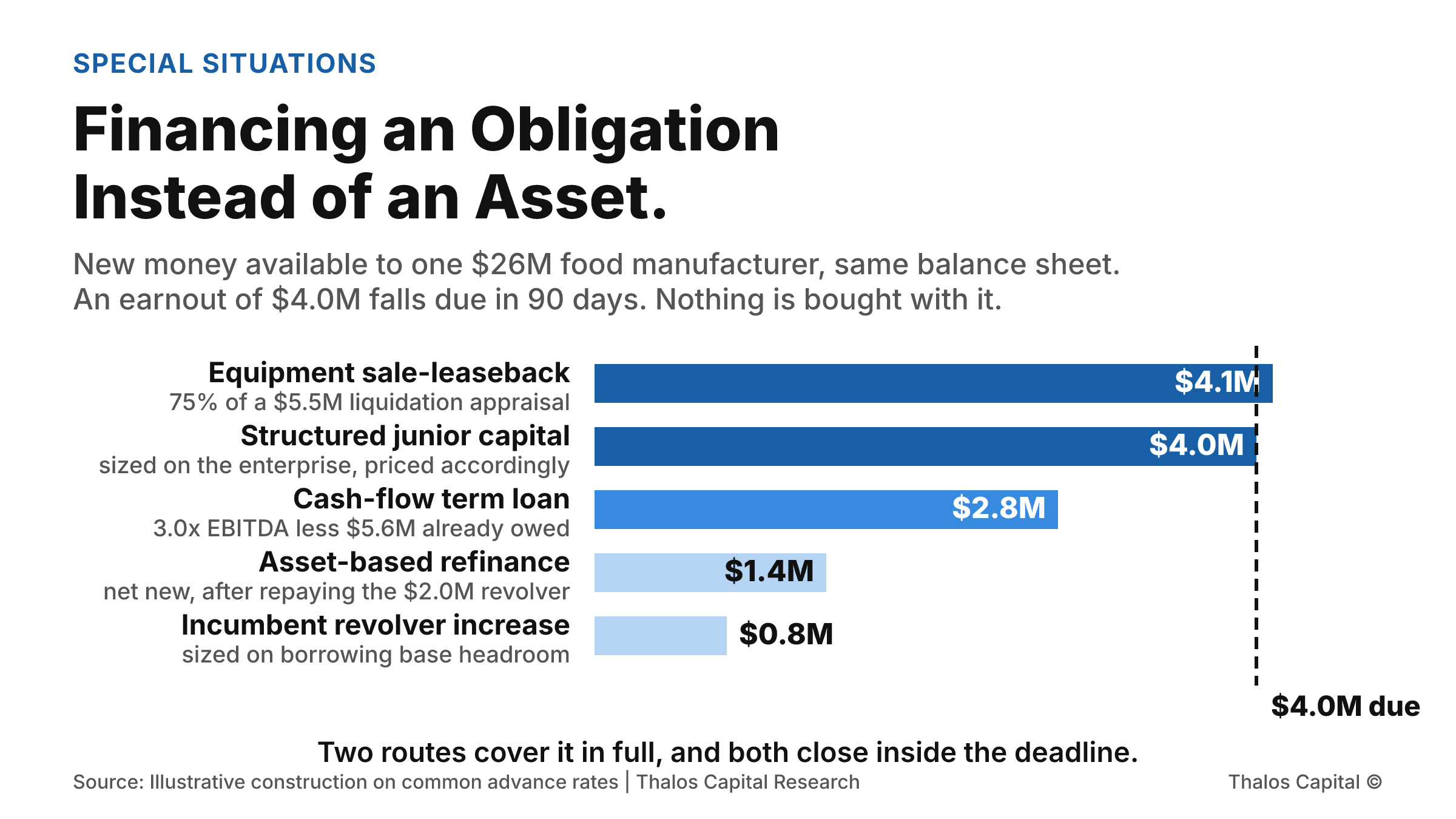
Five horizontal bars of new money available to the same food manufacturer: a revolver increase at $800,000, an asset-based refinance at $1.4 million net, a cash-flow term loan at $2.8 million, structured junior capital at $4.0 million and an equipment sale-leaseback at $4.1 million, against a $4.0 million obligation due in 90 days.

Financing an Obligation Instead of an Asset

A food manufacturer owes $4 million in 90 days with nothing new to show for it. Five funding routes against the same balance sheet produce $800,000 to $4.1 million, and only two of them close in time.
Read More
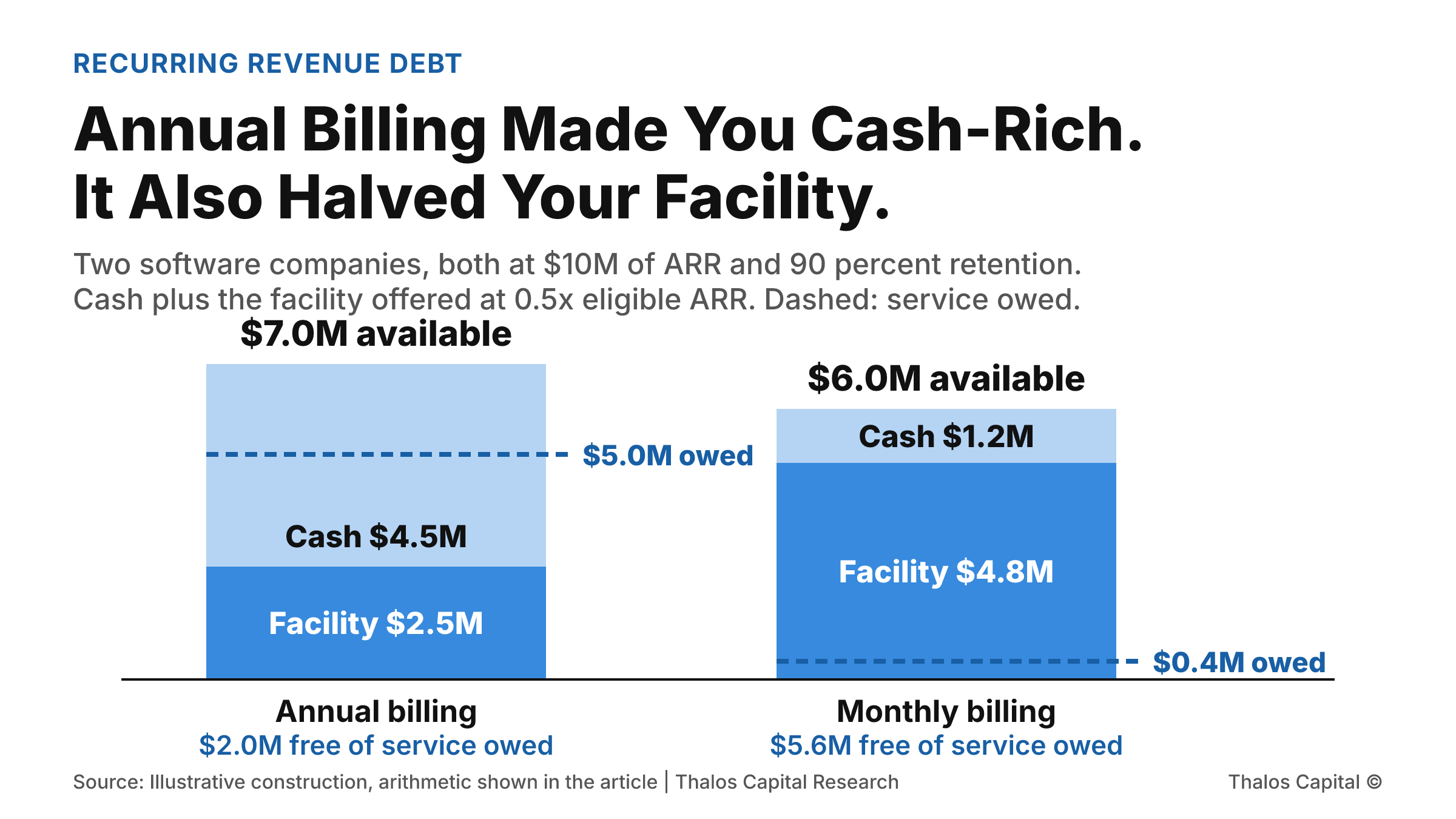
Two stacked bars of available liquidity. The annual biller holds $4.5 million of cash and is offered a $2.5 million facility, $7.0 million in total, of which $5.0 million is service already paid for and still owed. The monthly biller holds $1.2 million of cash and is offered $4.8 million, $6.0 million in total, of which $400,000 is owed.

Annual Billing Made You Cash-Rich. It Also Halved Your Facility.

Two software companies have identical ARR and retention. One bills annually in advance and holds $4.5 million of cash. The other bills monthly. The monthly biller is offered $4.8 million of debt against the annual biller's $2.5 million.
Read More
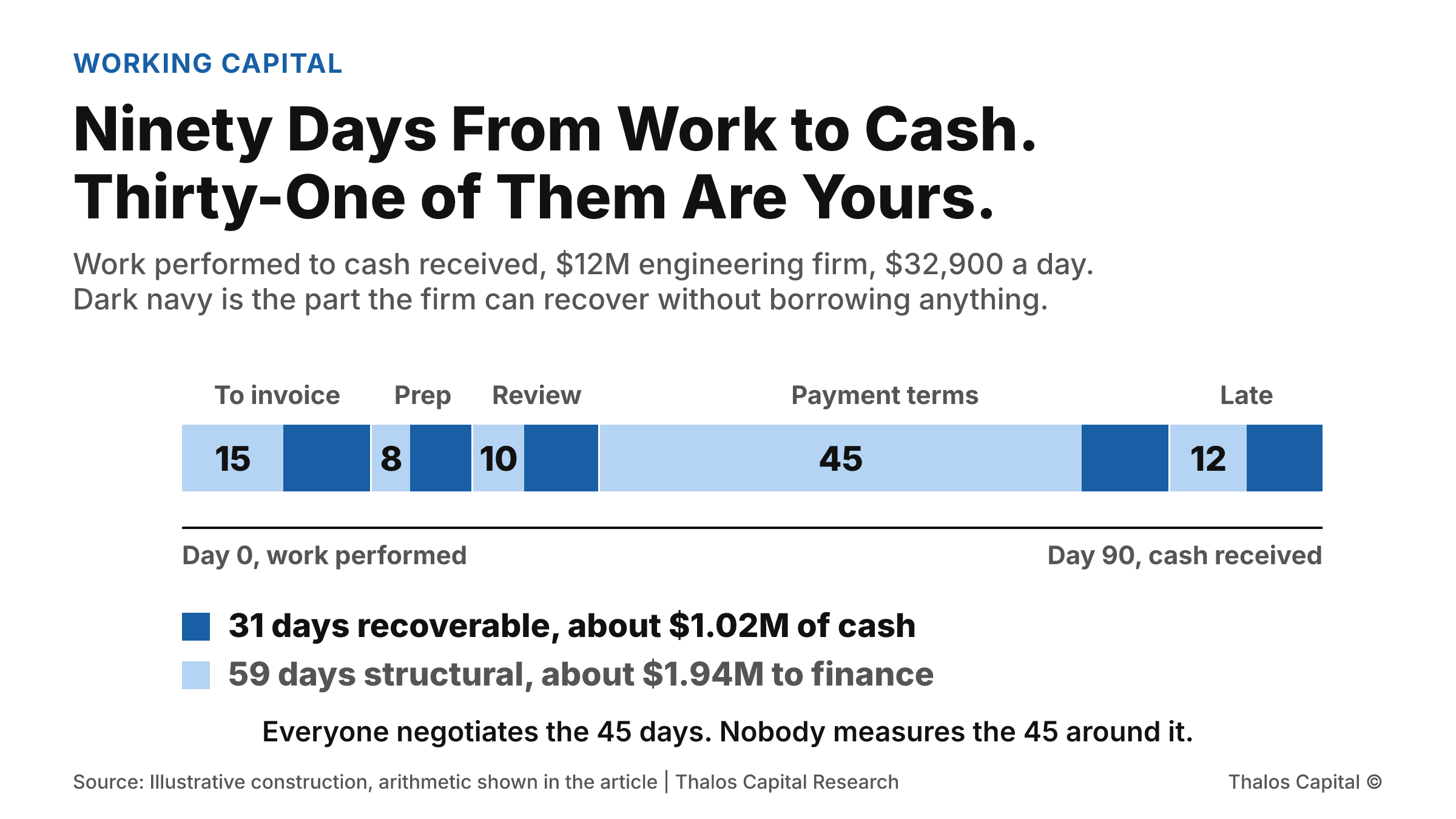
A 90-day timeline from work performed to cash received at an engineering firm, split into five stages: 15 days to month-end billing, 8 days of internal invoice preparation, 10 days of client review, 45 days of payment terms and 12 days of lateness. Thirty-one of the 90 days are marked as recoverable by the firm itself.

Ninety Days From Work to Cash. Thirty-One of Them Are Yours.

An engineering firm waits 90 days between doing the work and being paid for it. Thirty-one of those days come from its own billing process, worth about $1.02 million of cash. The other 59 days are a real financing need.
Read More
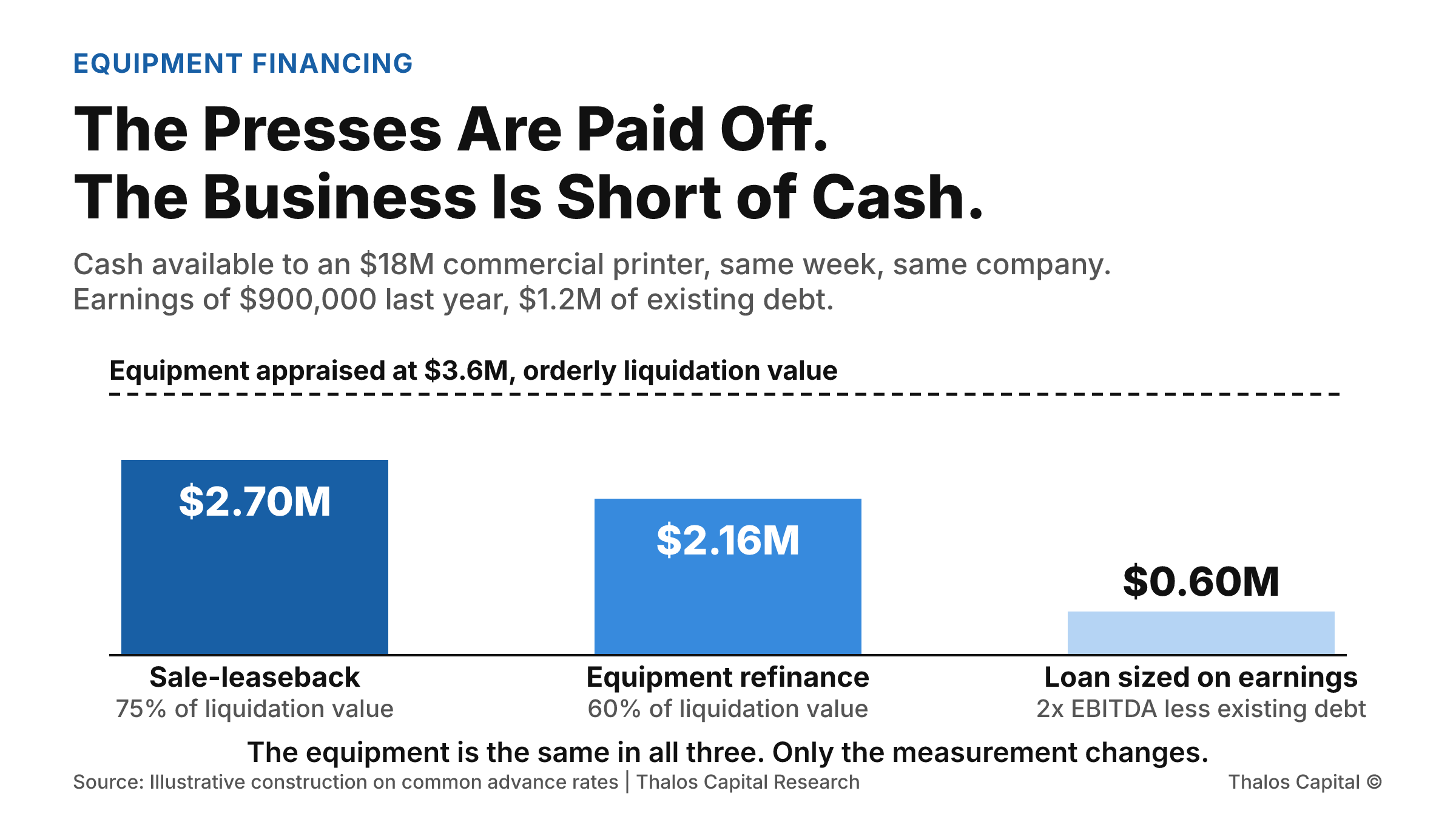
Three columns of cash available to a commercial printer. A sale-leaseback of owned presses raises $2.70 million, an equipment-secured refinance raises $2.16 million, and a loan sized on last year's earnings raises $600,000, against equipment appraised at $3.6 million.

The Presses Are Paid Off. The Business Is Short of Cash.

A commercial printer owns $3.6 million of appraised equipment and can borrow $600,000 on last year's earnings. A sale-leaseback on the same presses raises $2.7 million, at $69,800 a month and $650,000 of total cost.
Read More
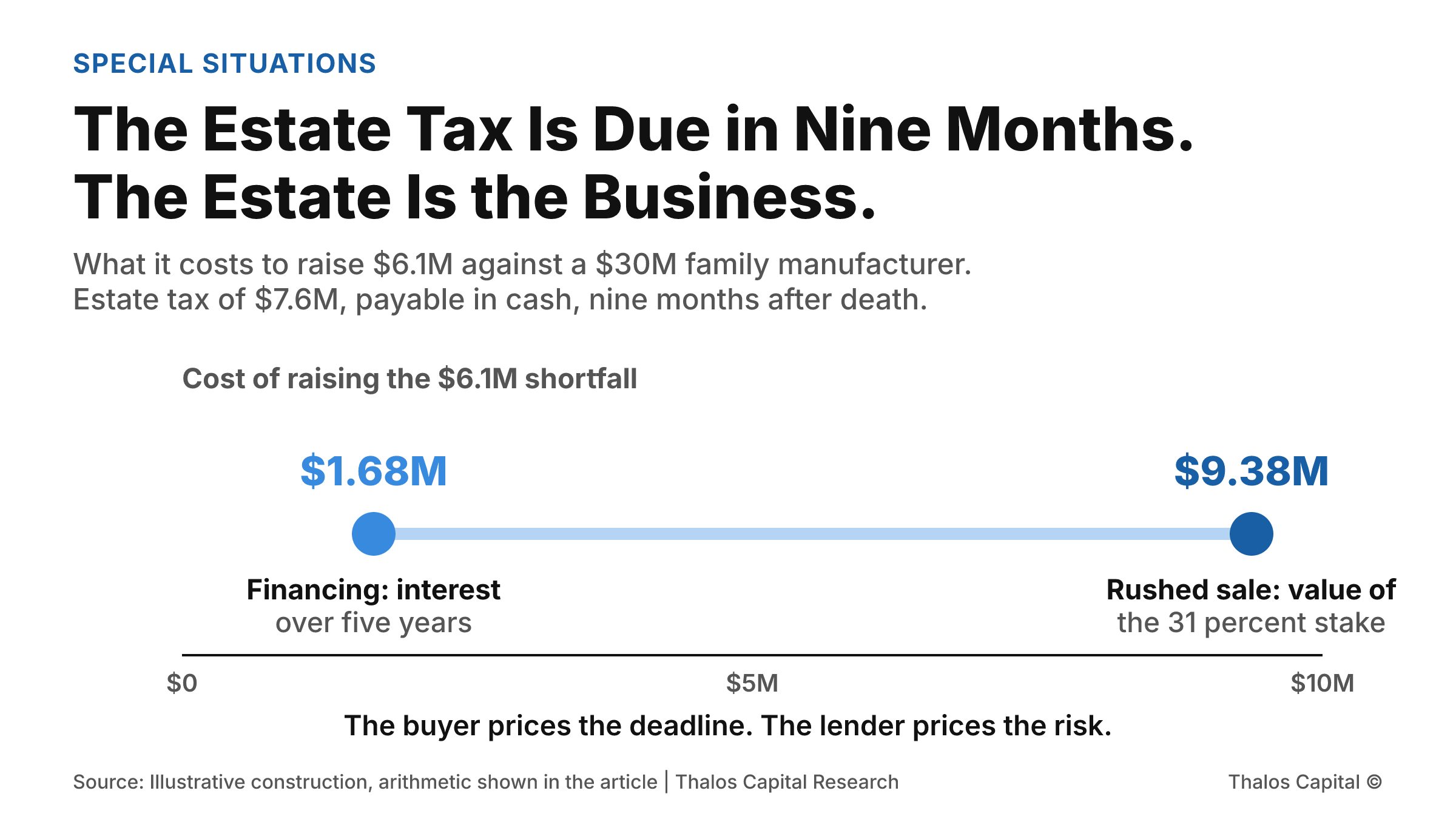
A two-point comparison of what it costs to raise $6.1 million against a $30 million family manufacturer. Selling a 31 percent stake under a deadline gives up $9.38 million of business value. Financing the same amount over five years costs $1.68 million of interest.

The Estate Tax Is Due in Nine Months. The Estate Is the Business.

A family owes $7.6 million of estate tax nine months after the founder's death, with $1.5 million of cash and a $30 million manufacturer. Selling a stake under the deadline gives up $9.4 million of value. Financing costs $1.68 million.
Read More
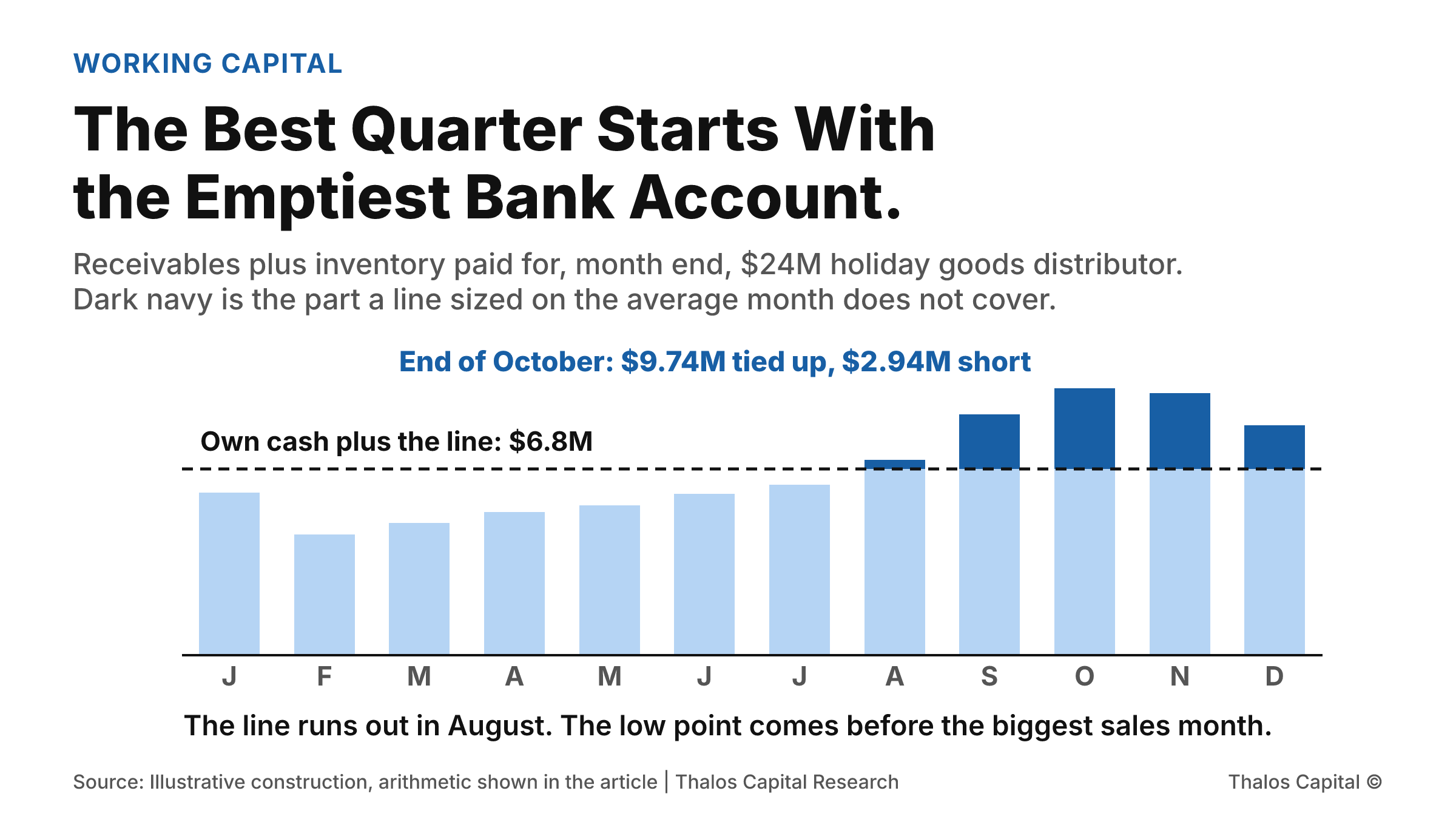
Twelve monthly columns of working capital tied up at a $24 million holiday goods distributor. Months January to July sit below the $6.8 million covered by the owner's cash and a line sized on the average month. August to December rise above it, peaking at $9.74 million at the end of October, $2.94 million short.

The Best Quarter Starts With the Emptiest Bank Account

A $24 million holiday goods distributor ties up $9.74 million in receivables and inventory at the end of October, against $6.8 million on an average month. A credit line sized on the average runs out in August and is $2.94 million short at the peak.
Read More
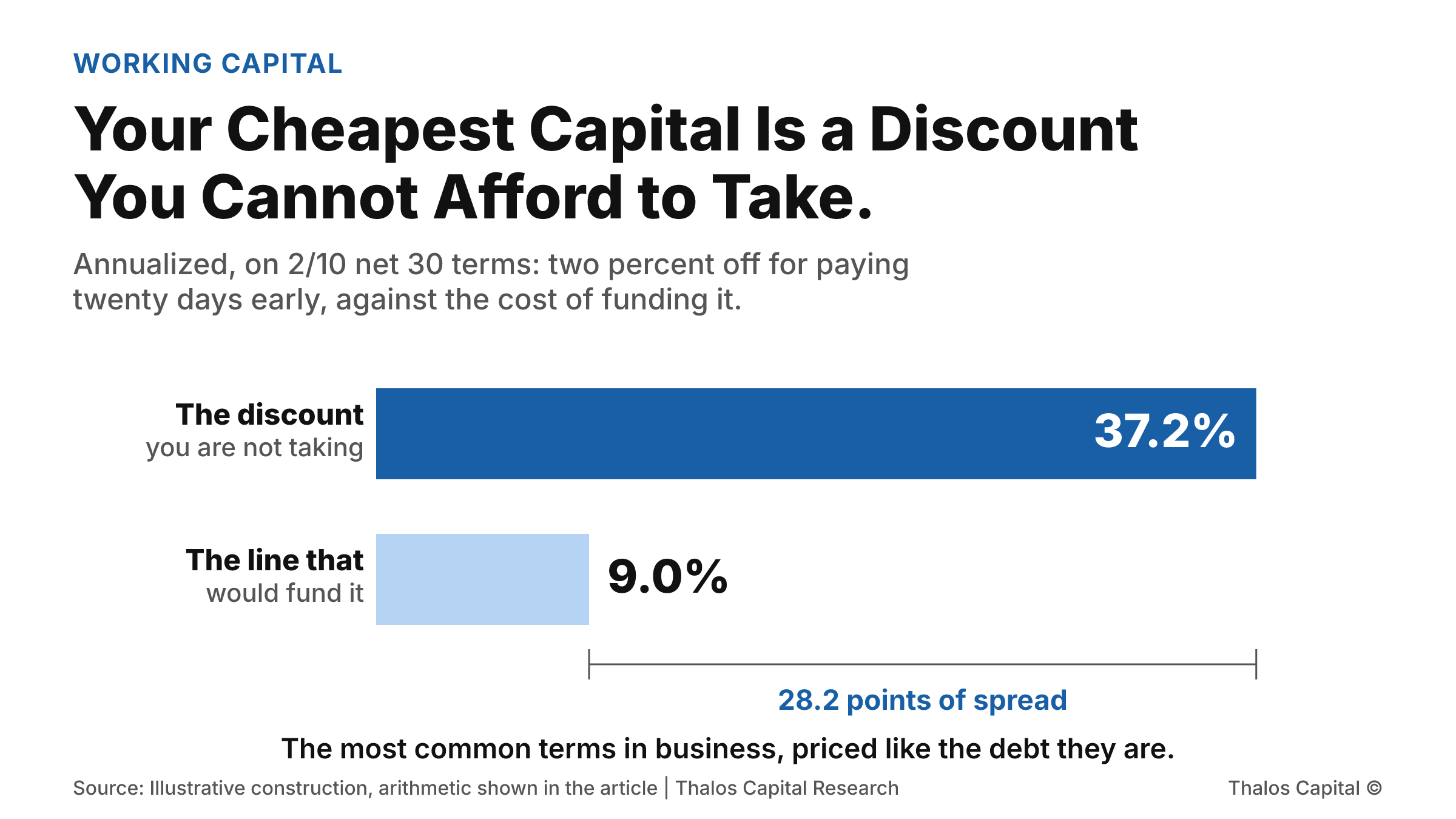
Two horizontal bars comparing the annualized value of a 2/10 net 30 early payment discount at 37.2 percent against the roughly 9 percent all-in cost of a working capital line used to fund it, a spread of 28.2 points.

Your Cheapest Capital Is a Discount You Cannot Afford to Take.

Customers moved from net 30 to net 60, which tied up an extra $1.08 million. The consequence shows up on the other side of the business, where $162,000 of supplier discounts go unclaimed every year because the cash is not there.
Read More
Working through a financing decision?
Insights are a starting point. A conversation maps your actual options.
Tell us what you are financing and we will map the structures and sources that fit.
Submit your financing request →
Explore our financing solutions
Equipment FinancingWorking CapitalAsset-Based LendingStrategic Debt