Category

Financing Strategy

46 insights · page 5 of 6

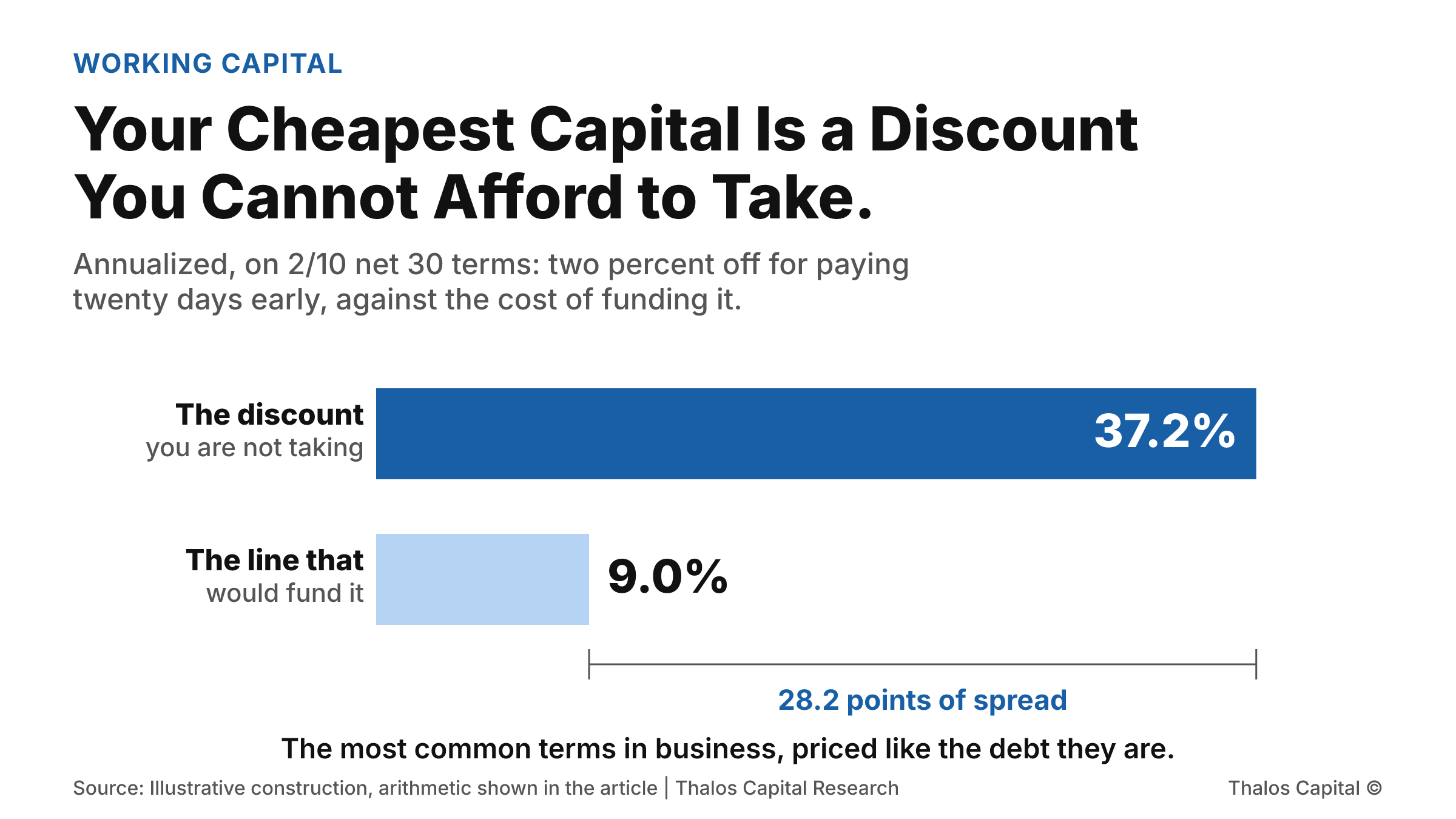
Two horizontal bars comparing the annualized value of a 2/10 net 30 early payment discount at 37.2 percent against the roughly 9 percent all-in cost of a working capital line used to fund it, a spread of 28.2 points.

Your Cheapest Capital Is a Discount You Cannot Afford to Take.

Customers moved from net 30 to net 60, which tied up an extra $1.08 million. The consequence shows up on the other side of the business, where $162,000 of supplier discounts go unclaimed every year because the cash is not there.
Read More
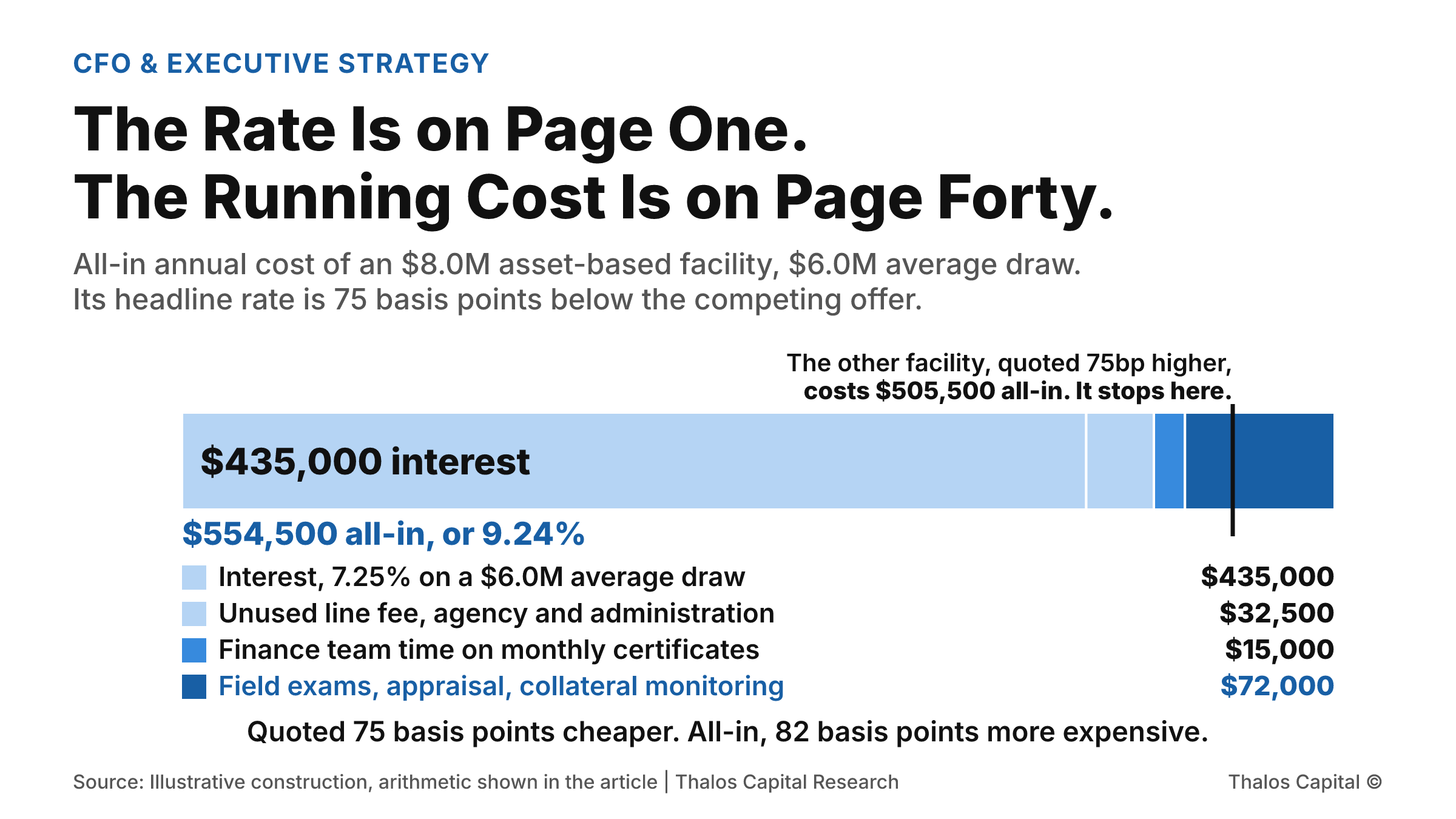
A single stacked bar of the all-in annual cost of an $8.0 million asset-based facility at a $6.0 million average draw, totalling $554,500, with a marker showing that a competing facility quoted 75 basis points higher costs $505,500 all-in.

The Rate Is on Page One. The Running Cost Is on Page Forty.

Two facilities quoted 75 basis points apart. Once field exams, appraisals, collateral monitoring and the finance team's own hours are counted, the cheaper-looking one costs 82 basis points more to run. The gap reverses entirely.
Read More
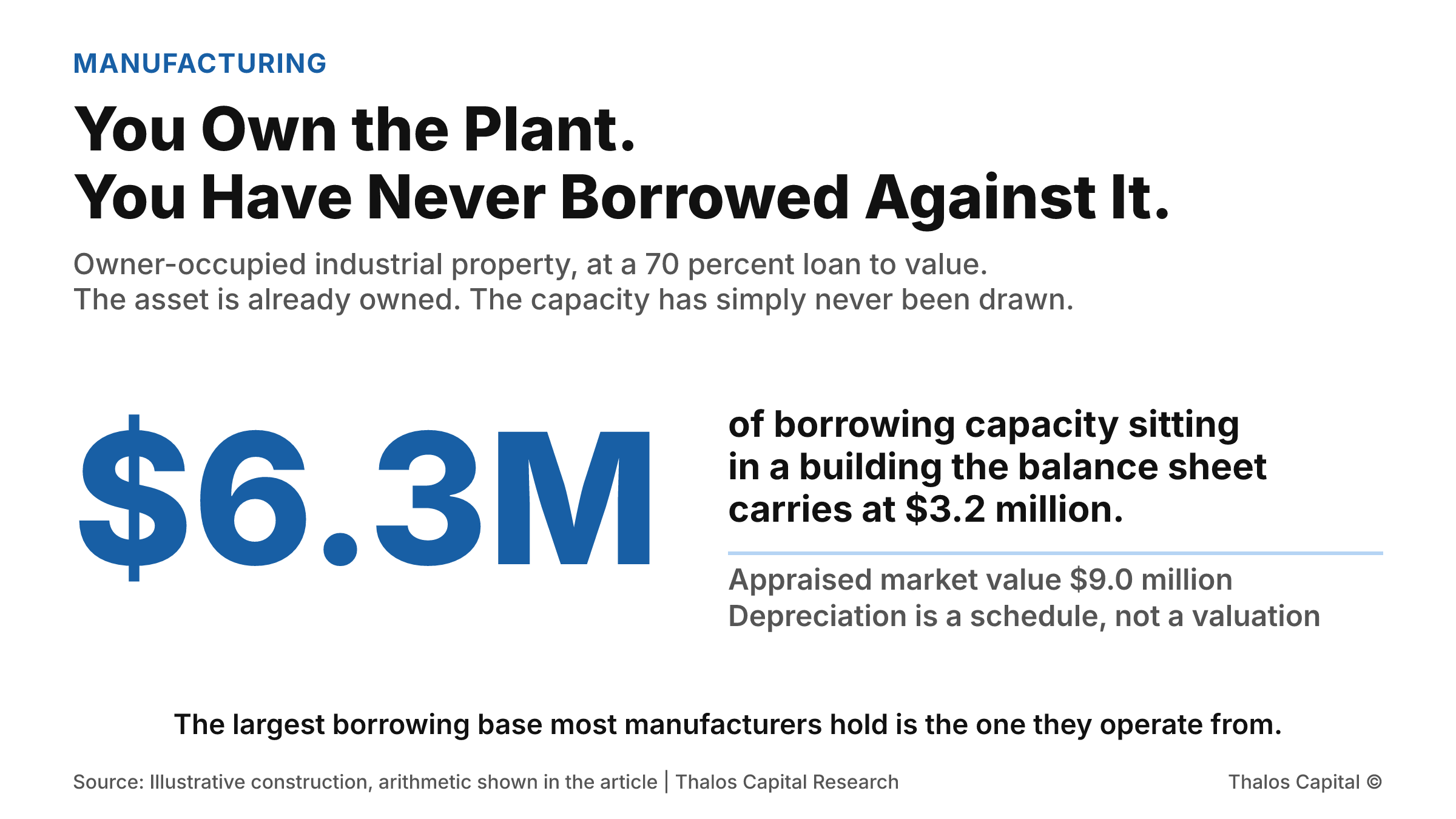
A single large figure of $6.3 million of borrowing capacity available against an owner-occupied manufacturing plant at a 70 percent loan to value, set against the $3.2 million depreciated book value the balance sheet carries and a $9.0 million market value.

You Own the Plant. You Have Never Borrowed Against It.

A manufacturer finances equipment and receivables while its largest asset sits untouched, carried at a depreciated book value that hides what it is worth. Two routes convert it to cash, and only one of them is a loan.
Read More
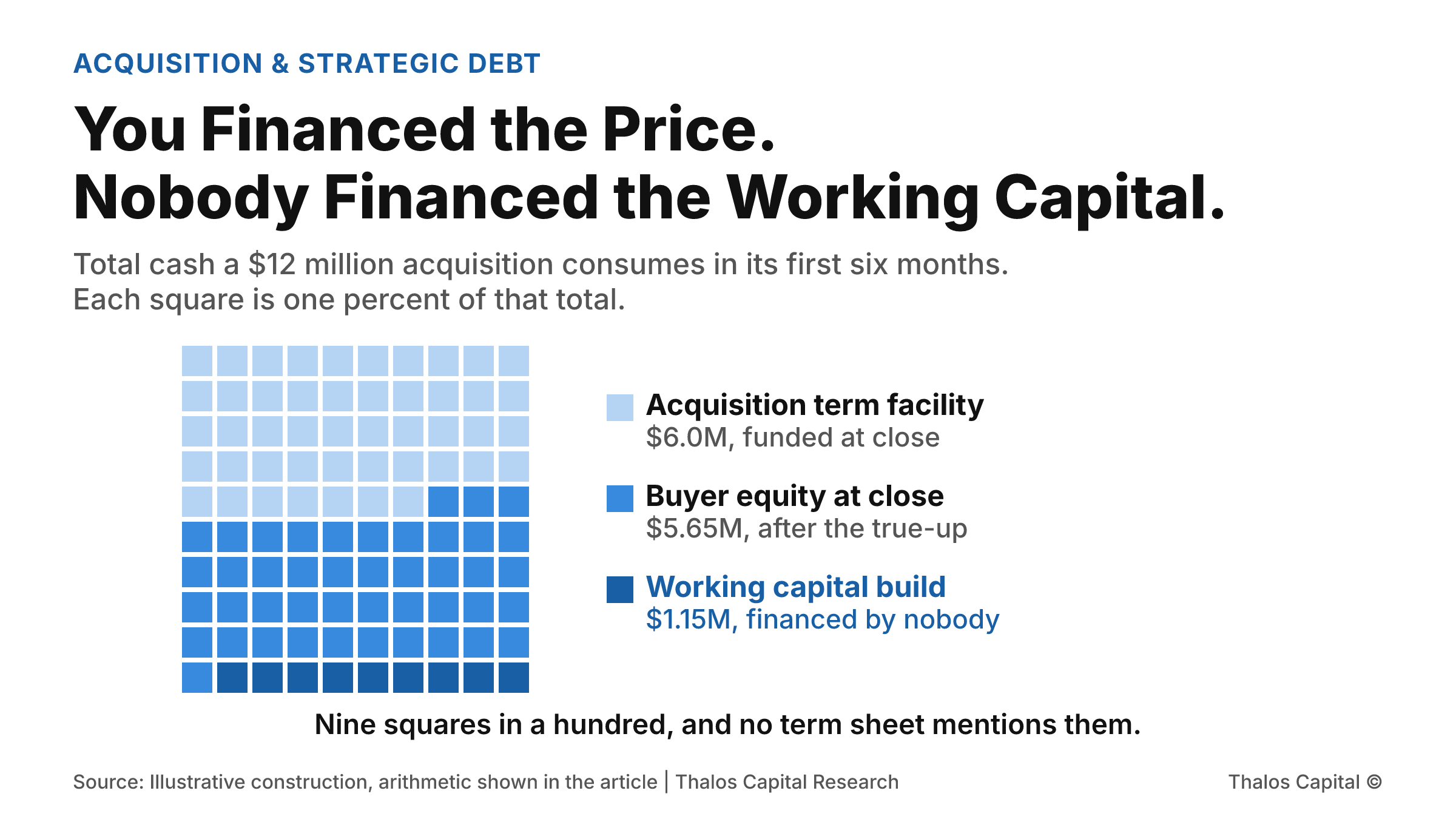
A hundred-square waffle showing the total cash a $12 million acquisition consumes in its first six months: 47 squares funded by the acquisition term facility, 44 by buyer equity at close, and 9 by a working capital build that sits outside the deal model.

You Financed the Price. Nobody Financed the Working Capital.

A buyer models an acquisition as price minus debt equals equity. Then the working capital true-up lands, and the seasonal build after it. The cash required is the same whichever month the deal closes, and the acquisition facility funds none of it.
Read More
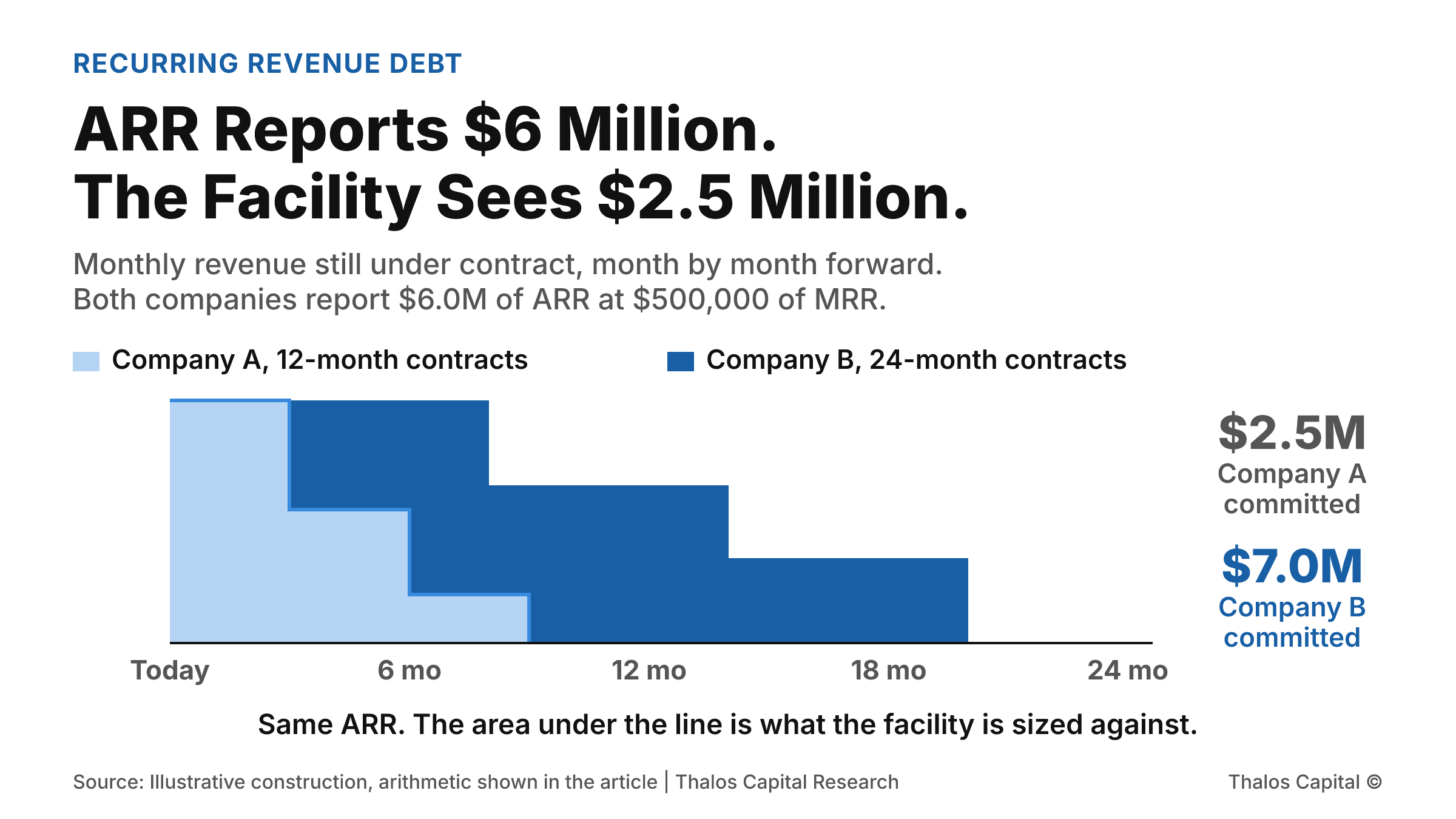
Two stepped areas showing monthly revenue still under contract over the next 24 months for two companies with identical $6.0 million ARR: a 12-month contract book holding $2.5 million of remaining contracted value and a 24-month contract book holding $7.0 million.

ARR Reports $6 Million. The Facility Sees $2.5 Million.

Two recurring-revenue companies each report $6.0 million of ARR. One is offered a $2.0 million facility and the other $1.0 million. The difference is contract length, and it does not appear in any metric either company reports.
Read More
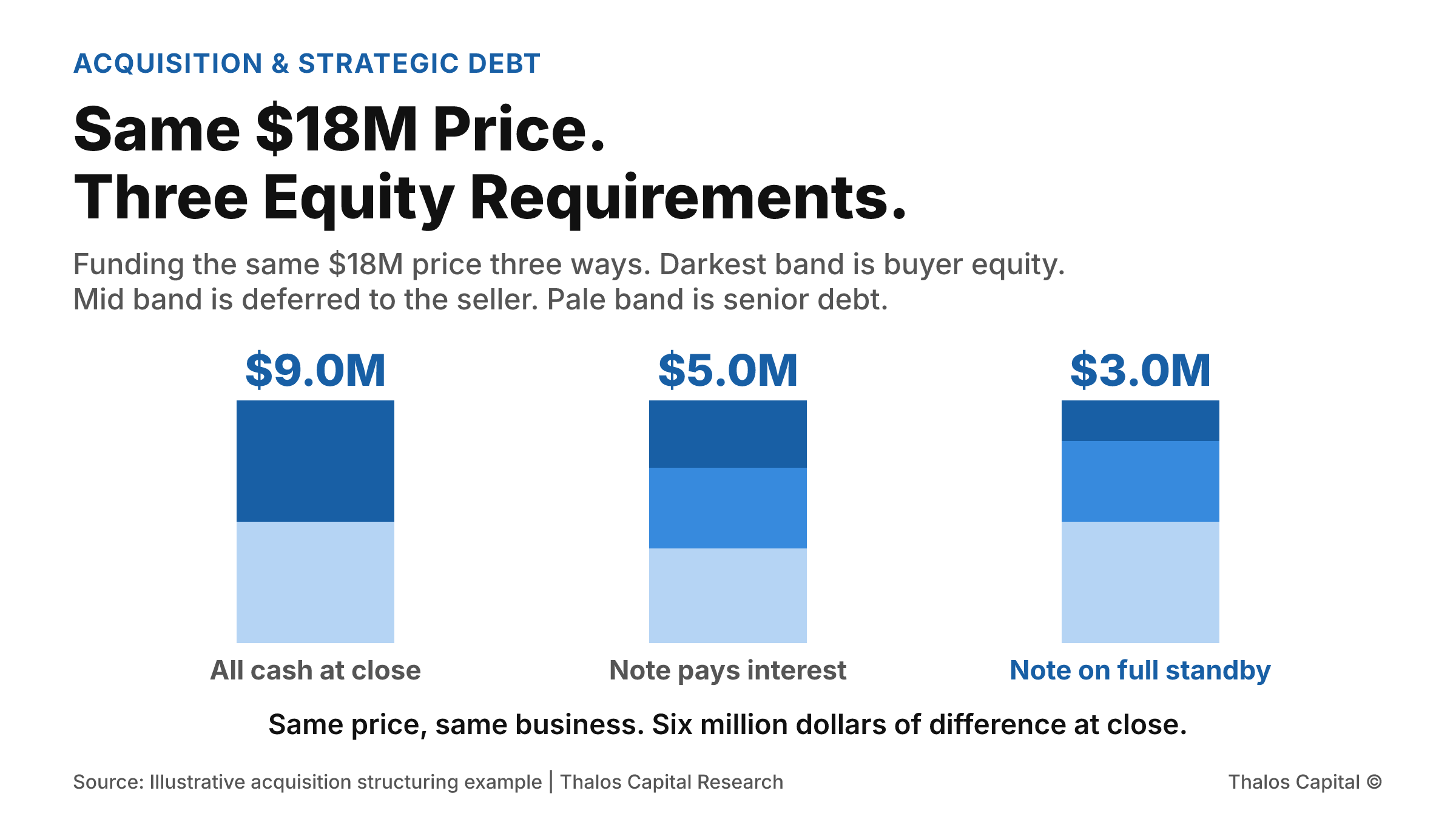
Three small stacked columns funding the same $18 million purchase price, showing buyer equity at close of $9 million on an all-cash deal, $5 million when the seller note pays current interest, and $3 million when the seller note sits on full standby.

Same $18M Price. Three Different Equity Requirements.

Two buyers agree the same $18 million price for the same business. Depending on how the deferred consideration is structured, the cash the buyer needs at close is $9 million, $5 million, or $3 million. The price never changed.
Read More
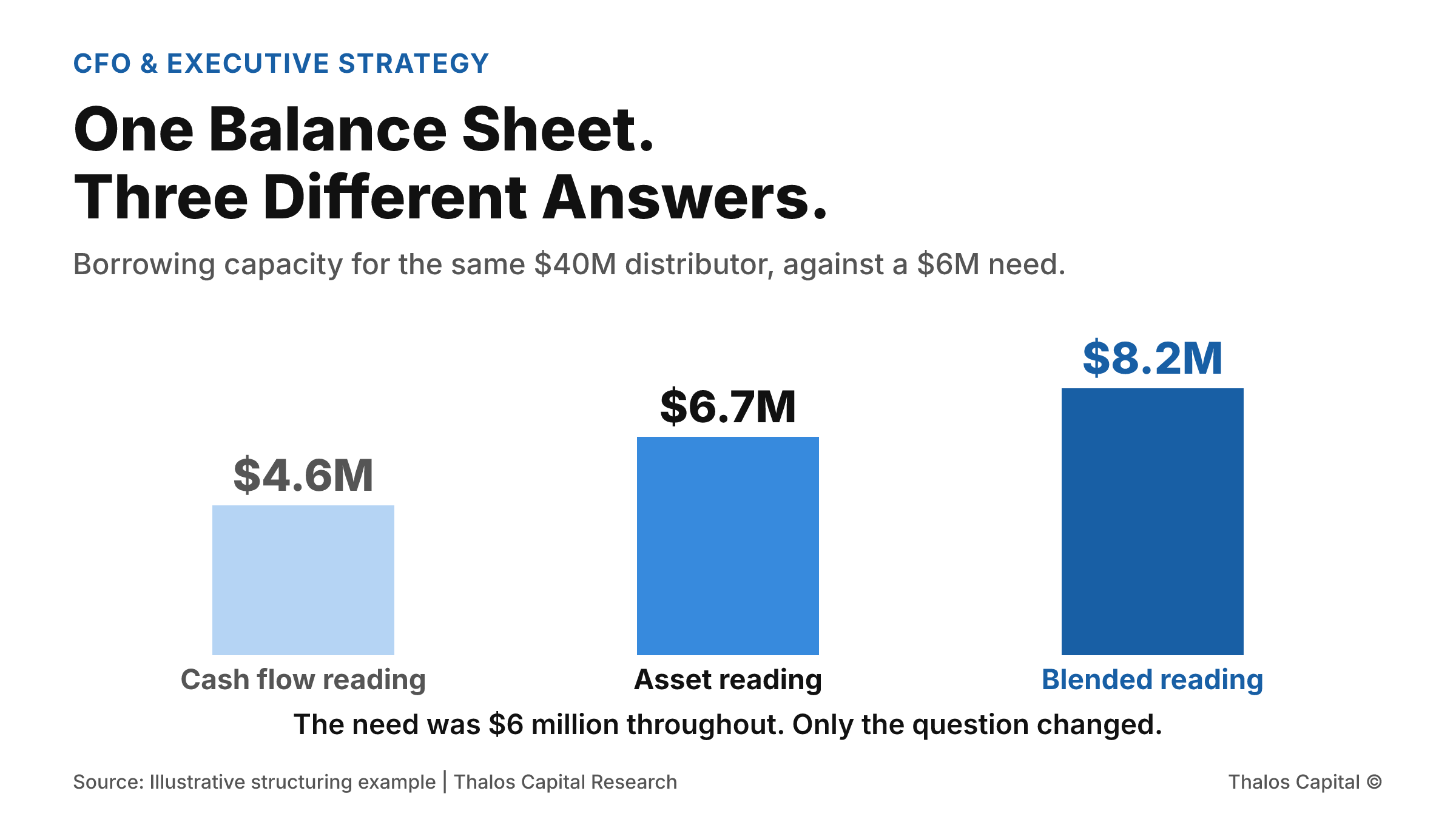
Column chart showing three borrowing capacity readings for the same distributor: $4.6 million on a cash flow reading, $6.7 million on an asset reading, and $8.2 million on a blended reading shown in the darkest navy, against a $6 million financing need.

One Balance Sheet. Three Different Answers.

A distributor doing $40 million in revenue needs $6 million. Read against cash flow it is short. Read against its assets it clears. Read as a blend it borrows $8.2 million. Same company, same week, three answers.
Read More
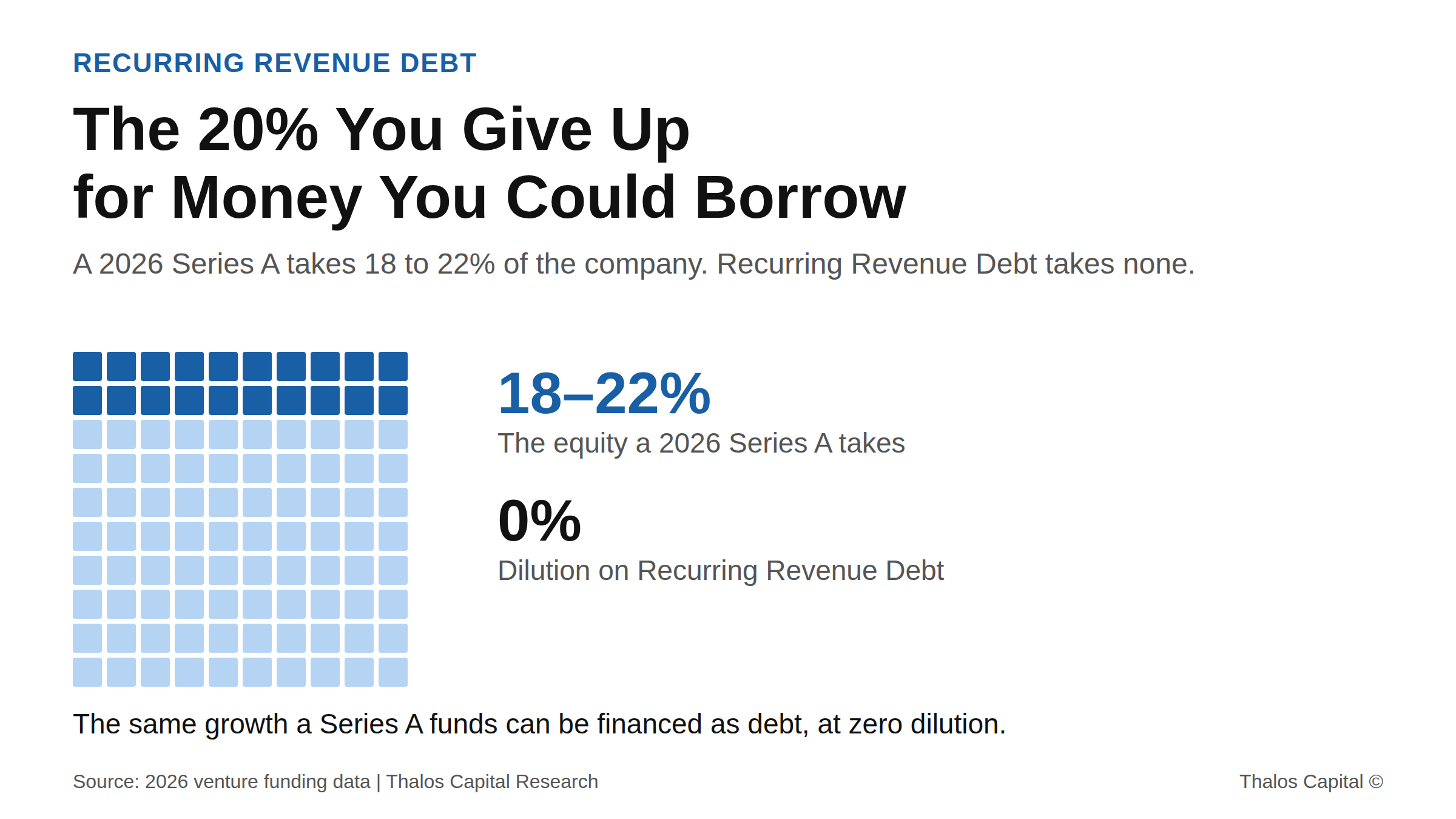
Waffle grid of 100 squares with 20 shaded navy, showing the 18 to 22 percent equity a 2026 Series A takes versus 0 percent dilution on Recurring Revenue Debt.

The 20% You Give Up for Money You Could Borrow: The Series A Math Founders Skip

A 2026 Series A takes 18 to 22% of the company at a reset valuation. For a recurring-revenue business that already clears the revenue bar, that dilution is a choice, not a requirement.
Read More
Working through a financing decision?
Insights are a starting point. A conversation maps your actual options.
Tell us what you are financing and we will map the structures and sources that fit.
Submit your financing request →
Explore our financing solutions
Equipment FinancingWorking CapitalAsset-Based LendingStrategic Debt